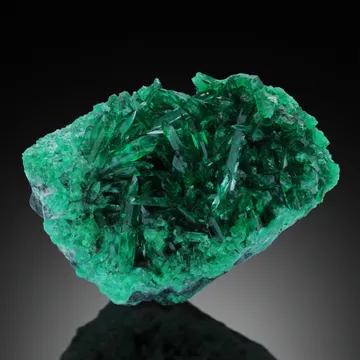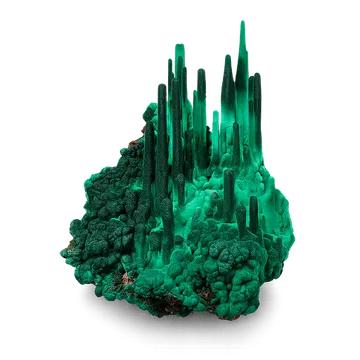
ExploreMarketCollectors

Earthwonders

The global marketplace for authentic geological specimens. Connecting passionate collectors with trusted dealers worldwide.

Get on the list for the latest from EarthWonders
Privacy Policy
Join Our Community
InstagramLinkedInFacebookYouTube
Discover

Browse Market

Browse specimens

Collector Profiles

Learn

Guides

All Policies

Blog

Newsletter

Company

About Us

Our Story

Contribute

Careers

© 2026 earthwonders
    GuidesEventsBlog
    AllFeaturedJust droppedUnder $500Statement piecesGreenBluePurpleAmethystQuartzFluoriteTourmalineMalachiteAzuriteRhodochrosite🇳🇦Tsumeb🇲🇽Mexico🇧🇷Brazil🇮🇳India
    0 views
    Login to Edit Guide
    Translated from English—See original

    Malachite from Tsumeb Mine, Namibia

    Overview

    Tsumeb malachite is not just “green copper carbonate” from a famous mine. It is one of the classic expressions of Tsumeb’s oxidized ore system: velvet crusts of radiating needles, sculptural pseudomorphs after azurite, dark botryoidal skins on copper-rich ore, and, more rarely, discrete blocky crystals. The best pieces carry the unmistakable Tsumeb look—saturated green malachite in sharp inherited azurite forms, often set against white to pale carbonate matrix, with the possibility of blue relict azurite, honeyed cerussite, yellow mimetite, olive duftite, or other copper-lead arsenates nearby.

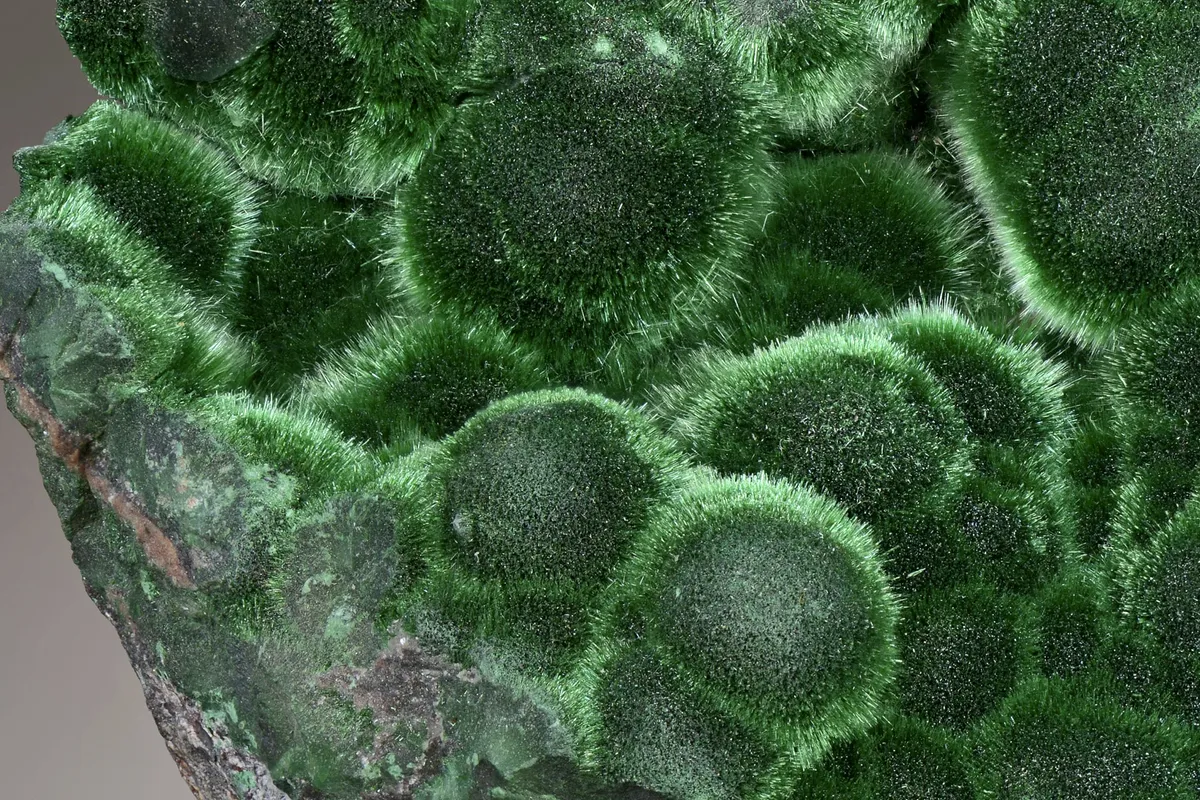
    botryoidal chatoyant malachite crust from Tsumeb — credit: Mariusz Oleszczuk / Tsumeb Mine Notebook

    Photo: Tsumeb Mine Notebook

    The locality’s importance comes from the setting. Tsumeb was a steep, irregular, polymetallic ore pipe cutting through Neoproterozoic Otavi Group carbonate rocks. Its primary ore contained copper, lead, zinc, silver, arsenic, cadmium, germanium, gallium, and other elements; its extraordinary secondary mineralogy developed where oxygenated groundwater penetrated the pipe and reacted with that chemically diverse sulfide ore. Malachite formed in all three oxidation zones and is the most common secondary copper mineral recorded at the mine, yet the best crystallized and pseudomorph specimens are anything but ordinary.

    For collectors, Tsumeb malachite is valued most highly when it preserves form. The premier pieces are pseudomorphs after azurite: sprays, blades, tabular crystals, or blocky forms in which the original azurite habit remains readable after replacement by malachite. Especially desirable are examples with a partial veneer or remnant of deep blue azurite, producing the blue-on-green contrast for which Tsumeb is celebrated. Velvety acicular aggregates are also sought after, particularly where they form clean spherules, sprays, or bright crusts on contrasting calcite, dolomite, cerussite, cuprite, or arsenate-rich matrix.

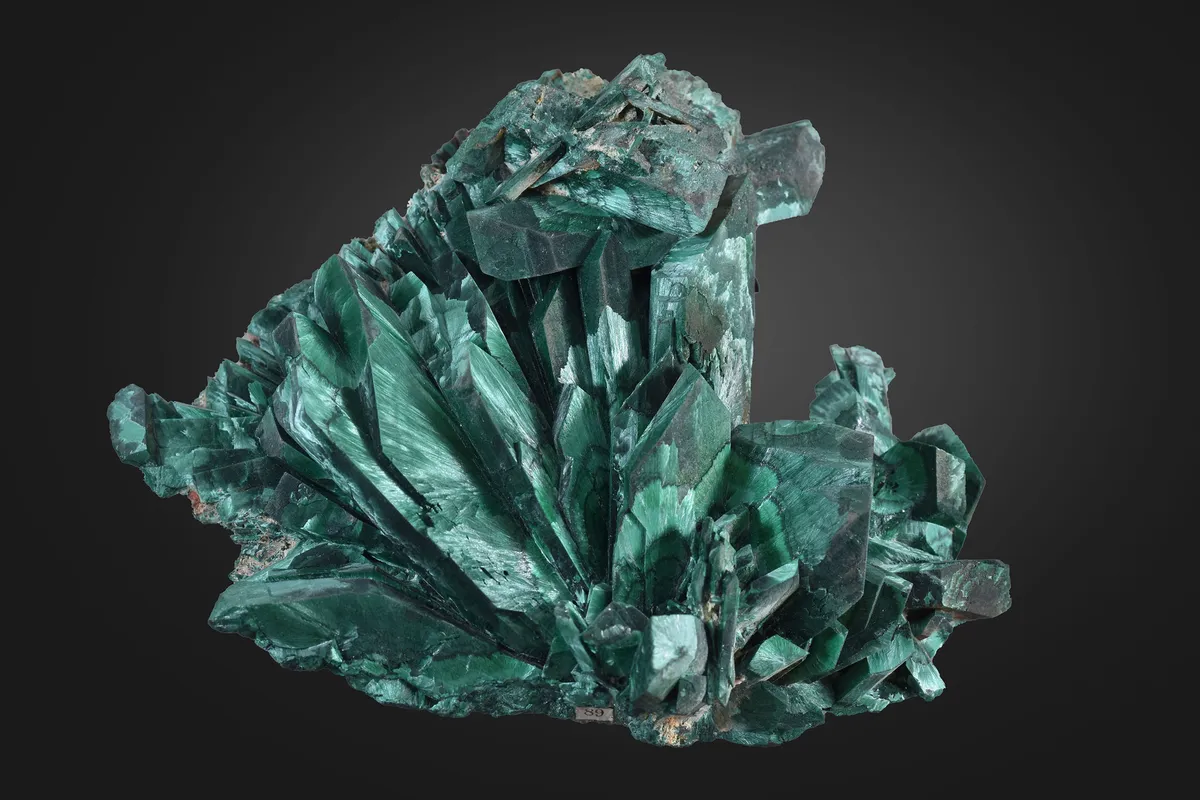
    fan of sharp malachite pseudomorphs after azurite from Tsumeb — credit: Malcolm Southwood / Tsumeb Mine Notebook

    Photo: Tsumeb Mine Notebook

    Tsumeb’s historical weight deepens the appeal. The “Green Hill” outcrop was known and worked for copper before European commercial mining. By the early twentieth century, specimens of azurite, cerussite, malachite, and smithsonite were already being recognized and preserved. The mine later became one of the most studied and collected mineral localities on Earth, famous for hundreds of mineral species and more than seventy type-locality species. Malachite is therefore a dual collectible: attractive in its own right, and a key witness to the oxidation history that made Tsumeb mineralogically unmatched.

    Featured Specimens

    Locality Information

    Search for specimens: View all malachite specimens from Tsumeb Mine, Namibia

    Tsumeb Mine is at the town of Tsumeb in the Oshikoto Region of northern Namibia. The deposit is generally treated as the model “Tsumeb-type” polymetallic pipe deposit: a steeply plunging ore body hosted in Otavi Group dolomite and limestone, with a core and margins involving feldspathic sandstone, sandstone breccia, dolomite breccia, hydrothermal alteration, and massive sulfide mineralization. In plan and section the ore body was irregular and pipe-like, with strong structural control by brecciation, fractures, folding, and carbonate-host permeability.

    The host rocks belong to the Neoproterozoic carbonate succession of the Otavi Mountainland. The ore pipe cut through roughly 1.7 kilometers of carbonate stratigraphy, and the deepest workings eventually reached about 48 Level, near 1,700 meters below surface. Primary ore minerals included bornite, chalcocite, tennantite, enargite in the upper levels, galena, sphalerite, and pyrite, with germanium-bearing minerals important in certain levels. That primary complexity supplied the chemical inventory for Tsumeb’s famous secondary minerals.

    The collector significance of Tsumeb depends on its three oxidation zones. The first oxidation zone extended from surface down through the upper mine; this was the great source of early oxidized ore and many classic azurite, malachite, cerussite, smithsonite, and mimetite specimens. The second oxidation zone, beginning in the deeper post-war workings around the 24–35 Level interval and centered near the North Break Horizon, produced many of the mine’s later marvels, including celebrated dioptase and rare germanium-arsenic minerals. A third oxidation zone was recognized still deeper, from around 42 Level downward, and produced unusual late-stage species and combinations.

    The early history is inseparable from the “Green Hill,” the copper-stained surface expression of the ore body. Local people had worked and traded copper from the area before European mining. Matthew Rogers, a British mining engineer sent to investigate the Otavi Mountainland, reached the outcrop in January 1893 and was astonished by what he saw. German interests later developed the property through Otavi Minen- und Eisenbahn Gesellschaft. Trial shafts were begun in 1900, but full commercial production waited for railway access and began in the 1906–1907 period.

    Mining started in and around the oxidized surface ore, including open-pit and shallow underground work, then moved progressively deeper. Production was interrupted by world events and economic downturns, but Tsumeb remained an important source of copper, lead, zinc, silver, germanium, cadmium, and other byproduct metals for much of the twentieth century. In 1947 the mine came under Tsumeb Corporation Limited, after which deep development and the discovery of the second oxidation zone greatly expanded both ore production and specimen output.

    For malachite, the upper workings were especially important. Oxidized ore rich in massive and earthy malachite was economically significant in the early mine, and the first oxidation zone produced the classic malachite-after-azurite pseudomorphs on which much of Tsumeb’s malachite reputation rests. The second oxidation zone also produced important pseudomorphs, including the celebrated Perkins Sams material from 1980, with large malachite pseudomorphs after azurite and thin blue relict azurite veneers.

    Large-scale mining ceased in the mid-1990s. In 1996, labor conflict, high pumping and mining costs, and unfavorable metal prices contributed to the shutdown; when pumps were stopped, the mine flooded rapidly. Small-scale upper-level work and a later specimen-mining attempt followed for a time, but the mine is no longer a regular collecting locality. Specimens available today come overwhelmingly from historic mine production, old dealer stock, museum duplicates, and private collections.

    Characteristics of Malachite from Tsumeb Mine, Namibia

    Malachite at Tsumeb occurs as Cu2(CO3)(OH)2 in the orthorhombic system, but the locality’s collector character is defined less by textbook crystallography than by habit and paragenesis. It is recorded from all three oxidation zones and is especially abundant in the first. In practical collecting terms, Tsumeb malachite falls into several recognizable types.

    The most famous type is malachite after azurite. These pseudomorphs preserve the azurite crystal habit as green malachite: bladed fans, elongated prisms, tabular crystals, blocky forms, and composite groups. Replacement may be complete, leaving a fully green pseudomorph, or partial, with blue azurite retained as a surface veneer, edge, core, or associated surviving crystal. Such specimens can be particularly dramatic when the malachite is velvet-textured but the original azurite geometry remains crisp.

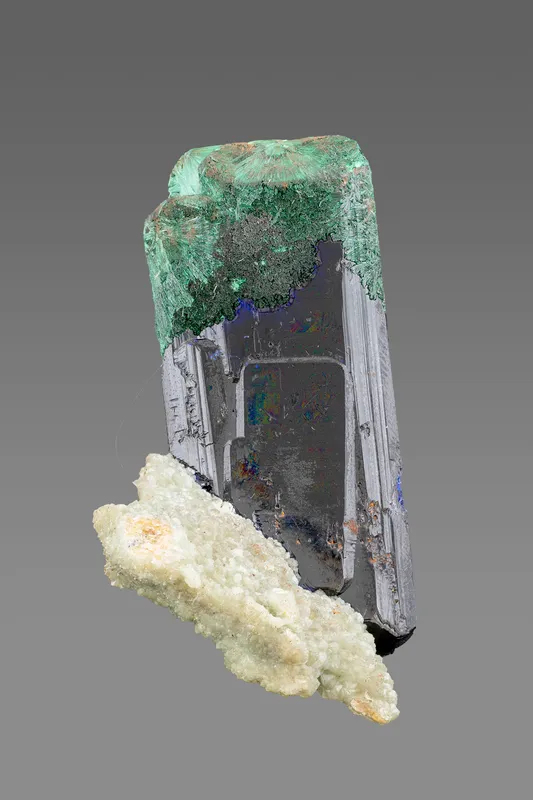
    partly altered azurite crystal with malachite from Tsumeb, 68 mm specimen — credit: Malcolm Southwood / Tsumeb Mine Notebook

    Photo: Tsumeb Mine Notebook

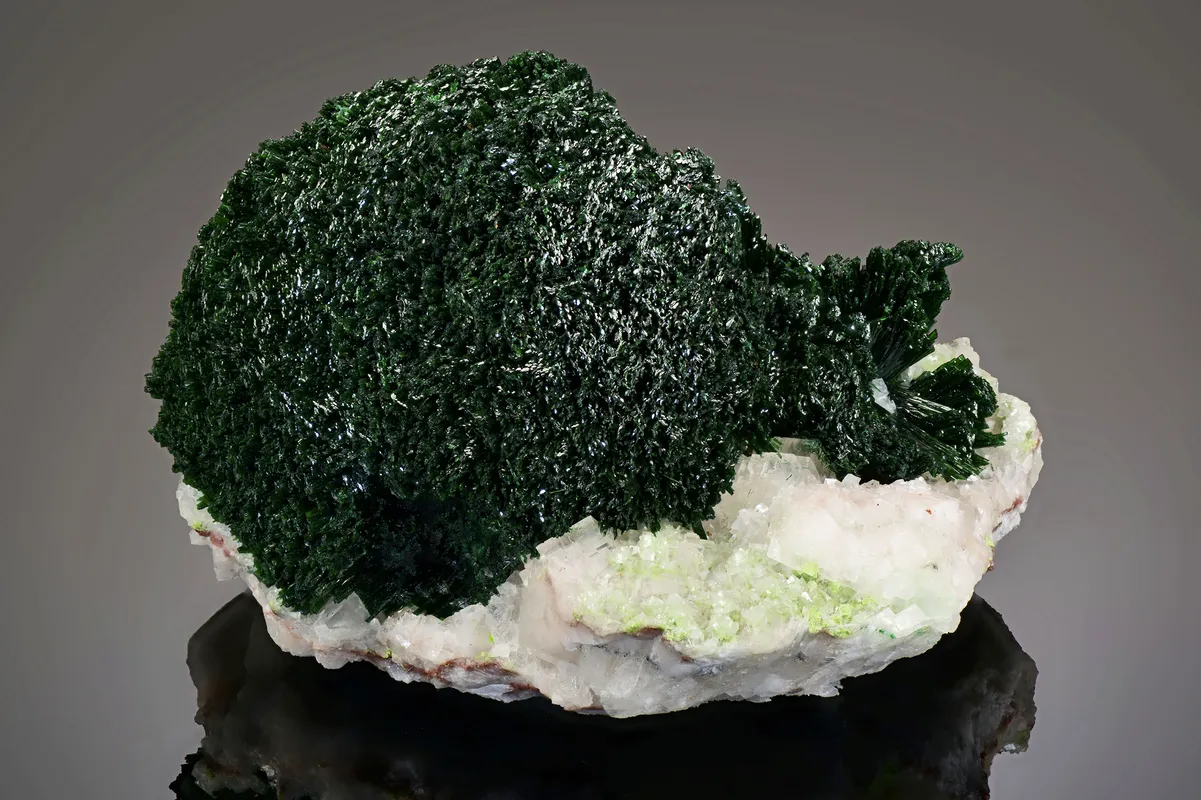
    A second important type is fibrous to acicular malachite in radiating aggregates. These form tufts, velvety crusts, spherules, botryoidal coatings, and sprays on copper ores or carbonate matrix. The surface can be richly chatoyant when the needles are tightly aligned. Pieces with clean, lustrous, undamaged fibrous surfaces and strong contrast against white calcite or pale dolomite are especially attractive.

    radiating dark green malachite needles on calcite from Tsumeb — credit: Mariusz Oleszczuk / Tsumeb Mine Notebook

    Photo: Tsumeb Mine Notebook

    Massive and earthy malachite was abundant in oxidized ore, sometimes intermixed with smithsonite, cerussite, arsentsumebite, bayldonite, gartrellite, duftite, and related arsenates. This material is less often pursued as fine display mineralogy unless it carries strong color, association, or historical ore interest, but it was important economically in the upper mine.

    True, non-pseudomorphous, well-formed malachite crystals are much scarcer at Tsumeb than pseudomorphs and fibrous aggregates. Blocky crystals to about 10 mm were reported from the first oxidation zone, and similar crystals associated with cuprite were encountered deep in the mine on 43 Level in the third oxidation zone. Exceptional malachite crystals up to 30 mm have been recorded, though such pieces are far outside normal availability.

    Associations are one of the joys and complications of Tsumeb malachite. Confirmed or reported companions include azurite, calcite, dolomite, cerussite, mimetite, duftite, bayldonite, arsentsumebite, gartrellite, conichalcite, olivenite, cuprite, native copper, chalcocite, tennantite, quartz, wulfenite, smithsonite, dioptase, mottramite, brochantite, linarite, posnjakite, serpierite, and many others. Malachite can also occur as inclusions in cerussite, a distinctive Tsumeb detail noted in the literature.

    Size varies widely. Velvety tufts and spherules may be millimetric to a few centimeters. Miniature and small-cabinet pseudomorph groups are commoner than large display pieces, but historic specimens reach cabinet scale and larger. The Perkins Sams pseudomorphs from the second oxidation zone are reported to reach up to 20 cm across, with most of the original azurite replaced by malachite and only a thin partial blue veneer remaining. Older first-oxidation-zone pseudomorphs also include large cabinet examples, including specimens from historic collections with crystal components many centimeters long.

    Quality depends on preservation, contrast, and paragenetic clarity. On a malachite-after-azurite pseudomorph, the best examples show sharp inherited crystal form, intact terminations, minimal bruising, and a surface that is velvety or crisply textured rather than abraded. A surviving ribbon or sheath of azurite can raise desirability if natural and well placed. On fibrous malachite, look for uncrushed needles, silky luster, saturated color, and an undisturbed spray or botryoidal surface. Matrix matters: white calcite, pale dolomite, cerussite, or contrasting blue azurite gives a specimen visual authority and helps separate Tsumeb material from more anonymous massive malachite.

    Collector Notes

    The first authenticity question is locality. Malachite is abundant worldwide, and malachite-after-azurite pseudomorphs are known from several classic sources, including Bisbee, Milpillas, Morenci, Ajo, Chessy, and many others. A Tsumeb label should be judged by morphology, matrix, associations, age, and provenance. Tsumeb pieces commonly show the mine’s complex carbonate-arsenate environment: dolomite or calcite matrix, cerussite, mimetite, duftite-conichalcite tones, bayldonite, smithsonite, or other lead-copper secondary minerals. A freestanding, highly polished, banded ornamental malachite mass should not be accepted as “Tsumeb” without strong documentation.

    No specific, well-documented class of artificial Tsumeb malachite fakes is central to the literature, but mislabeling and over-attribution are real market risks. Because Tsumeb commands a premium, generic malachite, non-Tsumeb azurite-malachite, or modern material from other copper mines may be offered with old-looking or vague labels. The safest examples have old dealer labels, collection history, museum deaccession provenance, or a visual association suite consistent with Tsumeb.

    Pseudomorph interpretation requires care. Many Tsumeb specimens are not simple “malachite on azurite,” but replacement textures: azurite altered partly or almost wholly to malachite, sometimes with relict azurite preserved as an external layer or partial veneer. The replacement can be counterintuitive, with alteration advancing from within the crystal rather than merely from the outside inward. A blue skin on a green pseudomorph is not automatically later azurite overgrowth, nor is it automatically artificial enhancement; it needs to be read in context.

    Condition is a major value factor. Fibrous malachite bruises easily. Velvet surfaces can be flattened by handling, old wrapping, dusting, or vibration. Pseudomorphs may have chipped terminations, rubbed edges, repaired crystal groups, or stabilized matrix. On older Tsumeb specimens, small contacts are common and not always fatal, but damage to the main pseudomorph face or termination strongly affects desirability. Ask whether any crystals have been reattached, whether the matrix has been trimmed, and whether soft fibrous areas have been consolidated.

    Treatments to watch for include oiling, waxing, resin stabilization, glued repairs, and artificial color enhancement. These are not uniquely Tsumeb problems, but malachite’s porosity and fibrous texture make them relevant. A too-glossy surface on normally velvety malachite, color collecting in cracks, unnatural shine in low areas, or adhesive fluorescence around contacts should prompt closer inspection. Massive malachite carvings and polished pieces are a separate decorative category and should not be confused with fine Tsumeb crystallized specimens.

    In rarity terms, Tsumeb malachite is common as a species but selective as a collectible. Earthy ore pieces and small green coatings are not rare. Attractive miniatures of malachite after azurite appear with some regularity as old collections recycle. Fine cabinet pseudomorphs, sharp large blades, pieces with strong blue azurite contrast, and undamaged velvety sprays on attractive matrix are much scarcer. True non-pseudomorphous crystals are rare by Tsumeb standards and should be evaluated carefully.

    Current market availability is entirely secondary-market driven. The mine is closed and flooded, so supply depends on old collections, historic dealer stock, and specimens reappearing at shows, auctions, and online marketplaces. This gives Tsumeb malachite a broad price spread: modest small examples remain obtainable, while large, sharp, historic, or aesthetically balanced pseudomorphs can compete strongly with the better-known Tsumeb azurite, dioptase, smithsonite, mimetite, and cerussite specimens.

    Stories & Field Notes

    The Tsumeb story begins with color on a hill. Long before scientific descriptions and mineral catalogues, African miners were recovering copper from the outcrop later remembered as the “Green Hill.” European explorers in the 1880s encountered copper ore and crudely smelted metal being transported and traded, then traced the source back to Otjisume, a name linked to “the place of the frog,” apparently inspired by the mottled, copper-stained appearance of the outcrop. It is hard not to picture malachite in that first visual impression: not as a specimen label, but as green copper color spread across weathered ore.

    In January 1893, Matthew Rogers reached the place as a British mining engineer investigating the Otavi Mountainland. His reaction has become one of the great locality quotes in mineral history. He wrote that he had “never seen such a sight” as the one before him at “Soomep,” and doubted he would ever see its equal elsewhere. That was before Tsumeb had yielded its famous named pockets, before the great museum collections, before the hundreds of species. The first shock was simply the outcrop itself: a copper-rich hill so conspicuous that it announced the ore body at surface.

    Specimen consciousness came early. In 1900, a large sample of ore was shipped to Germany for metallurgical testing. At the Bergakademie in Freiberg, Wilhelm Maucher, the engineer handling the samples, recognized and saved crystallized secondary minerals from what might otherwise have been treated only as furnace feed. That act matters to malachite collectors because the early oxidized ore was exactly the environment that produced abundant azurite, cerussite, malachite, and smithsonite. Maucher later wrote one of the first detailed mineralogical descriptions of the Tsumeb ore, helping convert a mining deposit into a mineralogical locality.

    By the inter-war years, Tsumeb had become a place where mine officials collected with unusual seriousness. F. W. Kegel, W. Klein, W. Thometzek, and a shift-boss known as Keller built important collections. Wilhelm Klein’s role is especially valuable to modern collectors because he recorded the mine level for his specimens. In a locality where oxidation zones and levels are everything, a level number can turn a pretty green pseudomorph into a documented geological object. Much of Klein’s collection was purchased by Harvard in 1954, and it still helps anchor interpretations of upper-level Tsumeb mineralogy.

    One historic malachite-after-azurite specimen now in the Mineralogical & Geological Museum at Harvard was number 1785 in the collection of Hans von Karabacek, much of which was acquired by the museum in 1935. It is a 140 mm fan of sharp, terminated blade-shaped pseudomorphs of malachite after azurite, completely replaced, with no residual azurite visible. Its age fixes it securely in the first oxidation zone. The form is everything: the crystals still speak azurite, but the material is green malachite.

    Another specimen carries the touch of Charles Palache himself. During Palache’s April 1922 visit to Tsumeb, he purchased a specimen later figured in the Palache and Lewis azurite monograph of 1927. The piece is a 68 mm specimen with a single composite azurite crystal, 55 mm long, partly replaced by malachite at the termination and set on pale green smithsonite. Palache and Lewis used it to illustrate the replacement process, describing malachite fibers radiating from centers and an alteration front roughly concentric to the fibers. For collectors, it is one of those rare objects where beauty, provenance, and published science coincide.

    The later mine produced another chapter in 1980 with the Perkins Sams Pocket. Unlike many of the classic upper-level azurites and malachite pseudomorphs, this discovery came from the second oxidation zone. The location was not officially published, but later accounts place it, or at least strongly suspect it, in the North-West Stope, No. 2 sub-level, 35 Level. The pseudomorphs reached up to 20 cm across and were almost completely malachite, with only a thin partial veneer of relict azurite giving an electric-blue contrast. The pocket is named for Texas oil man Perkins Sams, who purchased most of the specimens. The result was one of the few major deeper-level azurite-malachite events in a mine whose earliest fame had been built near the surface.

    The end of the mine was abrupt. By the mid-1990s, workings had reached about 1,700 meters below surface. Pumping costs, mining costs, and weak metal prices were already severe. In mid-1996, when striking miners denied management access to the site, the pumps were switched off and the mine flooded rapidly. For collectors, that moment marks the transformation of Tsumeb from producing mine to finite legacy. Every malachite pseudomorph on the market now belongs to that closed history: a rescued fragment of an ore pipe no longer accessible in any ordinary way.

    Mineralogical Records & Publications

    • Palache, Charles, and Lyman W. Lewis. “Crystallography of azurite from Tsumeb, Southwest Africa, and the axial ratio of azurite.” American Mineralogist 12, no. 4 (1927): 99–143. A foundational monograph on Tsumeb azurite that also documents malachite replacement textures in azurite crystals.
    • Southwood, Malcolm, and Bruce Cairncross. “Connoisseur’s Choice: Malachite Pseudomorphs after Azurite—Part 1: Bisbee, Arizona, and Tsumeb, Namibia.” Rocks & Minerals 97, no. 1 (2022): 72–83. The key modern collector-focused treatment of Tsumeb malachite-after-azurite pseudomorphs and replacement mechanisms.
    • Wilson, Wendell E., ed. “Tsumeb [Namibia]!” The Mineralogical Record 8, no. 3 (May–June 1977). The classic special issue on Tsumeb, including history, geology, descriptive mineralogy, paragenesis, the Kegel Collection, and Ed Ruggiero’s note on malachite inclusions in cerussite.
    • Keller, Paul. “Paragenesis: Assemblages, Sequences, Associations [at Tsumeb].” The Mineralogical Record 8, no. 3 (1977): 38–47. Important for understanding where malachite fits in Tsumeb’s complex secondary-mineral sequences.
    • Ruggiero, Ed. “Malachite Inclusions in Cerussite from Tsumeb.” The Mineralogical Record 8, no. 3 (1977): 100. A short but distinctive record of a Tsumeb association that collectors may encounter in transparent cerussite specimens.
    • Lombaard, A. F., Günzel, A., Innes, J., and Krüger, T. L. “The Tsumeb lead-copper-zinc-silver deposit, South West Africa/Namibia.” In Mineral Deposits of Southern Africa, Geological Society of South Africa, 1986. The major geological reference for the ore pipe, summarized in the IUGS geoheritage entry and the Tsumeb Mine Notebook geology pages.
    • Bowell, R., and Mocke, H. “Minerals New to Tsumeb.” Communications of the Geological Survey of Namibia 19 (2019): 20–46. A modern accounting of new and revised Tsumeb mineral species, useful for placing malachite within the broader evolving mineralogy of the mine.
    • Tsumeb Mine Notebook specimen TSNB429, malachite after azurite, MGMH 93575. A documented 140 mm first-oxidation-zone malachite-after-azurite fan from the Hans von Karabacek provenance.
    • Tsumeb Mine Notebook specimen TSNB683, malachite after azurite, MGMH 87485. A Palache-provenance specimen figured in the 1927 azurite monograph, with a 55 mm composite crystal partly replaced by malachite.
    • Tsumeb Mine Notebook specimen TSNB753, malachite after azurite with olivenite and quartz, MGMH 126806. A large 180 mm Wilhelm Klein specimen from the Open Pit, illustrating large first-oxidation-zone pseudomorph material.

    Videos & Media

    • “SPECIAL TSUMEB-related EXCERPT from What’s Hot in Tucson 2008,” Dave Wilber and Bryan Swoboda / The Arkenstone — A short posted interview excerpt featuring Marshall Sussman discussing his Tsumeb collecting career, linked from the Tsumeb Fine Minerals archive.
    • “Smithsonite from Tsumeb Mine, Tsumeb, Namibia,” Fabre Minerals — A specimen video of a Tsumeb smithsonite; not malachite, but useful for seeing the style of fine Tsumeb specimen documentation and display.

    Further Reading & External Links

    • Tsumeb Mine Notebook: Malachite — The best single online species page for Tsumeb malachite habits, oxidation-zone distribution, associations, pseudomorphs, and literature notes.
    • Tsumeb Mine Notebook: Geology — A detailed, collector-readable account of the ore pipe, host rocks, levels, oxidation zones, and mine geology.
    • Tsumeb Mine Notebook: History — A well-illustrated narrative of the Green Hill, early mining, named pockets, deep oxidation zones, closure, and specimen legacy.
    • Mindat: Tsumeb Mine locality page — Core locality data, mineral list, coordinates, historical names, photos, and references for the inactive Tsumeb Mine.
    • Mindat: Malachite from Tsumeb Mine — Species-specific occurrence page with photo gallery access and reference indexing for malachite at Tsumeb.
    • IUGS Geological Heritage Site: Tsumeb Ore Deposit — Concise geoheritage summary of the deposit type, age, ore-pipe dimensions, oxidation zones, and scientific significance.
    • The Mineralogical Record: Tsumeb special issue, Vol. 8 No. 3, May–June 1977 — Essential historical collector literature, including mineral descriptions, paragenesis, classic collections, and Tsumeb research papers.
    • Tsumeb Fine Minerals archive — Dealer-reference archive with historical galleries, market context, and links to the online posting of the 1977 Mineralogical Record Tsumeb issue.
    • Rocks & Minerals: “Connoisseur’s Choice: Malachite Pseudomorphs after Azurite—Part 1” — Modern article focused on malachite-after-azurite pseudomorphs from Bisbee and Tsumeb.
    • Main malachite Collector's Guide