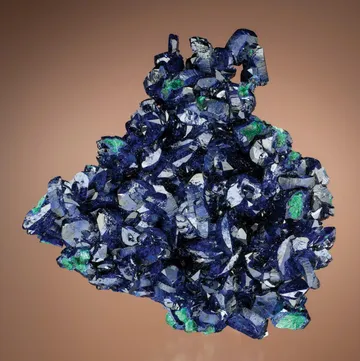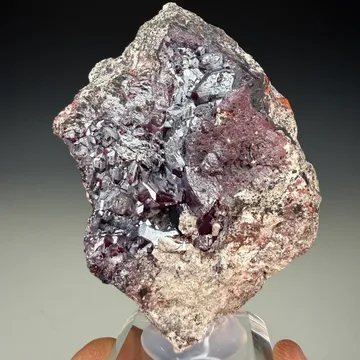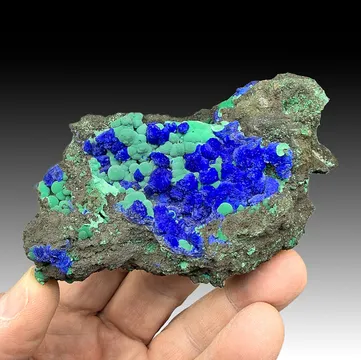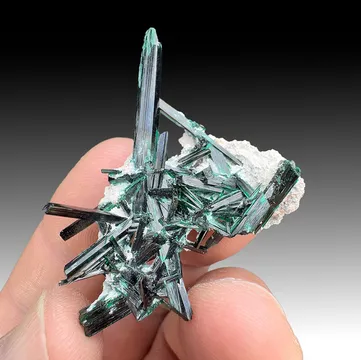
Malachite de Milpillas, provenant de la mine Milpillas dans le Sonora, offre des formes pseudomorphes d’azurite, une brillance soyeuse verte et des contrastes de couleur bleu-vert que les collectionneurs apprécient.
Key facts
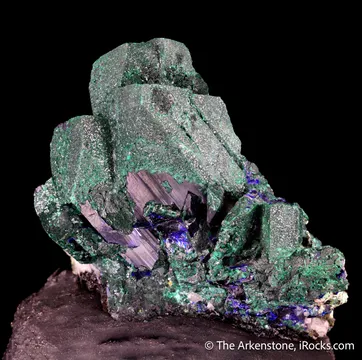
La malachite de Milpillas est une royauté minérale mexicaine moderne: vive, tactile et indéniablement liée aux spectaculaires zones de minerai oxydé d’un important porphyre de cuivre enfoui dans le nord de Sonora. La mine est mieux connue du public pour ses azurites d’un bleu électrique, mais la moitié verte de l’histoire est tout aussi importante. Nombre des malachites de Milpillas les plus prisées sont des pseudomorphes après l’azurite — des lames acérées, des coins et des rosettes dans lesquels une malachite fibreuse, soyeuse et chatoyante a conservé la géométrie angulaire des anciens cristaux d’azurite. Le résultat peut être déroutant de la meilleure façon qui soit: un spécimen qui se lit cristallographiquement comme de l’azurite mais qui brille du vert velouté de la malachite.

Photo : Rob Lavinsky, iRocks.com, via Wikimedia Commons
Le cadre Milpillas explique l’intensité. Le gisement se situe sur la ceinture cuivreuse Sonora-Arizona-Nouveau-Mexique de Laramide, dans le graben de Cuitaca, et consiste en un système de cuivre porphyrique partiellement oxydé avec des horizons carbonate-oxydes de cuivre et des nappes d’enrichissement en chalcocite développés au-dessus d’une minéralisation primaire chalcopyrite-bornite de grade inférieur. Le cuivre a été lixivié, déplacé, reconcentré, puis retravaillé par l’évolution des conditions supergènes. La malachite s’est formée dans les portions oxydées supérieures de ce système, le plus souvent avec l’azurite, la brochantite, la chrysocolle, la plancheite, l’goethite, le dickite, le quartz, le volborthite, la vésigniéite et d’autres minéraux secondaires du cuivre.
Les collectionneurs apprécient la malachite de Milpillas pour trois raisons liées. Premièrement, la forme: les meilleurs pseudomorphes conservent l’habitus aigu de lame ou d’angle de l’azurite plutôt que de s’effondrer en une croûte verte massive. Deuxièmement, la surface: un matériau fin présente un lustre soyeux à velouté, avec de minuscules cristaux fibreux produisant un chatoyement sous une lumière mouvante. Troisièmement, le contraste de couleur: des remplacements partiels et des pièces recoiffées peuvent montrer des restes d’azurite bleu profond sur ou dans la malachite verte, et certains spécimens portent de la malachite sur une matrice blanche riche en argile ou sur une plancheite bleue, donnant à la localité une palette qui peut sembler presque mise en scène.

*Photo : Rob Lavinsky, iRocks.com, via Wikimedia Commons*Historiquement, Milpillas a redéfini les attentes de ce qu’une mine de cuivre nouvellement développée pouvait encore offrir au XXIe siècle. Des spécimens fins ont commencé à atteindre le marché environ un an après l’ouverture de la mine, d’abord avec une certaine incertitude sur la source, puis dans une remarquable séquence de poches qui a fait de la localité une référence pour les pseudomorphes modernes de azurite et de malachite. Bien que le but commercial de la mine ait été le cuivre cathodique, sa brève fenêtre de spécimens a produit une série distinctive que les collectionneurs sérieux reconnaissent désormais au premier coup d’œil.## Specimens en vedette
Rechercher des spécimens : Voir tous les spécimens de malachite de la mine Milpillas, Sonora, Mexique
Milpillas, également opérationnellement connu sous le nom de La Parreña, se situe dans la municipalité de Santa Cruz, Sonora, près de Cuitaca et dans le cadre plus large du district cuprifère de Cananea. Il s’agit d’une mine de cuivre porphyrique souterraine développée pour les minéraux de cuivre solubles et la production de cuivre cathode, avec extraction minière, broyage, lixiviation en tas, extraction par solvants et électrolyse comme partie intégrante de l’exploitation.
Géologiquement, Milpillas n’est pas une simple localité de gossan proche de la surface. Le gîte a été préservé sous une importante couverture post-minéraire de gravats dans le semigraben Cuitaca Norte. Cette mise en terre a protégé le système supergénique : une calotte lixiviée, des zones de cuivre oxydé et des nappes de chalcopyrite enrichies formées au-dessus de la minéralisation primaire porphyrique. Les spécimens minéraux de la localité provenaient de ces horizons oxydés et enrichis, en particulier lorsque les espaces ouverts, l’altération argileuse et l’évolution de la chimie cuivre-carbonate permettaient à l’azurite et à la malachite de se cristalliser ou de se remplacer mutuellement dans des formes bien développées.
L’exploration du gîte remonte à la fin du XXe siècle. Peñoles rapporte une exploration débutant dans les années 1980 et se poursuivant jusqu’en 2001, après quoi les réserves suffisantes justifièrent la construction de la mine. D’autres récits de collectionneurs mentionnent l’histoire de la découverte à partir de 1978, suivie d’un long retard avant la production car le minerai était caché sous de lourds alluvions profondes et nécessitait un développement souterrain coûteux. La mine est entrée en production en 2006. Peñoles a suspendu les opérations en 2020, puis a repris l’extraction, le broyage et le dépôt du minerai au deuxième trimestre de 2022 pour la production de cuivre cathode.
Pour les collectionneurs, l’histoire de production importante est plus restreinte que l’histoire minière industrielle. Les premiers spécimens d’azurite et de malachite ont commencé à apparaître vers 2007. La période de spécimens la plus célèbre s’est poursuivie jusqu’à la fin des années 2000 et au début des années 2010, avec de grandes poches qui ont donné de l’azurite sur malachite, des pseudomorphes de malachite après l’azurite, des rosettes azurite-malachite et des espèces associées. Le niveau 1100 est à plusieurs reprises associé à d’importantes découvertes précoces ; le niveau 1160 a produit des pseudomorphes de malachite après l’azurite sur du velours planchéite en 2008 ; des niveaux et poches ultérieurs ont produit d’autres minéraux cuivreux, y compris des associations notables quartz-dioptase-shattuckite du niveau 992 en 2019.
Milpillas est une mine industrielle souterraine active ou intermittente, et non une localité publique à accès payant. Le matériel de collection est entré sur le marché par le biais de récupérations liées à la mine, de marchands mexicains de minéraux, puis de marchands et enchères internationaux ultérieurs. Parce que les zones des spécimens oxydés étaient limitées et que beaucoup avaient été extraits ou contournés lors de l’extraction normale du cuivre, les meilleures spécimens de malachite ne sont pas renouvelables de la même manière que le matériel provenant d’une zone de collecte ouverte.## Caractéristiques de la malachite de la Mine Milpillas, Sonora, Mexique
L’habitus signature de la malachite de Milpillas est de la malachite après l’azurite : des lames nettes, des lathes, des coins, des rosettes et des groupes cristallins composites qui conservent la géométrie de l’azurite tout en la remplaçant par une malachite fibreuse. Les meilleurs exemples présentent des arêtes pseudomorphes nettes, un chatoyance soyeux et une surface qui passe du vert émeraude à un vert forêt plus profond à mesure que la lumière se déplace. Certains sont presque entièrement verts ; d’autres conservent l’azurite bleue au niveau des pointes, des arêtes, des noyaux ou comme revêtement ultérieur. Ces pièces mixtes azurite-malachite peuvent être parmi les exemples Milpillas les plus visuellement spectaculaires, en particulier lorsque des cristaux bleus émergent d’une base de malachite vert velours.
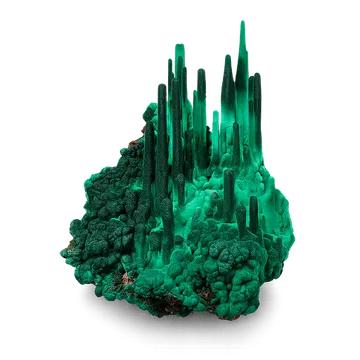
Milpillas a également produit de la malachite botryoïdale, mammillaire et crustiforme. Celles-ci sont moins nettes sur le plan cristallographique que les pseudomorphes mais peuvent être extrêmement attractives lorsque la surface est veloutée et la couleur saturée. Des revêtements fibreux apparaissent sur la matrice, sur l’azurite et avec d’autres minéraux cuivreux secondaires. Des groupes arborescents et en gerbe de cristaux primitifs de malachite sont également connus, avec des cristaux aciculaires à fibreux et un lustre soyeux.
La couleur est généralement soutenue : vert riche, vert profond, vert émeraude et parfois légèrement vert bleuté lorsque la chrysocolle, la plancheéite ou l’azurite est présente à proximité. Le lustre va d’un velours mat à un soyeux et chatoyant ; les pseudomorphes les plus fins peuvent scintiller d’un éclat intérieur lumineux plutôt que de paraître poudreux. Les spécimens les plus désirables évitent les surfaces dulles, abrasées ou écrasées et conservent les contours originaux du cristal sans lourds meurtrissures.
Les tailles typiques de collection vont des miniaturettes et miniatures aux petits spécimens de cabinet. De beaux pseudomorphes complets de malachite autour de 3 à 6 cm sont particulièrement caractéristiques du marché. Des groupes plus importants existent, y compris des spécimens portant de la malachite et de l’azurite sur malachite dans la plage de 7 à 13 cm, mais les pseudomorphes de malachite nets, bien composés et peu endommagés sont beaucoup plus rares que les petites remplacements partiels ou les pièces mélangées.
Les minéraux associés sont centraux pour l’identification et le desirabilité Milpillas. L’azurite est le partenaire classique, soit comme zones bleues résiduelles au sein des pseudomorphes de malachite, soit comme des cristaux perchés sur la malachite. La plancheéite peut offrir un contraste botryoidal bleu royal à turquoise, notamment avec les pseudomorphes de malachite à partir du niveau 1160. La baryte, la goethite, la chrysocolle, la dickite, le quartz, la shattuckite, la vésigniéite, la volborthite, la tangeite, l’hématite, la calcite, le tenorite, l’antlerite, l’atacamite et le brochantite ont tous été notés dans la localité ou dans les données photo associées à la malachite. La dickite blanche ou une matrice riche en argile peut rendre les minéraux cuivreux verts et bleus particulièrement saturés.La qualité est jugée sur une combinaison de préservation, de contraste et de surface. Une malachite de Milpillas de premier choix devrait présenter une forme indubitable dérivée de l’azurite, une surface malachite fibreuse ou soyeuse propre, une couleur fortement saturée, des éraillures sur les bords minimales et une composition qui se révèle naturellement. Des remnants partiels d’azurite peuvent ajouter de la valeur lorsqu’ils sont nets, attrayants et clairement partie de l’histoire paragnétique; ils peuvent diminuer la valeur lorsqu’ils représentent des patches cassés ou abrasés plutôt qu’une exposition naturelle.## Notes du collectionneur
La malachite de Milpillas est bien représentée sur le marché comparativement aux localités classiques du XIXe siècle et du début du XXe siècle, mais les plus beaux échantillons ne sont plus aussi abondants. Les meilleures pièces proviennent souvent de matières anciennes de poche dispersées via des stocks de marchands, des collections privées et des ventes aux enchères. La disponibilité actuelle est la plus forte pour les miniatures miniatures d’azurite-malachite mixte de petite taille et pour les pseudomorphes individuels de malachite; les ensembles plus grands, d’un grand esthétisme, peu endommagés et entièrement remplacés, après azurite-malachite, sont beaucoup moins courants.
La principale question d’authenticité n’est généralement pas « la malachite de Milpillas fausse » au sens grossier. L’inquiétude plus subtile concerne l’état et l’interprétation des interfaces azurite-malachite. Certaines azurites bleu électrique de Milpillas semblent être constituées d’une très fine couche d’azurite sur malachite après azurite, et là où ce revêtement bleu se termine, la surface verte exposée peut être naturelle, écaillée, naturellement incomplète, ré-guérie, ou une combinaison. Cela compte car un collectionneur peut payer une prime pour une frontière de couleur naturelle qui est en réalité le bord d’un revêtement d’azurite perdu. L’examen à la loupe ou au microscope est utile, surtout le long des contacts bleus-verts abrupts.
Les problèmes d’état courants incluent des arêtes de lame cabossées, des surfaces veloutées frottées, des revers en contact, et de petites zones écrasées où la malachite fibreuse est exposée. La surface fibreuse peut paraître non endommagée à l’œil nu même lorsqu’un revêtement fin d’azurite a été perdu. Sur les pseudomorphes nets, vérifier les pointes de cristal, les arêtes et les lathes qui dépassent; sur les pièces botryoïdales, vérifier les points hauts pour abrasion ou polissage terne dû à la manipulation. La présence d’une matrice argileuse lâche est également courante et peut s’effriter si l’échantillon n’est pas stabilisé ou monté avec soin.
La confusion avec les minéraux cuivreux associés est possible. La brochantite de Milpillas peut être verte et aciculaire ou fibreuse, tandis que la chrysocolle, la plancheéite et la shattuckite peuvent créer des revêtements bleu-verts qui ne sont pas de la malachite. Les pièces plus anciennes bien étiquetées provenant de marchands réputés sont préférables, et les combinaisons inhabituelles — surtout du matériel vendu comme Milpillas mais riche en shattuckite et en quartz épais sans les associations typiques de Milpillas — méritent un examen attentif car des matériaux ressemblants provenant de la région de Cuítaca ont circulé sous une attribution Milpillas incorrecte.
Le soin est simple mais prudent. Gardez les échantillons au sec, évitez le nettoyage par ultrasons, évitez le nettoyage chimique et manipulez les surfaces fibreuses avec parcimonie. L’attrait de la malachite de Milpillas dépend d’une texture de surface délicate; une fois le velours frotté, la perte ne peut être inversée.## Stories & Field Notes
Milpillas est l’une de ces localités modernes qui, avec le recul, semblent n’avoir jamais dû rester cachées si longtemps. Le district du cuivre autour de Cananea était célèbre depuis des générations, et la plupart des systèmes porphyriques de cuivre comparables dans la région avaient été découverts et exploités plus d’un siècle plus tôt. Milpillas a survécu parce que la géologie l’avait rangée au fond d’un fossé. Le repliement après oxydation a déposé le gisement dans un graben, et le fossé s’est rempli de roches et de sables meubles provenant des hautes terres voisines. Au moment où l’exploration l’a rattrapé, le système oxydé porteur de spécimens était enterré sous environ 250 mètres d’alluvions.
L’histoire de la découverte présente un retournement agréable. Des pavés altérés dans les graviers au-dessus de Milpillas suggéraient du cuivre porphyrique, d’où le début du forage. Le cuivre est apparu rapidement, mais l’indice était trompeur : les pavés altérés semblaient provenir d’ailleurs. Leur source d’origine demeurait un mystère, mais le forage avait tout de même trouvé Milpillas. En termes de collecte de spécimens, c’était une fausse piste géologique qui a conduit à l’une des grandes découvertes minérales du cuivre au XXIe siècle.
Le défi d’ingénierie était sévère. Les planificateurs miniers devaient atteindre le minerai à travers environ 250 mètres d’alluvions mal consolidées et porteuses d’eau, puis continuer vers une cible dont la minéralisation supérieure se situait bien en dessous de la surface. Seuls de hauts taux de cuivre et des prix élevés du cuivre rendaient le pari possible. Cet environnement enterré, si problématique pour l’exploitation minière, explique aussi pourquoi les zones oxydées et supergènes ont survécu assez longtemps pour produire les spécimens que les collectionneurs connaissent aujourd’hui.
En moins d’un an de production, les premiers spécimens ont commencé à entrer dans le monde minéral sans histoire d’origine claire. Des marchands mexicains ont franchi la frontière de l’Arizona avec des cristaux d’azurite et des pseudomorphes malachite après l’azurite — certains médiocres, d’autres déjà suffisamment bons pour attirer l’attention. Les spécimens ne correspondaient ni à des localités mexicaines ni à des localités de l’Arizona. Leur source a été gardée secrète au début, et le mystère a rendu le matériau plus intrigant. Bientôt la réponse est apparue : la nouvelle mine souterraine de cuivre à Milpillas.
Une première pièce en 2007 a éveillé l’attention des collectionneurs : un cristal d’azurite unique de 4 pouces acquis par Jimmy Vacek. Gene Schlepp faisait aussi la promotion du bel ancien matériel de Milpillas. Ces premiers spécimens n’étaient que l’ouverture. En 2010, des poches au niveau 1100 produisaient de l’azurite sur malachite; la Pocket Tolvas Duales a livré des spécimens de 7,5 cm et 13,3 cm qui deviendraient plus tard des exemples illustrés dans la littérature des collectionneurs. En 2011, la Rosette Pocket sur le même niveau 1100 a produit des azurites célèbres, dont un spécimen de 11,5 cm surnommé « la Boule de Canon ».Pour les collectionneurs de malachite, l’un des moments cruciaux est venu du niveau 1160 en 2008. Là, des pseudomorphes de malachite après l’azurite sont apparus sur une planchèite veloutée, associant une malachite de forme azurite verte à des surfaces de silicate de cuivre bleu. Parmi les exemples illustrés figure un spécimen de 9 cm dans la collection Thomas Weiland et un spécimen de 4 cm photographié par Jeff Scovil. Ce sont des Milpillas par excellence : pas seulement de la malachite, pas seulement de l’azurite, mais une séquence d’événements minéraux du cuivre figée dans un seul objet.
Le Watercourse Pocket de 2013–2014 est devenu l’un des grands épisodes de Milpillas. Il a donné des milliers de cristaux d’azurite nets, légèrement incurvés, d’en moyenne environ 1,5 cm. Bien que ce pocket soit surtout retenu pour l’azurite, il appartient à la même histoire plus large d’une abondance de carbonate de cuivre qui a fait de la mine une localité de malachite d’importance. À ce moment-là, le marché international avait appris ce que Milpillas pouvait faire : bleu électrique, vert velouté, pseudomorphes nets, rosettes, et des associations qui semblaient trop vives pour être des minéraux d’ordinaire.
Puis la séquence des spécimens a changé. Les minerais oxydés de cuivre vert qui avaient produit tant de trésors d’azurite et de malachite avaient été largement épuisés vers 2015 environ. La brochantite, la volborthite, la cuprite et d’autres espèces ont eu leurs moments lorsque la mine est passée par différentes zones, mais la grande bonanza azurite-malachite a ralenti de manière spectaculaire. Des trouvailles ultérieures, y compris du matériel de 2019 provenant du niveau 992 avec la dioptase, la shattuckite, le quartz et une malachite plus sombre, ont montré que Milpillas n’était pas fini sur le plan minéralogique. Il n’en reste pas moins que le chapitre central — les années où des pseudomorphes d’azurite et de malachite de classe mondiale inondaient le marché — était devenu de l’histoire ancienne.## Registres et publications minéralogiques
Jones, Evan A., et Peter K. M. Megaw. “La mine Milpillas, Cuitaca, Sonora, Mexique.” The Mineralogical Record, 52(5), 493–626, 2021. Le compte rendu moderne définitif pour les collectionneurs, avec une histoire détaillée des poches, des spécimens illustrés, des niveaux, des dates et des espèces associées, y compris les pseudo-orphelines de malachite après l’azurite du niveau 1160 et les découvertes d’azurite sur malachite du niveau 1100. (mineralogicalrecord.com)
Moore, Thomas P., et Marcus Origlieri. “Lieux minéraux célèbres : La mine Milpillas, district de Cananea, Sonora, Mexique.” The Mineralogical Record, 39(6), 25–34, 2008. La première grande présentation de Mineralogical Record sur ce site, préparée après l’enthousiasme initial autour des magnifiques spécimens d’azurite et de malachite. (mindat.org)
Noguez-Alcántara, Benito, Martín Valencia-Moreno, Jaime Roldán-Quintana, et Thierry Calmus. “Enrichissement supergène et analyse d’équilibre massique dans le gisement de cuivre porphyrique Milpillas, district de Cananea, Sonora, Mexique.” Revista Mexicana de Ciencias Geológicas, 24(3), 368–388, 2007. Important article géologique sur le système d’enrichissement supergène, la cape réincipiante, les nappes de chalcocite et la minéralisation oxydée du cuivre qui sous-tend l’ensemble des spécimens. (scielo.org.mx)
Valencia, Víctor A., Benito Noguez-Alcántara, Fernando Barra, Joaquín Ruiz, George Gehrels, Francisco Quintanar, et Martín Valencia-Moreno. “Datation géochronologique Re-Os de la molybdénite et LA-ICPMS-MC U-Pb zircon pour le dépôt de cuivre porphyrique Milpillas: perspectives sur le timing de la minéralisation dans le district de Cananea, Sonora, Mexique.” Revista Mexicana de Ciencias Geológicas, 23(1), 39–53, 2006. Établit le cadre temporel laramien pour le système de cuivre porphyrique, incluant une âge de cristallisation du porphyre quartz-monzonite de 63,9 ± 1,3 Ma. (rmcg.unam.mx)
Enregistrement d’occurrence Mindat pour la malachite de la Mine Milpillas. Enregistre la malachite comme occurrence valide de la mine, mentionne les pseudo-orphes et liste les minéraux associés à partir des données photographiques incluant azurite, plancheite, baryte, goethite, chrysocolle, dickite, quartz, volborthite, shattuckite et vésigniéite. ()## Vidéos & Médias
“Azurite with Malachite from Milpillas Mine, Sonora, Mexico” — Fabre Minerals. Vidéo d'échantillon Vimeo montrant une azurite Milpillas de 9,2 × 6,6 × 4,1 cm avec malachite, décrite par Fabre comme ayant le bleu électrique profond typique des meilleurs échantillons de Milpillas. URL: https://vimeo.com/549299976 (vimeo.com)
“Azurite from Milpillas Mine, Sonora, Mexico” — Fabre Minerals. Vidéo d'échantillon Vimeo d'une azurite Milpillas niveau 1100 mesurant 4,6 × 3,4 × 1 cm, utile pour comprendre la morphologie cristalline nette aplanie que les pseudomorphes de malachite de la localité préservent souvent. URL: https://vimeo.com/429423398 (vimeo.com)## lectures supplémentaires et liens externes
Mindat : Mine Milpillas, Milpillas, Municipalité de Santa Cruz, Sonora, Mexique — La page principale de la base de données des localités, avec géologie, liste des espèces, coordonnées et liens vers des photos. (mindat.org)
Mindat : Malachite de la mine Milpillas — Page d’occurrence spécifique à l’espèce pour la malachite à Milpillas, y compris les données d’association et les références de publication. (mindat.org)
Peñoles : Unité minière Milpillas — Informations sur l’opérateur, la propriété, la méthode de production, les installations, les réserves, les périodes d’exploitation et la production actuelle de cuivre cathode. (penoles.com.mx)
SciELO : Enrichissement super-génique et analyse de balance massique dans le dépôt porphyrique de cuivre Milpillas — Article géologique expliquant le système supergénique, la cime lessivée, les couvertures de calcocénite et les assemblages cuivre-oxydé-carbonaté. (scielo.org.mx)
The Mineralogical Record : numéro d’échantillon — The Milpillas Mine, Cuitaca, Sonora, Mexique — Pages publiques d’échantillons tirées du principal article Milpillas 2021, avec noms de poche, niveaux, captions des spécimens et contexte pour les collectionneurs. (mineralogicalrecord.com)
Rock & Gem : « De Colores : Milpillas, Sonora » — Vues d’ensemble lisibles axées sur les collectionneurs par Peter Megaw, incluant l’histoire de la découverte enfouie et l’essor du bonanza azurite-malachite Milpillas. (rockngem.com)
Wikimedia Commons : Catégorie Milpillas Mine — Large archive d’images des spécimens de Milpillas, incluant malachite, malachite-azurite et minéraux de cuivre associés. (commons.wikimedia.org)
Mindat discussion : Azurites et Malachites « Electric Blue » de Milpillas — Naturel ou éclatées ? — Discussion utile pour les collectionneurs sur les questions d’état et d’interprétation aux interfaces azurite/malachite bleu-vert. (mindat.org)