






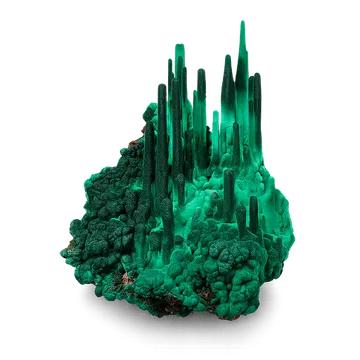
Malachite from Bisbee, Arizona — classic copper-carbonate featuring deep emerald to blue-green botryoidal crusts, velvety chatoyancy, and sculptural vug forms.
Key facts
Bisbee malachite is one of the classic American copper-carbonate specimens: old, richly colored, and inseparable from the district’s legendary azurite, cuprite, native copper, calcite, chrysocolla, and limonitic gossan. The best pieces have the look serious collectors hope for from a great oxidized copper camp—deep emerald to blue-green botryoidal crusts, velvety chatoyant fibers, stalactitic forms with concentric banding, and dramatic associations with inky azurite or red cuprite. Unlike the broad, ornamental slabs associated with some African or Russian malachite, Bisbee’s finest collector pieces usually speak the language of vugs, limestone cavities, stopes, and ore pockets: compact, sculptural, mineralogically busy, and unmistakably tied to a nineteenth- and twentieth-century underground mining district.

Photo: Wikimedia Commons
The district lies in the Mule Mountains of southeastern Arizona, within the Warren mining district, where copper mineralization was developed in and around Paleozoic carbonate rocks and intrusive bodies. The malachite belongs mainly to the oxidized copper suite: a secondary mineral produced when copper-bearing sulfides and oxides reacted with oxygenated, carbonate-bearing waters in limestone-rich ground. That carbonate setting mattered. It favored spectacular copper carbonates—malachite and azurite—while the open spaces of altered limestone, solution cavities, fractures, and mined ore bodies provided the rooms in which botryoids, crusts, stalactites, and crystalline encrustations could form.
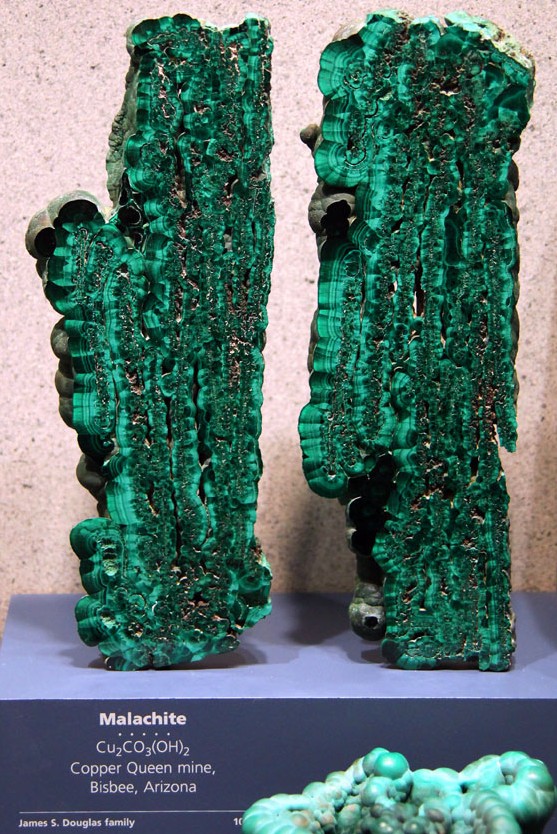
Photo: Wikimedia Commons
Historically, Bisbee was not a specimen locality first; it was one of the great copper camps of the United States. Mining began around 1880 and continued, in changing forms, until the mid-1970s. The great names on old labels—Copper Queen, Czar, Holbrook, Spray, Cole, Campbell, Junction, Shattuck, Southwest, Lavender Pit—are not merely romantic place names. They mark a complex industrial district that produced billions of pounds of copper and also released into the collecting world a mineral suite now represented in major museums and old private collections.
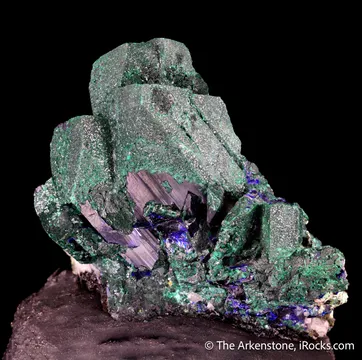
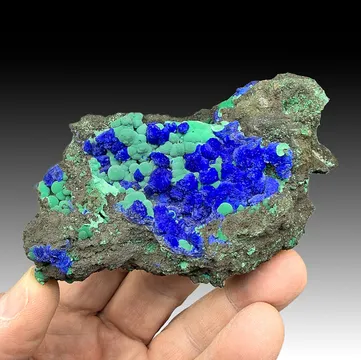
For malachite collectors, the strongest Bisbee pieces combine three virtues: convincing old locality provenance, expressive form, and a tight mineral association. Botryoidal or mammillary malachite alone can be excellent, especially when satiny and intensely colored, but the district’s most charismatic pieces often include azurite roses or blades on malachite, malachite after azurite, malachite coatings on cuprite, malachite with native copper, or banded stalactitic material from the early carbonate-rich workings. A clean old Bisbee label, especially naming a mine, can add as much interest as another centimeter of specimen.
Search for specimens: View all malachite specimens from Bisbee, Arizona, USA
Bisbee is in Cochise County, Arizona, in the Mule Mountains near the Mexican border. The mineral locality used by collectors is broader than the city itself and generally corresponds to the historic Warren mining district and its mines, pits, claims, and underground workings. On old labels, “Bisbee” may stand alone, but more desirable locality data may specify the Copper Queen Mine, Holbrook Mine, Czar Mine, Spray Mine, Cole Mine, Campbell Mine, Southwest Mine, Junction Mine, Shattuck Mine, Lavender Pit, or another named working.
Geologically, the district is a classic copper camp in carbonate and altered intrusive terrain. The important ore bodies occurred as irregular replacement deposits in limestone, with structural control from faults, contacts, folds, and favorable carbonate horizons. Early descriptions emphasize the oxidation of copper ores to limonitic clays, cuprite, native copper, azurite, malachite, chrysocolla, and brochantite above or near sulfide bodies containing minerals such as chalcocite, bornite, chalcopyrite, pyrite, galena, and sphalerite. In places, oxidation was deep and irregular, making Bisbee unusually productive in secondary copper minerals rather than merely a thin surface-stain locality.
The Copper Queen was the dominant early producer. Ransome’s early twentieth-century descriptions record the Copper Queen workings as a maze reached by the Czar, Holbrook, Spray, and Gardner shafts, while the neighboring Calumet & Arizona mine was already emerging as a major producer by 1902. In the older Copper Queen workings, malachite had been abundant in beautiful masses with azurite and calcite in limestone caverns; by the time Ransome examined the district, it was less abundant in active Copper Queen workings, generally appearing as nests and bunches in soft limonitic ore with earthy cuprite. In the Calumet & Arizona mine, he also noted malachite in vugs within crystalline cuprite and native copper. These observations explain many surviving specimens: Bisbee malachite is often not a single-species display mineral but part of a richly oxidized copper assemblage.
Mining history at Bisbee runs from early surface and underground discoveries in the late 1870s and 1880s through the great Copper Queen and Calumet & Arizona years, consolidation under Phelps Dodge, large-scale underground mining, and finally open-pit mining at the Lavender Pit from 1954 to 1970. The district’s official history records nearly a century of mining, with Bisbee producing about 8 billion pounds of copper, 102 million ounces of silver, 2.8 million ounces of gold, and substantial lead, zinc, and manganese. By December 1974, closure was announced; underground operations ceased in 1975. The Copper Queen Mine Tour opened to visitors on February 1, 1976, preserving a small, interpreted part of the underground world rather than reopening it for collecting.
Collecting access today should be approached conservatively. The historic mines are closed industrial sites, many dumps and workings are private, and underground entries are dangerous. The Copper Queen Mine Tour is an educational tour, not a collecting venue. Casual collecting on public lands in the broader region requires attention to land status, active claims, private mineral rights, local restrictions, and safety; collectors should not assume that a dump, pit edge, shaft collar, or fenced mine area is open simply because it is historic. For most serious collectors, Bisbee malachite is now chiefly a market and old-collection locality rather than a field-collecting destination.
Notable finds include stalactitic and banded malachite from early carbonate cavities, velvety chatoyant malachite on copper-rich matrix, azurite rosettes on malachite, malachite pseudomorphs after azurite, and malachite-coated or malachite-associated cuprite. The district also produced important post-mining secondary minerals in underground environments, but post-mining malachite is generally described as thinner, scaly, or less inspiring than the classic nineteenth- and early twentieth-century material.
Bisbee malachite most commonly appears as botryoidal, mammillary, stalactitic, fibrous, earthy, velvety, or crustiform material. On collector-grade specimens, the most desirable surfaces are silky to chatoyant, with tight fibrous structure and saturated green color. The best botryoidal pieces show rounded, lustrous lobes rather than dull powdery crusts; the best stalactitic or banded pieces show clean concentric growth, contrasting green tones, and natural sculptural balance.
Color ranges from pale green through rich emerald and deep blue-green. The deepest pieces can look nearly black-green in recesses, especially when azurite or manganese/iron oxides are present nearby, but genuine malachite should still show green in broken or polished areas. Weathered or post-mining material may be paler, chalkier, or more granular. Old Bisbee malachite with a silky fibrous surface often has a sheen that is hard to imitate convincingly.
Crystal faces of malachite itself are not the usual attraction at Bisbee. The district is more famous for form and association: botryoids, velvet coatings, stalactites, crusts, pseudomorphs, and mixed secondary copper assemblages. Malachite after azurite is particularly prized when the original azurite habit remains legible—bladed, spear-like, or rosette-like forms now replaced or coated by green malachite. Malachite after cuprite or malachite coating cuprite can also be significant, especially where red cuprite, dark limonite, and green copper carbonate produce strong color contrast.
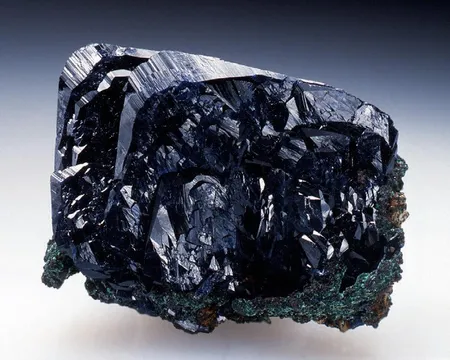
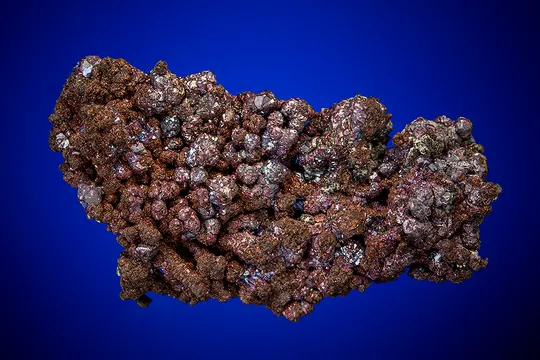
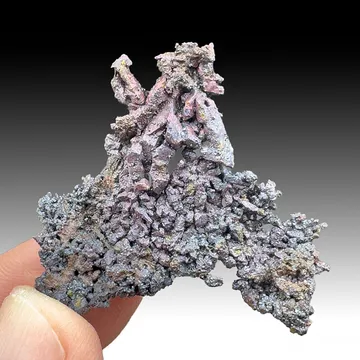
Associated minerals are central to Bisbee’s appeal. Azurite is the classic partner, occurring as dark blue crystals, blades, roses, sparkling crusts, or earlier material later altered to malachite. Cuprite, including earthy masses and crystalline material, is a common and historically documented companion in the oxidized ores. Native copper may occur with malachite, sometimes as a core or visible metallic remnant in old specimens. Chrysocolla, brochantite, calcite, limonite/goethite, and carbonate matrix are also common associations. Because brochantite can be green and was historically noted as easily confused with malachite in Bisbee ores, careful identification matters on fine-grained green coatings.
Typical specimen size varies widely. Thumbnail and miniature pieces are available from old collections and later dump material, but the most desirable cabinet specimens often fall in the hand-sized range: compact plates of azurite on malachite, botryoidal malachite on limonitic matrix, malachite-coated copper, or banded fragments from larger stalactitic masses. Museum pieces can be much larger, including substantial stalactitic or massive display specimens from early collections. A single well-formed miniature with exceptional azurite association and old mine attribution can be more desirable than a larger but dull massive specimen.
Quality factors are locality-specific. For Bisbee malachite, a collector should look for:
Bisbee malachite is available, but the best examples are not common. The mines that produced the classic specimens are closed, and much of the finest material entered museums, company collections, and old private cabinets long ago. Good pieces still circulate through mineral dealers and auctions, but collectors should expect the strongest prices for old-time specimens with mine-specific labels, azurite association, velvet or stalactitic form, or provenance to collections connected with Bisbee, Phelps Dodge, the Copper Queen, or well-known Arizona collectors.
Authenticity concerns usually fall into two categories: species identification and locality attribution. Species confusion is real because Bisbee has many green secondary copper minerals, including brochantite, chrysocolla, conichalcite, aurichalcite, and others. A dull green coating on limonite is not automatically malachite, even if the label says Bisbee. Brochantite was specifically noted in early descriptions as a green mineral that could be mistaken for malachite in Bisbee ores. Chrysocolla can also be confused with massive malachite, especially when both occur together. When a piece is expensive, identification by habit, hardness, luster, reaction behavior, and—where appropriate—analytical confirmation is preferable to relying on color alone.
Locality attribution is the larger market issue. “Bisbee” is a famous name and has been used loosely. Some old specimens labeled simply “Arizona” later become “Bisbee” in dealer circulation without supporting evidence. A specimen style can be suggestive but rarely proves locality by itself. Strong provenance matters: original handwritten labels, museum or company labels, old dealer labels, and documented collection history all improve confidence. Mine-specific labels are especially desirable but should be evaluated critically; a fresh-looking “Copper Queen” tag paired with a specimen of uncertain style is not the same as an old collection label with consistent handwriting, paper, and history.
Documented Bisbee-specific malachite fakes are not a major literature topic, but malachite as a material is widely imitated and altered in the broader gem and decorative market. Dyed banded agate, resin imitation, reconstituted malachite, dyed carbonate rock, and plastic “malachite” are common in jewelry and décor. These are less likely to fool a serious specimen collector when matrix and associated minerals are present, but polished slabs, beads, eggs, spheres, and carved items should be approached with caution. Natural malachite is relatively dense, cool to the touch, and shows complex organic banding; imitations often display repetitive striping, overly stark black-green contrast, low weight, resinous feel, or molded surfaces.
Condition issues are common. Fibrous malachite can bruise or polish at high points; velvet surfaces mat down when handled; stalactitic pieces may be broken at terminations; botryoidal surfaces can show scuffs from old packing; and limonitic matrix may shed. Azurite associations introduce another vulnerability: azurite crystals bruise easily and may show edge wear or partial alteration to malachite. Pieces with cuprite or native copper should be kept dry and stable, and all copper-carbonate specimens should be protected from acids, prolonged humidity swings, and aggressive cleaning.
Market availability is healthiest for small and mid-sized old Bisbee specimens with mixed azurite-malachite, malachite on limonite, or malachite with chrysocolla. Fine velvet malachite, large stalactitic sections, and malachite pseudomorphs after azurite are scarcer. Museum-scale pieces, especially those connected to early Copper Queen or James Douglas material, are rarely available. In practical collecting terms, a sharply provenanced miniature may be the smartest acquisition; a showy cabinet specimen with questionable locality or heavily worn surfaces may be less satisfying in the long run.
The story of Bisbee begins, fittingly, with a rock picked up in the Mule Mountains. In the late 1870s, Lt. Dunn, leading a cavalry detail from Fort Huachuca during Apache scouting duties, camped near a spring in the canyon that would become Old Bisbee. After dinner he walked the slopes and picked up an interesting piece of mineralized rock, then found more along the south wall of the canyon. Military obligations prevented him from working the discovery himself, so he confided in a prospector, George Warren, and made an arrangement: Warren would locate the claims and work the ground, with Dunn as partner. Warren, however, stopped on the way to visit friends and drink whiskey. By the time the claims were staked, Dunn was out of the deal. It is one of the great messy origin stories of American mining: a district built on a discovery, a broken partnership, and a prospector whose name would become attached to the Warren mining district.
The specimens themselves helped change the district’s future. In 1898, John Graham, a former Bisbee resident, arrived in Calumet, Michigan carrying beautiful malachite and azurite specimens to sell. He found an old friend and fellow miner, Captain Jim Hoatson. Hoatson was captivated by the copper carbonates and asked whether good ground could still be obtained at Bisbee. Graham’s reply was the sort of sentence that launches mining companies: there was “just as good as the Copper Queen at Bisbee.” Hoatson traveled west on behalf of the Lake Superior and Western Development Company. After looking over the district, he chose what seemed to others an unpromising hard limestone knob called Mag Hill, owned by Tombstone saloon keeper Martin Costello. The Irish Mag claim lay east of known ore and was generally considered of little value, but Hoatson’s experience told him that surface showings in a copper camp could mislead. The decision helped bring the Calumet & Arizona Mining Company into Bisbee and altered the balance of power in the district.
Bisbee also had its share of claim fever. By 1900, more than 1,000 mining claims covering nearly 20,000 acres had been filed, with about 400 patented. More than 40 mining companies claimed to be developing or exploring ground at Bisbee at one time or another. Some were honest failures; others were speculative ventures; a few existed chiefly to separate investors from money. The Copper Glance Mining Company followed scattered ore fragments in a younger formation far east of the real ore bodies and found nothing of consequence. The Cochise Development Company sank in mineralized porphyry and schist north of the Dividend fault and found only low-grade mineralization. The Copper King of Arizona promoted its proximity to the Copper Queen mines, but the Dividend fault cut off the hoped-for ore extensions, and much of the money went to directors rather than discovery. In a district where a single rich replacement body could make a fortune, hope was cheap and shafts were expensive.
One of Bisbee’s most consequential stories is not about a specimen but about restraint. The success of the Calumet & Arizona and other nearby mines could have thrown the district into years of apex-law litigation, the kind of bitter boundary warfare that consumed many western mining camps. Dr. James Douglas of the Copper Queen could have tried to claim new ore bodies under old legal theories, but he rejected that path. He is remembered for saying, “we must decide which industry is to prosper here - that of mining or that of lawyers.” Instead, the companies treated vertical sidelines as the mining boundaries and allowed access to one another’s mines so that geological information near property lines could be shared. In a camp of hidden replacement ores, that was extraordinary. The decision helped keep Bisbee a mining district rather than a courtroom.
The end came with less romance. Bisbee had been declared nearly finished many times, and each time another ore body, another metal price, another technology, or another plan extended its life. Lead and zinc helped carry the camp after World War II. The Lavender Pit gave it another quarter century. But in June 1975, high costs and low metal prices finally closed the last three underground mines: Campbell, Cole, and Dallas. A note from the last day records a motorman placing a sample on a trolley motor on June 12, 1975. Six years later, pumping stopped and the mines were allowed to flood. The district that had produced such brilliant green and blue copper minerals passed from active mining into memory, museum cases, old labels, and the guided darkness of the Queen Mine Tour.

.jpg)