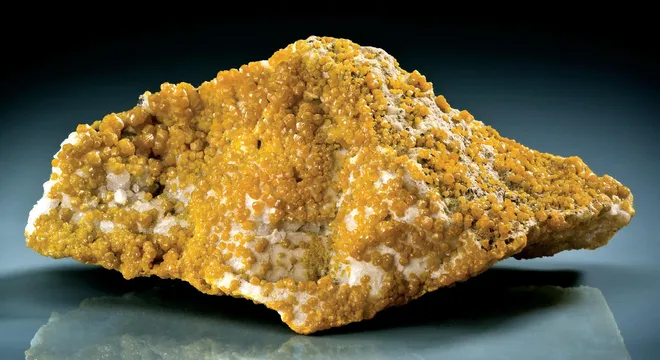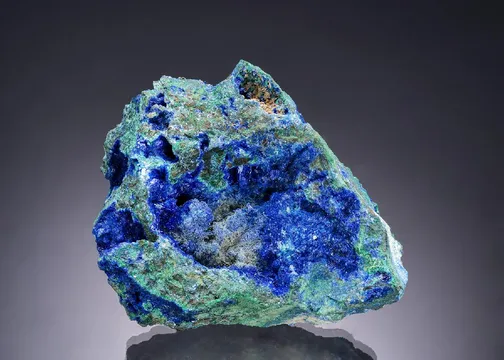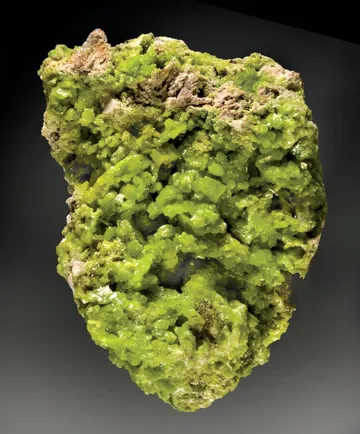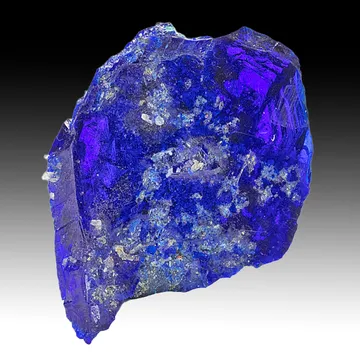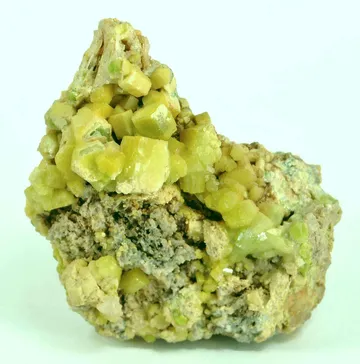
Red Gill Mine, England — berühmt für tief azurblaues Linarin mit scharfen Kristallen, seine historische Zuordnung und Status als eine der wichtigsten britischen Fundorte für Sammler.
Key facts
Red Gill Mine gehört zu den klassischen britischen Heimatorten der Linarin, und seine besten Exemplare nehmen einen besonderen Platz in der Geschichte der Spezies ein. In den winzigen oxidierten Hohlräumen von Quarz-Blei-Sulfid-Gestein produzierte die Mine tief azure-blau—PbCu(SO4)(OH)2—Kristalle, die für Sammler des 19. Jahrhunderts außergewöhnlich waren: dicke, scharfe, glasige Klingen, die Größen erreichten, die Red Gill-Material zu den feinsten jemals bekannten Linariten machten. Die Farbe ist der unmittelbare Reiz — kein weiches puderblau, sondern ein konzentriertes, fast emailliertes Blau, das gegen weißen Quarz, eisenverfärbtem Gossan, dunklen Sulfiden und dem helleren blaugrün von Caledonit gesetzt ist.
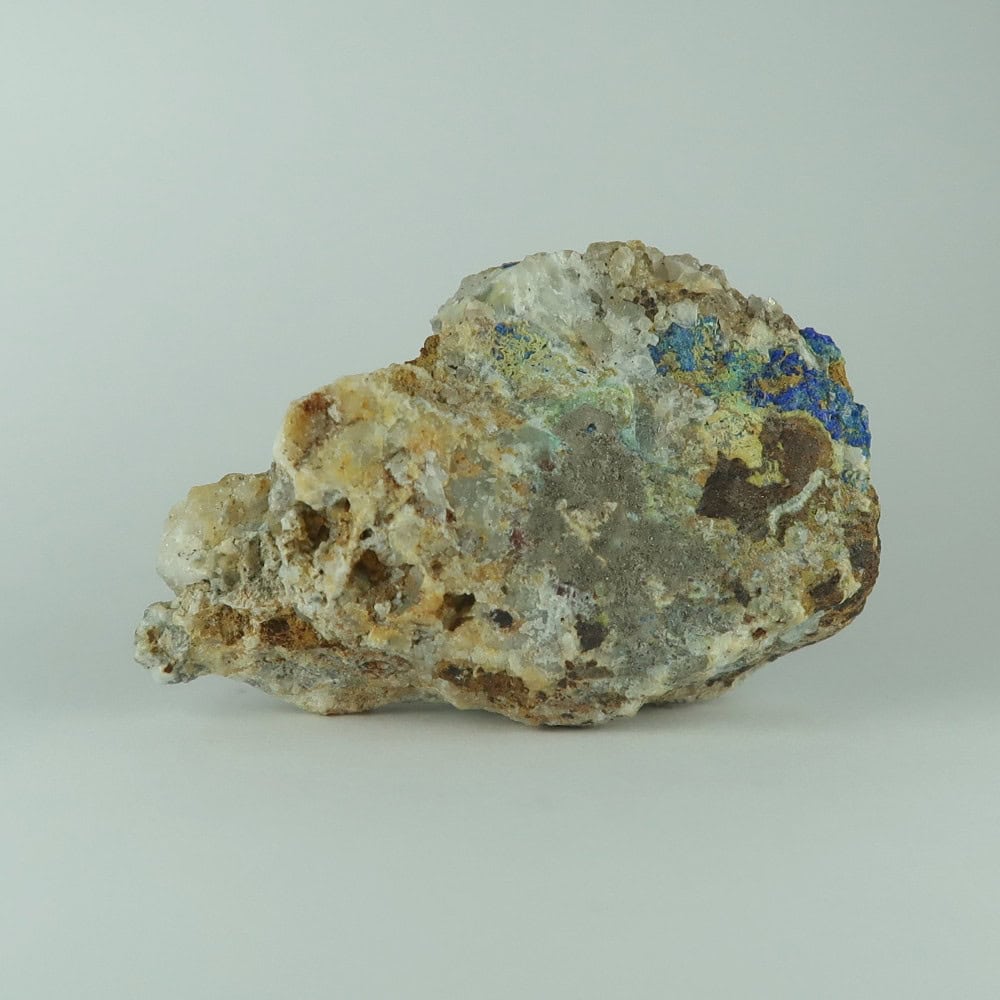
Foto: Albion Fire and Ice
Die Mine liegt in den Caldbeck Hills von Nord-Cumbria, ein kompakter Bezirk, dessen kleine Bleikilobungen eine mineralogische Literatur in einem unverhältnismäßigen Verhältnis zu ihrer Erzproduktion hervorbrachten. Red Gill ist vor allem eine Sekundärmineral-Lokalität: Das primäre Erzensembles basierte auf Bleiglanz (Galena) und Chalkopyrit, doch durch verlängerte Oxidation bleihaltiger und kupferhaltiger Sulfide entstand eine bemerkenswerte Suite von Bleikupfer-Sulfaten, Carbonaten, Phosphaten und verwandten Supergene-Species. Linarit ist das charakteristische blaue Mineral in diesem Ensemble, üblicherweise begleitet von Caledonit, Leadhillit, Cerussit, Anglesit, Quarz, Malachit und Eisenoxide.
Die Sammlerbedeutung von Red Gill ist auch historisch. Viele frühe Exemplare waren einfach mit „Cumberland“ oder „Roughton Gill“ etikettiert, ein weiter gefasster und bekannter Sammelname. Moderne Neubewertung des Red Gill/Roughton Gill-Gebiets hat argumentiert, dass viele der alten, großen, klassischen „Roughton Gill“-Linarite wahrscheinlich direkt aus Red Gill Mine stammen. Das ist für Sammler wichtig: Eine präzise Red Gill-Zuordnung verbindet ein Exemplar mit der tatsächlichen Quelle des feinsten bekannten neunzehnten Jahrhunderts Caldbeck-Linarits, statt lediglich mit dem breiteren Bergbaugebiet.
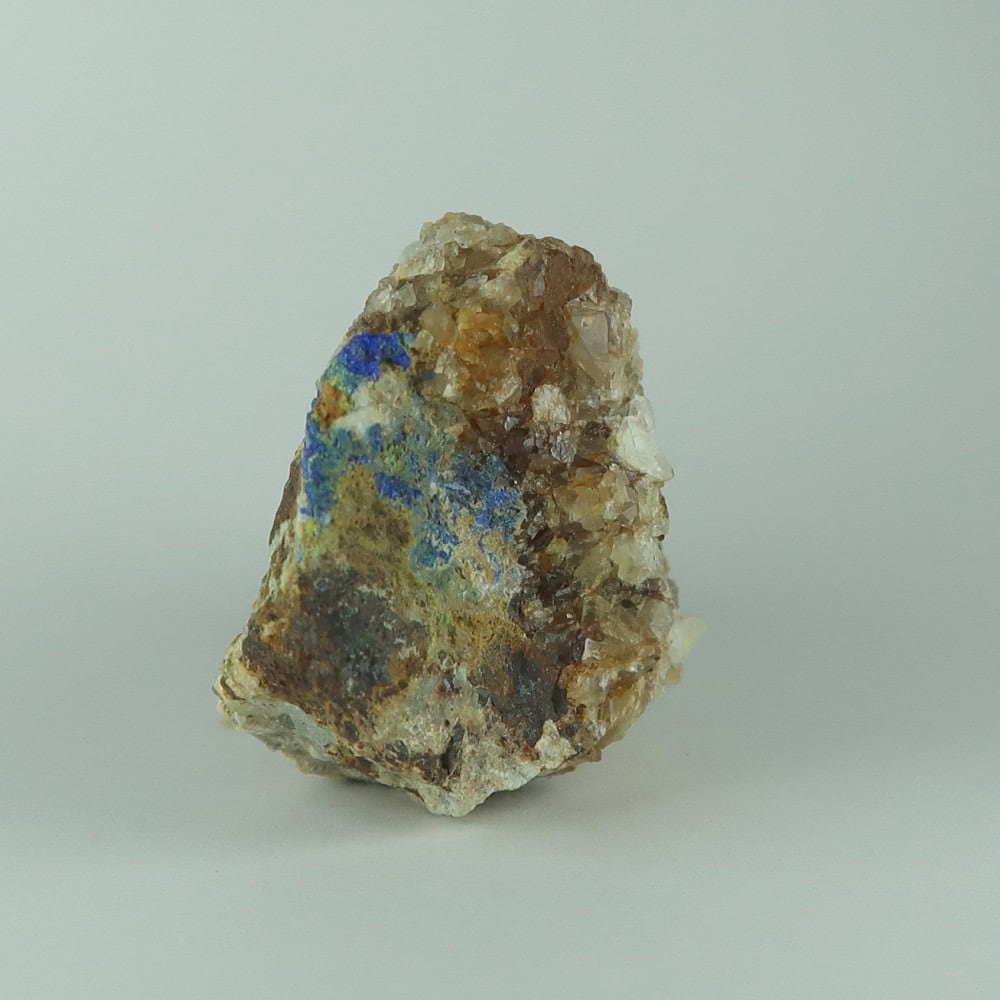
Foto: Albion Fire and Ice
Für den fortgeschrittenen Sammler ist der beste Red Gill-Linarit nicht bloß „blaues Mineral aus England“. Es ist ein klassisches britisches Supergene-Exemplar mit spezieller Optik: tiefblaue blattförmige Kristalle oder reiche kristalline Bereiche im Quarz-Blei-Sulfid-Matrix, oft mit genügend assoziierten Bleikupfer-Sekundärmineralien, um eindeutig in die Caldbeck Fells zu passen. Feine Kristalle sind selten; alte Etiketten und schlüssige Provenienz erhöhen die Begehrlichkeit erheblich.## Vorgestellte Exemplare
Nach Exemplare suchen: Alle Linarit-Exemplare aus der Red Gill Mine, England anzeigen
Red Gill Mine liegt bei Roughton Gill in den Caldbeck Fells, nördliches Lake District, Cumbria, England. Die Fundstelle ist im National Grid Reference NY295347 verzeichnet, Mindat listet Koordinaten von ca. 54°42'8" N, 3°5'38" W. Es handelt sich um eine verlassene Mine innerhalb der Roughton Gill-Gruppe von Minen.
Die Ablagerung gehört zum Bleiglanz-Kupfer-Spat-Venen-System der Caldbeck Fells. Die Red Gill-Venen schneiden Gesteine der ordovizischen Eycott Volcanic Group, insbesondere Andesite. Die abgebauten Erze bestanden überwiegend aus Galenit und Chalkopyrit. Die wichtigsten Sammlerexemplare stammen jedoch aus den oxidierten oberen Teilen des Venensystems, wo sauerstoffreiches Grundwasser auf Sulfide wirkte und eine reich variierte Supergene-Mineral-suite erzeugte. Der berühmte Linarit von Red Gill bildete sich in Hohlräumen innerhalb von Quarz-Sulfid-Gestein; die besten Exemplare sind nicht lose Krusten, die von ihrem Umfeld gelöst sind, sondern Teil eines kompakten Bleiglanz-Kupfer-Oxidations-Assemblage.
In Red Gill sind drei Venen bekannt. Die meisten Arbeiten folgten der Haupt- oder Südven, die grob von Nord-Nordwest nach Süd-Südost verliefen. Historische geologische Beschreibungen führten die Vene als bis zu etwa 1,2 m breit in einem 8 m tiefen Schacht in der Nähe der Verzweigung von Red Gill und Swinburn Gill, bestehend aus Quarzrippen und zerbrochenem Muttergestein in einer tonigen, Eisen- und Mangan-Färbungshalbmatrix. Eine weitere Ebene legte Material bis zu etwa 1,5 m Breite frei. Das sind kleine Minen nach industriellem Maßstab, doch ihre oxidierte Mineralogie war ungewöhnlich reich.
Der Bergbau dürfte sehr früh begonnen haben. Von Red Gill soll im Elizabethanischen Zeitalter abgearbeitet worden sein, und einige Schächte könnten älter sein. Dokumentarische Belege existieren aus dem achtzehnten Jahrhundert, aber die Arbeiten im neunzehnten Jahrhundert sind besser dokumentiert. Überlebende Produktionszahlen sind unvollständig: Aufzeichnungen vermerken 47 Tonnen veredeltes Kupfererz, das zwischen 1863 und 1869 gehoben wurde, und knapp unter 18 Tonnen Bleierz zwischen 1861 und 1866. Diese bescheidenen Tonnenangaben stehen in scharfer Gegenüberstellung zum Erbe der Exponenten der Mine.
Die unterirdischen Arbeiten sind heute im Allgemeinen nicht zugänglich. Bergbauforscher haben in der Vergangenheit Teile der Arbeiten betreten, aber Red Gill ist kein Sammelort, den man als offenes unterirdisches Gelände anfassen sollte. Das klassische Material stammte aus alten Arbeiten und Halden, insbesondere Material aus der Haupt- oder Südvene. Die Halden wurden von Generationen von Sammlern durchsucht, und moderne Berichte beschreiben sie als stark erschöpft bis praktisch wüst für guten Linarit, obwohl von Zeit zu Zeit kleine repräsentative Stücke und Mikromontagen aufgetaucht sind.Der Zugang ist kontrolliert. Red Gill liegt im Verteilungsgebiet Caldbeck and Uldale Commons, das von der Lake District National Park Authority verwaltet wird und mit daran beteiligten Grundbesitzern zusammenarbeitet. Mineralien sammeln in diesen Commons erfordert gemäß dem aktuellen Genehmigungssystem eine Erlaubnis, wobei Sammelzonen und Bedingungen von der Behörde festgelegt werden. Serious collectors should treat Red Gill as a protected historic and geological locality, not as an unrestricted dump site.
Notable finds from Red Gill extend beyond linarite. The mine is renowned for caledonite and leadhillite associated with linarite, and its mineral list includes anglesite, cerussite, malachite, pyromorphite, mattheddleite, macphersonite, queitite, native silver, and many other species. Redgillite, Cu6(SO4)(OH)10·H2O, is named for Red Gill because the mineral was first noted there, though the accepted type locality is nearby Silver Gill; Red Gill remains central to the mineral’s history and reputation.## Eigenschaften von Linarin aus Red Gill Mine, England
Red Gill-Linarin wird für seine gesättigte Azur- bis Tiefblau-Färbung geschätzt. In den besten Kristallen ist das Blau reich und glasig statt chalky, und es bildet einen starken Kontrast zu weißem Quarz, rostigen Eisenoxiden, grauen Sulfidresten und den türkisblau bis blaugrünen Tönen von Caledonit. Die begehrtesten Proben zeigen diskrete blättrige oder dicke tabulare Kristalle in geschützten Kavernen statt nur eine massige Blauverfärbung.
Der Fundort-Eintrag bei Mindat beschreibt Red Gill-Linarin als blättrige Kristalle bis zu 6 mm, zusammen mit Beschichtungen kleiner Kristalle auf Kupfersulfiden, von denen einige wahrscheinlich nach der Förderung entstanden sind. In der weiterführenden Literatur werden deutlich größere klassische Kristalle aus dem Bergwerk beschrieben: Cooper und Stanley beschrieben und illustrierten dicke tiefblaue Kristalle bis zu 25 mm Länge, und spätere Zusammenfassungen betonen, dass Red Gills Linarin des neunzehnten Jahrhunderts zu den feinsten bekannten Beispielen gehörte, als sie gesammelt wurden.
Der Kristallhabit ist typisch für Linarin, aber ungewöhnlich attraktiv bei den besten Red-Gill-Stücken: verlängerte Blätter, tabulare Kristalle, Sprays, kristalline Krusten und Kaverneninnenräume. Einige Proben zeigen eine breite dunkelblaue Kristallabdeckung über Quarz- oder Blei-Galena-Trümmern; andere sind Mikromount-Kavernen mit isolierten, hochglänzenden Kristallen. Ästhetische Red Gill-Proben sind oft miniatur- bis thumbnailgroß, aber die visuelle Wirkung hängt von der Intensität des Blaus und der Kristallklarheit ab, nicht allein von der Länge der Aufbewahrung/Kabinettgröße.
Häufige und bedeutende Begleiter sind Caledonit, Anglesit, Cerussit, Leadhillit, Bindheimilit, Quarz, Malachit, Kalkit und kupferhaltige Silikate ähnliches Material von Chrysokolla. Caledonit ist besonders wichtig visuell und genetisch: Red-Gill-Stücke mit türkisblauem Caledonit-Kristallen und dunklerem Linarin sind klassische Caldbeck-Assoziationen. LeadHillit und Cerussit deuten auf die bleihaltige Seite der Oxidationsfolge hin, während Malachit und andere kupferhaltige Sekundärmineralien die Verwitterung von Chalkopyrit und verwandten Kupfermineralien widerspiegeln.
Matrix ist ein Qualitätsfaktor. Die überzeugendsten Red-Gill-Linarine liegen auf Quarz-Sulfid-Gestein mit Eisenfleckung, verbleibendem Galenit oder Chalkopyrit oder assoziierten Blei-Kupfer-Sekundärmineralien. Massive blaue Flächen auf verwitterter Matrix mögen attraktiv sein, aber scharfe Kristalle in Kavernen sind sammlerfreundlicher. Dunkle sulfidhaltige Stücke und mit Quarz ausgekleidete Kavernen sind besonders begehrt, weil sie den geologischen Kontext des Linarins bewahren.
Der Zustand ist von großer Bedeutung. Linarin besitzt eine perfekte Spaltbarkeit und eine geringe Härte, daher lassen sich blättrige Kristalle durch unsachgemäße Handhabung leicht drücken, einknicken, lösen oder stumpf werden. Gute Red-Gill-Beispiele sollten unter Vergrößerung auf gebrochene Kristallspitzen, abgeriebene Kavernenränder, lose pudrige Beläge und Hinweise untersucht werden, dass das blaue Material lediglich eine Verschmierung statt kristallines Linarin ist. Eine kleine, scharfe, unbeschädigte Kristallgruppe ist vorzuziehen gegenüber einer größeren, aber gequetschten Beschichtung.## Collector Notes
Das Hauptechtheitsthema bei Red Gill-Linarin ist die Provenienz. Neunzehntes und frühen zwanzigsten Jahrhunderts erhaltene Etiketten können „Cumberland“, „Roughton Gill“, „Roughten Gill“ oder „Caldbeck Fells“ statt Red Gill Mine sagen. Moderne Lokalisationsforschung deutet darauf hin, dass viele frühe klassische Linarite, die grob Cumberland oder Roughton Gill zugeordnet sind, wahrscheinlich am Red Gill entstanden. Dies ist eine gute Nachricht für Sammler, wenn das Exemplar dem Red Gill-Habitus und der associated matrix entspricht, bedeutet aber auch, dass Etiketten historisch mit Vorsicht interpretiert werden sollten statt mit wörtlicher Gewissheit.
Es gibt auch eine weitergehende Caldbeck-Vorsicht in Bezug auf A.W.G. Kingsbury. Eine umfangreiche Überprüfung des Kingsbury-Materials zeigte gefälschte Fundorte zahlreicher seltener britischer Mineralienansprüche, insbesondere im Lake District und bei Caldbeck Fells. Red Gill selbst wurde nicht abschließend als Gegenstand einer solchen Täuschung nachgewiesen, aber nicht bestätigte Seltenheitsansprüche in Verbindung mit Kingsbury sollten vorsichtig behandelt werden. Für Linarit ist das Problem eher weniger „gefälschter Linarit“ als ungenaue oder vererbte Fundortzuordnung.
In den konsultierten Quellen für diesen Leitfaden ist keine spezifische Red-Gill-Linarit-Behandlungstradition dokumentiert. Die üblichen Risiken sind natürliche Kondition, Fehlidentifikation assoziierter blau-grüner Mineralien und postbergbaubedingte Bildung einiger kleiner Sulfat-Beschichtungen. Linarit kann visuell mit Azurit, Langit, Caledonit und anderen blauen Kupfer- oder Blei-Kupfer-Sekundärmineralien in schlechten Fotos verwechselt werden. Bei seriösen Exemplaren sind ein seriöses altes Etikett, die Assoziation mit bekannten Red-Gill-Matrixmineralien und eine analytische Bestätigung für mehrdeutige Mikromäntel wertvoll.
Da Linarit Blei enthält, sollten Exponate mit der üblichen Blei-Mineralpflege behandelt werden: Staubinhalation vermeiden, Display-Stücke nicht lecken oder säuretesten, Hände nach dem Umgang waschen und Bruchstücke außer Reichweite von Kindern und Nahrungsmitteln halten. Die Reinigung sollte konservativ erfolgen. Wasser, Säuren und aggressive mechanische Reinigung können empfindliche zugehörige Sulfate beschädigen oder fragile Kristalle in Kavernen lockern.
Das Angebot am Markt ist uneinheitlich. Kleine Red-Gill-Stücke erscheinen weiterhin bei britischen Händlern und in alten Sammlungen, manchmal als bescheiden kleine Vitrinenstücke mit hellblauen Kristallen oder massives Linarit auf eisenverfärbtem Quarz. Verkaufte Händlerbeispiele zeigen ebenfalls die klassische Assoziation mit Caledonit in stichkartengroßen Stücken. Stärkere historische Exemplare, insbesondere solche mit alten Etiketten oder reichen Kavernen von „Elektro-Blau“-Kristallen, sind deutlich seltener und können in eine andere Preisklasse fallen. Breitere „Caldbeck Fells“- oder „Roughton Gill“-Linarite können attraktiv sein, aber Spezialisten achten stärker darauf, ob das Exemplar plausibel zur klassischen Red-Gill-Sammlung gehört.## Geschichten & Feldnotizen
Die alte Red Gill-Geschichte ist eine Geschichte kleiner Grubenarbeiten und großer mineralogischer Berühmtheit. Industriell war die mine nie ein Gigant. Ihre dokumentierte Produktion im neunzehnten Jahrhundert — 47 Tonnen aufbereiteter Kupfererz in den 1860er Jahren und etwas weniger als 18 Tonnen Bleierz über einen ähnlichen Zeitraum — würde neben einer großen Metallmine kaum ins Gewicht fallen. Dennoch produzierten die oxidierten Hohlräume in ihrem Quarz-Sulfid-Gestein Linarit-Kristalle, an die sich Sammler und Museumskuratorinnen lange nach den Erzfiguren als Fußnoten erinnerten.
Einer der eindrucksvollsten Felddetails stammt von der No. 2- oder „Old Dutch“-Ebene. Eine Aufnahme von 1979 zeigte die Ebene und ihr Gangsystem als Teil einer späteren mineralogischen Überprüfung, ein Schnappschuss von Red Gill nach seinem produktiven Leben, aber bevor die letzten Reste des alten Mineralbodens durch weitere Sammlungen erschöpft wurden. Die gleiche Überprüfung illustriert ein Exemplar, das Peter Briscoe 1983 von den Abraumhalden der No. 2 Level sammelte: tabellarische smaragdgrüne Brochantit-Kristalle bis zu 0,3 mm Länge, die neben einem großen Linarit-Kristall lagen. Das ist Red Gill im Miniaturformat — winzige kupferhaltige Sulfate, eine historische Abraumhalde und das tiefblaue Mineral, das die Mine berühmt gemacht hat.
Die Etiketten erzählen ihre eigene Geschichte. Einige große alte Linarite wurden mit „Roughton Gill“ bezeichnet, weil dieser Name in der Sammlerwelt Gewicht hatte, aber spätere Studien haben argumentiert, dass viele der frühen klassischen Cumberland- und Roughton Gill-Linarite wahrscheinlich aus Red Gill stammten. In praktischen Sammelbegriffe bedeutet dies, dass eine neunzehnteljährige „Roughton Gill“-Linarite mit dem richtigen Habit, Matrix und Verbindung tatsächlich ein Überrest von Red Gill sein könnte, der unter einem älteren Bezirksnamen wandert. Das Probenetikett mag in einem engen Sinn falsch sein, doch historisch gesehen sagt es etwas über die Sammelkultur aus, die es produziert hat.
Händlerunterlagen bewahren eine zweite Art von Feldnotiz: das Weiterleben des Red Gill-Materials in Schränken. Ein klassischer Caldbeck-Linarit, der 2010 verkauft wurde, wurde als Miniatur mit einem 1,8 cm Vug beschrieben, der von funkelnden „elektrisch-blauen“ Kristallen bis zu 4 mm ausgekleidet war, mit einem A. E. Foote-Etikett aus etwa 1884–1890, von dem angenommen wird, dass er wahrscheinlich in den 1840er–1870er abgebaut wurde. Obwohl sein Etikett die breiteren Caldbeck Fells statt speziell Red Gill Mine angab, erfasst es die Periode und den Stil des alten Materials, dem Sammler noch immer nachjagen: eine kompakte, schwere Quarz-Sulfid-Matrix, blaue Kristalle in einer geschützten Kavität und die dokumentarische Romanze eines frühen amerikanischen Händlertickets, das am Boden angeklebt ist.## Mineralogische Aufzeichnungen & Veröffentlichungen- Red Gill Mine, Roughton Gill, Caldbeck, Cumbria — Mindat-Lokalitätsseite — Kernlokalitätsdatensatz mit Koordinaten, Mineralienliste, Referenzen und Hinweise auf den wahrscheinlichen Ursprung von Red Gill bei vielen frühen “Cumberland”- und “Roughton Gill”-Linariten.
Linarite aus Red Gill Mine — Mindat-Fall — Artenspezifischer Red Gill-Linarit-Eintrag, einschließlich Habitus, Farbe, begleitende Mineralien und Bibliographie.
Red Gill Mine, Cumbria — GeoGuide / Geological Conservation Review — Geologischer und historischer Überblick über die Mine, einschließlich Adernbeschreibungen, Produktionszahlen, Zugangsstatus und die Bedeutung von Red Gill-Linarit.
Bridges, T.F., Green, D.I., Rumsey, M.S. & Leppington, C.M. (2008). “A review of the mineralisation at Red Gill Mine, Caldbeck Fells, Cumbria, England.” Journal of the Russell Society, 11, 29–47. — Die maßgebliche moderne Übersicht zur Mineralisation von Red Gill, mit Feldfotos, Exemplarfotos und Neubewertung der Mineralzusammensetzung der Lokalität.
Greg, R.P. & Lettsom, W.G. (1858). Manual of the Mineralogy of Great Britain and Ireland. John Van Voorst, London. — Früher britischer mineralogischer Referenztext, zitiert für Red Gill/Cumberland-Linarit.
Hessenberg, F. (1864). “Linarit (Bleilasur) aus Cumberland.” Abhandlungen der Senckenbergische Naturforschende Gesellschaft, 7, 304–308. — Historische kristallografische/mineralogische Behandlung von Cumberland-Linarit, aufgeführt in der Bibliographie zum Red Gill-Linarit.
Koksharov, N.I. (1869). “Ueber Linaritkristalle” und “Notiz über Linaritkristalle.” — Kristallografische Referenzen aus dem 19. Jahrhundert, verbunden mit der klassischen Cumberland/Red Gill-Linarit-Literatur.
Cesàro, G. (1905). “Formes nouvelles dans la Linarite et dans la Mélinose.” Bulletin de l’Académie Royale des Sciences, des Lettres et des Beaux-Arts de Belgique, 328–333. — Spätere kristallographische Arbeiten, zitiert in der Bibliographie zum Red Gill-Linarit.
Cooper, M.P. & Stanley, C.J. (1990). Minerals of the English Lake District: Caldbeck Fells. Natural History Museum, London. — Standardmodernes Buchwerk zur Mineralogie der Caldbeck Fells, einschließlich Red Gill-Linarit, Caledonite, Leadhillite und dem breiteren supergenen Spektrum.
Stanley, C.J. & Cooper, M.P. (1991). “Famous Mineral Localities: Pyromorphite-Group Minerals from the Caldbeck Fells, Cumbria, England.” The Mineralogical Record, 22(2), 105–121. — Wichtiger lokalitybezogener Kontextpapier für die Supergene-Blei-Mineralisation der Caldbeck Fells.
Pluth, J.J., Steele, I.M., Kampf, A.R. & Green, D.I. (2005). „Redgillite, Cu6(OH)10(SO4)·H2O, ein neues Mineral aus Caldbeck Fells, Cumbria, England: Beschreibung und Kristallstruktur.“ Mineralogical Magazine, 69(6), 973–980. — Beschreibung von Redgillite, benannt nach Red Gill; nützlich zum Verständnis der breiteren kupfer-sulfat-Mineralogie der Mine.
Redgillite — Mindat-Mineralseite — Klärt, dass Redgillite nach Red Gill benannt wurde, während der akzeptierte Typ-Ort Silver Gill ist, und verweist auf das Typmaterial des Manchester Museums.## Further Reading & External Links
Lake District National Park Authority — Caldbeck minerals — Current collecting-policy source for Caldbeck and Uldale Commons, including permit guidance and zone-based collecting controls.
Natural England — Managing geological specimen collecting: Caldbeck Fells case study — Conservation background for the Caldbeck Fells specimen-collecting scheme.
Lake District Minerals — Mineral locations — Collector-oriented notes on Lake District minerals, including Red Gill linarite, caledonite, and leadhillite.
Albion Fire and Ice — Red Gill Mine locality page — Dealer locality summary showing current-style Red Gill material and market availability for small specimens.
Albion Fire and Ice — Linarite from Red Gill Mine product page — Example of a modern small-cabinet Red Gill linarite with photographs and dimensions.
Steetley Minerals — Caledonite & Linarite from Red Gill Mine — Sold thumbnail example showing the classic caledonite-linarite association.
Mineral Auctions — Caldbeck Fells linarite old-timer — Archived sale record for a classic old-labelled Caldbeck linarite, useful for comparison with nineteenth-century material.
Crystal Classics — Roughton Gill linarite specimen — Market example illustrating the broader Roughton Gill/Red Gill provenance question for classic Caldbeck linarite.
RRUFF Handbook of Mineralogy — Linarite PDF — Compact mineral data sheet for linarite, including formula, properties, and notable localities.