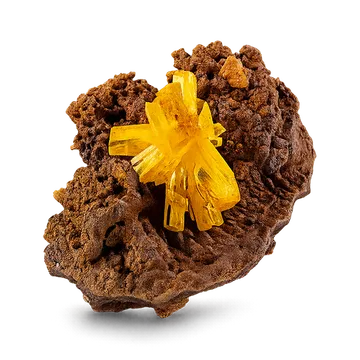
Legrandite from Flor de Peña Mine, Mexico — type locality; golden-yellow prismatic crystals, rosettes in oxidized zinc ore, prized for pedigree.
Key facts
Flor de Peña is one of those localities whose fame rests on a very small quantity of mineral, but on a very large idea: it is the type locality for legrandite, Zn2(AsO4)(OH)·H2O. Long before the spectacular Ojuela Mine specimens made legrandite a Mexican classic, the species was recognized from a small amount of bright yellow, transparent material on massive sphalerite from Flor de Peña, near Lampazos de Naranjo in Nuevo León.
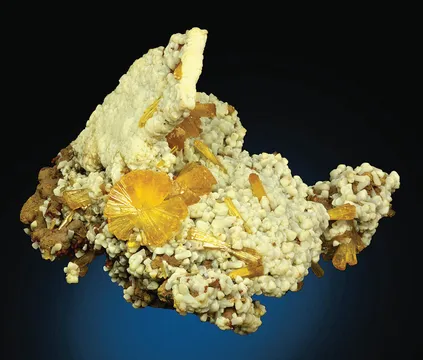
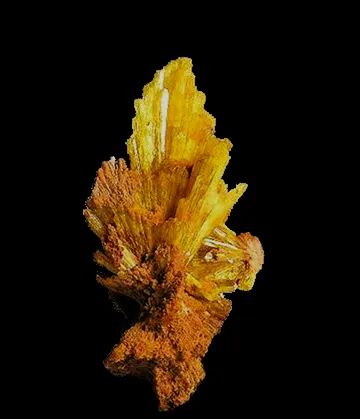
The best Flor de Peña legrandites have a personality distinct from the more familiar Ojuela material. They tend to be valued less for sheer abundance and more for pedigree, color, matrix, and historic presence: golden-yellow to canary-yellow prismatic crystals, rosettes, sheaves, and radial sprays set in oxidized zinc ore, limonitic gossan, and, in better specimens, pale to gray botryoidal smithsonite. The crystals may be only a few millimeters long on many pieces, but notable examples show sharply defined sprays around 1 cm, and a small number of exceptional specimens carry substantially larger crystals.

Photo: Mineral Auctions / The Arkenstone
The locality is mineralogically important because it captures the conditions legrandite needs: zinc, arsenic, water, and oxygen acting in the oxidized zone of a sulfide deposit. Primary sphalerite supplied zinc; arsenic-rich, oxidizing fluids helped produce the secondary arsenates; and the weathered gossan environment provided cavities in which delicate yellow crystals could form. At the type locality, the historically associated minerals include sphalerite, pyrite, siderite, smithsonite, galena, goethite, hematite, mimetite, adamite, aurichalcite, baryte, calcite, and carminite.
Collectors look first for the locality. A Flor de Peña label is not merely a geographic note; it is the species’ origin story. The best pieces combine saturated yellow color, vitreous luster, clean terminations, dimensional radial sprays or rosettes, and visible contrast against dark limonitic matrix or pale smithsonite. Because Flor de Peña specimens are far scarcer on the market than Ojuela legrandites, even modest but well-documented examples can be important additions to a Mexican suite or type-locality collection.
Search for specimens: View all legrandite specimens from Flor de Peña Mine, Mexico
Flor de Peña Mine is in the Lampazos de Naranjo area of Nuevo León, northern Mexico. Its standing among collectors is out of proportion to the size of the mine itself: the locality is obscure in mining history, but central in legrandite history. The mine is listed as the type locality for legrandite, and the species’ original description ties the mineral to massive sphalerite from Flor de Peña carrying a small amount of bright yellow, transparent material that could not be matched to any known mineral.
The deposit is an arsenic-bearing zinc occurrence with legrandite forming in the oxidized zone. The primary ore assemblage included zinc sulfide, and the classic type-locality association given for legrandite is pyrite, siderite, and sphalerite. Later specimen material shows the supergene character more visibly: yellow legrandite on limonitic or gossanous matrix, commonly with smithsonite coatings or botryoids, and locally with other secondary zinc and lead arsenate species.
Mining appears to have been intermittent and modest. Compañia Minera Flor de Peña operated the property from the late nineteenth century into the early twentieth century, but published records are sparse, and the mine was never a major producing locality in the way Ojuela was. Its ore had a reputation for being difficult because it was rich in arsenic, a fact that matters both historically and mineralogically: the same arsenic that made the ore unattractive for mining helped make the locality important to mineral collectors.
Collecting history is better known through specimens than through formal mine records. Some material was recovered before the famous Ojuela production of the 1960s and 1970s reshaped the legrandite market. Additional collecting occurred in the 1960s and 1970s, and Dr. Miguel Romero’s early-1980s visit to the main dump produced a noteworthy group of specimens. His best reported piece measured about 20 cm and was covered with sprays of stout yellow crystals to 3.5 cm on a smithsonite-coated matrix, a size and richness that place it among the standout Flor de Peña legrandites.
Access should not be assumed. Flor de Peña is a mine locality, not a casual collecting site, and any visit would require permission from land and mineral-rights holders as well as a realistic understanding of underground and dump hazards. For most collectors, Flor de Peña legrandite is a specimen-market locality: one buys the label, the provenance, and the surviving crystal quality rather than planning to collect new material.
Flor de Peña legrandite is typically golden yellow to canary yellow, with vitreous to somewhat resinous luster and transparent to translucent crystal tips when fresh. The type material was described as mostly massive radiating-prismatic material with rare freely developed crystals, and that description still fits much of the locality’s visual identity: sprays, sheaves, rosettes, and radiating aggregates dominate over isolated long single crystals.
On better matrix pieces, the crystals form compact radial clusters, divergent sprays, or small rosettes scattered across dark brown gossan. Some specimens show legrandite on botryoidal smithsonite, where the yellow crystals stand out against cream, gray, or yellowish-white rounded surfaces. Other examples show crystals in protected vugs, a favorable setting because legrandite is brittle and its exposed terminations are easily chipped.
Typical collector pieces are thumbnails to miniatures, often with crystals only a few millimeters to about 1 cm. Published and dealer-documented examples include a 3.3 x 3.1 x 1.3 cm miniature with gemmy sprays to 1.1 cm; a 5.3 x 5.0 x 4.3 cm small-cabinet specimen with a 1.5 cm radial cluster; and several Fabre Minerals reference specimens with main crystals or aggregates in the 0.5–1.5 cm range. The celebrated Romero specimen with sprays to 3.5 cm shows that larger Flor de Peña crystals exist, but they are exceptional.
The most characteristic associated matrix minerals for the locality’s collectible legrandites are smithsonite and limonitic gossan. Mindat’s locality list also records adamite, aurichalcite, baryte, calcite, carminite, galena, goethite, hematite, mimetite, pyrite, siderite, sphalerite, and smithsonite among the valid species reported from Flor de Peña. Paradamite has appeared as an erroneous literature entry for the locality; at least one such record has been rejected because the specimen and matrix more closely resembled Ojuela material.
Quality is judged differently here than with Ojuela legrandite. Ojuela sets the standard for abundant, large, spectacular sprays; Flor de Peña sets the standard for type-locality significance. The best Flor de Peña pieces have strong yellow saturation, crisp prism faces, bright luster, intact terminations, multiple visible clusters, and convincing matrix character. A small, undamaged, well-documented type-locality example can outrank a larger but poorly attributed specimen.
The main authenticity issue is mislocality, not treatment. Ojuela legrandite is far more common and far better known, so Flor de Peña pieces should be evaluated carefully for label history, matrix style, and provenance. Strong provenance to old Mexican collections, to recognized dealers, to published specimens, or to named collections such as Evan Jones, Wouter van Tichelen, Dr. Miguel Romero, or well-documented Fabre and Arkenstone material adds real confidence.
Collectors should be cautious with any specimen attributed to Flor de Peña but showing a matrix and habit more typical of Ojuela. A documented example of this problem exists in the locality record: paradamite once reported from Flor de Peña was rejected because the specimen and matrix were considered to resemble Ojuela material rather than Flor de Peña. That same caution applies to legrandite. A label alone is not proof when the species is much more abundant from another Mexican locality.
Condition is critical. Legrandite is brittle, has imperfect to fair cleavage, and often grows as exposed sprays or delicate rosettes. Common issues include bruised crystal tips, cleaved prisms, detached sprays, glue repairs, and edge chipping visible only under magnification. Vug-protected crystals are especially desirable because the matrix itself shields the legrandite from contact damage.
No well-established treatment tradition is associated with Flor de Peña legrandite. The color is natural, and the species is not normally enhanced in the way some gem materials are. Cleaning, however, can matter: aggressive chemical or mechanical cleaning could dull luster, loosen crystals from porous gossan, or damage smithsonite matrix. Arsenate minerals should also be handled with normal mineral-collector hygiene: avoid inhaling dust, do not lick or soak specimens casually, and wash hands after handling.
Rarity is high for attractive matrix specimens. Flor de Peña material appears only occasionally compared with Ojuela legrandite, and fine examples are often described by dealers as rare or exceptional for the locality. Market examples show a wide range: small, lightly chipped pieces may trade modestly, while rich, aesthetic, well-provenanced type-locality specimens with multiple sprays, smithsonite association, or publication history command a premium far beyond their size.
The story begins with a widow, a box of old specimens, and a small flash of yellow on massive sphalerite. Julien Drugman had obtained mineral specimens from the widow of a Belgian mine manager named Legrand. Among them was a piece from the Flor de Peña mine at Lampazos, Nuevo León: massive blende carrying a bright yellow transparent substance that neither Drugman nor Max H. Hey could match to a known mineral. Goniometric and optical work showed monoclinic symmetry; chemical analysis showed a basic zinc arsenate. In 1932 they named the species legrandite.
The mine itself was already part of the story because Legrand had described it in memorable terms: a “mine with complex zinc and lead minerals, unfortunately very rich in arsenic, which renders it unworkable.” It is a wonderfully collector-minded irony. The arsenic that helped doom the ore made the mineral famous. Flor de Peña was not a great mine in the industrial sense, but it had the exact chemical misfortune needed to produce one of the most coveted yellow arsenates.
For decades, even the identity of “Mr. Legrand” remained a puzzle. Drugman and Hey honored him, but did not give his first name. Collectors and researchers chased several possible Legrands: mining engineers in Belgium, men connected with Arizona and Mexico, and even candidates whose dates did not fit the clue that Drugman had obtained specimens from a widow before the 1932 paper. The mystery had all the pleasures of a mineralogical detective story—old labels, institutional holdings, personal correspondence, and the question of whether the man behind the name had been hiding in plain sight.
The solution came through work later summarized in the literature: the collector was Louis Charles Antoine Legrand, born in Liège in 1861 and deceased in 1920. He was a well-traveled Belgian mining engineer and mineral collector who visited Mexico during the early twentieth century. A portion of the type material in Brussels, acquired with Drugman’s collection, was shown to relate to the holotype material in London, and an old label in Legrand’s handwriting tied the specimen back to Flor de Peña. A species that had begun as a nameless yellow film on sphalerite regained the hand of the man who had recognized and saved it.
The collecting history after the type discovery is fragmentary, but a few moments stand out. Some Flor de Peña material was collected in the 1960s and 1970s, before Dr. Miguel Romero’s early-1980s expedition to the main dump produced numerous specimens. The best reported Romero piece was not a mere thumbnail curiosity: it was a 20 cm specimen carrying sprays of stout yellow legrandite crystals to 3.5 cm on smithsonite-coated matrix. For a locality often represented by small crystals and rare market appearances, that specimen is the sort of object that changes how collectors imagine the mine.
Modern dealer records preserve other flashes of the locality’s quality. A specimen documented around 1963 from the Evan Jones collection carried a sharply defined 2.1 x 1 cm legrandite crystal on limonite matrix, with a smaller transparent side crystal and old labels. Another small-cabinet specimen formerly in the Wouter van Tichelen collection displayed a 1.5 cm radial divergent cluster made of at least two dozen gemmy, lustrous, yellow prisms inside a protective vug. Such pieces explain why Flor de Peña remains desirable even in the shadow of Ojuela: they are not merely type-locality tokens, but beautiful minerals in their own right.