Legrandite Collectors Guide
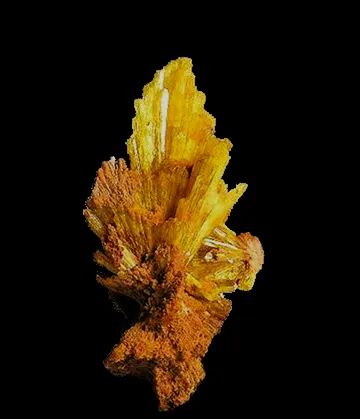
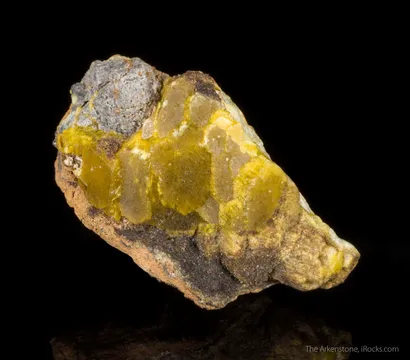
Legrandite is a rare zinc arsenate renowned for its luminous lemon- to canary-yellow color and elegant, radiating crystal sprays. The best crystals are strikingly bright and transparent to translucent, forming fine prismatic to acicular needles with glassy luster. While it occurs at several localities, it is overwhelmingly associated with Mexico, where a few legendary finds produced the world’s finest specimens. Aesthetic contrasts against dark limonitic matrix or with associated zinc minerals (smithsonite, adamite) make legrandite a cornerstone of arsenate suites and Mexican classic collections.
Crystals range from delicate clusters only a few millimeters long to showy sprays measuring several centimeters across; exceptional Ojuela Mine groups exceed 10 cm and are among the most coveted yellow secondary minerals in the hobby. Because legrandite is scarce and fragile, truly fine, undamaged clusters are rare and command strong prices. The species is also historically important: it was first described from the Flor de Peña Mine in Nuevo León, Mexico, cementing Mexico’s preeminence for the species.
Legrandite sits high on many collectors’ wish lists for three reasons:
- Color: its saturated, vibrant yellow is unmatched among arsenates.
- Form: radiating sprays and isolated prisms with razor-sharp terminations create dramatic geometry.
- Provenance: classic Mexican localities—especially Ojuela—are pillars of the mineral’s lore.
Availability is limited. Ojuela Mine produced several significant waves of material during the late 20th and early 21st centuries; even then, most pieces were small and/or fragile. Today, competition for top-quality, unrepaired sprays is intense. Miniatures and thumbnails with strong color and minimal damage trade briskly; cabinet-sized, pristine clusters on attractive matrix can reach top-tier prices. The species’ combination of rarity, fragility, and unmistakable aesthetics ensures enduring demand.
The Ojuela Mine (Mapimí, Durango) is unequivocally the world’s premier source of legrandite. Multiple production pulses yielded dazzling sprays and divergent bouquets of lemon-yellow prisms, commonly perched on brown to black limonitic goethite and often accompanied by adamite, smithsonite, calcite, or hemimorphite. Outstanding examples show:
- Large, radiating sprays with individual crystals to several centimeters, sometimes exceeding 8–10 cm.
- High transparency and saturated color that “glows” under strong lighting.
- Superb luster and sharp wedge-like terminations.
Most crystals formed in oxidized cavities; many were contacted or broken in situ, so intact, unrepaired matrix clusters are scarce. Ojuela sets the standard for size, brightness, and sculptural aesthetics in legrandite, and the finest pieces rank among the most iconic secondary mineral specimens of Mexico.
The type locality for legrandite, the Flor de Peña Mine (Lampazos de Naranjo, Nuevo León), produced historically significant crystals and small clusters. Though generally smaller and less abundant than Ojuela material, Flor de Peña specimens are valued for:
- Historic importance as the source of the species’ original description.
- Bright canary-yellow color and sharply formed, slender prisms or sheaves.
- Matrix associations in oxidized zinc-bearing ore, often with limonitic material or calcite.
Because quality pieces are limited and many ended up in early institutional or private holdings, any well-documented type-locality legrandite—especially with attractive aesthetics—commands a premium.
- Color and Transparency:
- Seek saturated, luminous lemon- to canary-yellow hues—bright, evenly colored crystals are most desirable.
- Transparency in individual prisms increases visual “sparkle,” especially toward the tips. Cloudy cores are acceptable if the terminations are bright and clean.
- Crystal Size and Form:
- Ojuela sets the benchmark for large sprays and long prisms. Individual crystals several centimeters long are exceptional.
- Look for well-terminated, slender prisms with a coherent radiating geometry. Balanced bouquets or divergent sprays that “fan” out attractively are preferred.
- Isolated crystals or discreet sprays on clean, contrasting matrix (dark limonite, white calcite) increase impact.
- Luster:
- A fresh, vitreous sheen elevates a piece. Dull or etched surfaces detract unless compensated by rarity or size.
- Condition:
- Legrandite is brittle. Minute tip nicks or micro-bruises are common and lower value on otherwise equivalent pieces.
- Inspect carefully with a loupe for crushed terminations, scuffs along edges, or shed micro-needles in the display zone.
- For matrix pieces, check that the primary spray is fully intact and not leaning or under stress.
- Aesthetics and Composition:
- Strong contrast with matrix and pleasing composition are key. Specimens where the main spray is framed and not crowded by other minerals tend to display best.
- Associations (e.g., with adamite or smithsonite) can add context and visual interest, but should not obscure the legrandite.
- Provenance:
- Labels from notable finds at Ojuela, and type-locality documentation for Flor de Peña, enhance desirability and value.
- Repairs and Stabilization:
- Reattachments are common; look for ultra-straight join lines, slight misalignments in striations, or a glossy “meniscus” of epoxy at breaks or at the spray’s base.
- Many large sprays are discreetly stabilized (consolidated) to prevent crystal shedding. Honest disclosure is expected; expertly done stabilization is often acceptable on significant pieces.
- Matrix Assemblies:
- Beware of mismatched matrix or “created” composites where a spray was set onto an unrelated host. Check contacts, glue halos, and whether associated minerals make paragenetic sense.
- Polishing/Coatings:
- Termination polishing is uncommon and generally discouraged; a perfectly mirror-flat tip may be suspect.
- Artificial coatings are rare but would produce an unnatural, plastic-like shine—compare overall luster under angled light.
In general, buy from trusted sources and use a loupe and (optionally) longwave UV to probe for modern adhesives.
Legrandite is a fragile, hydrated zinc arsenate and contains arsenic—handle with care.
- Handling:
- Support the matrix; avoid touching sprays or tips directly. Use two hands for larger pieces.
- Consider a fitted stand or a small dot of museum putty on the base (not on crystals) to prevent shifting.
- Cleaning:
- Prefer gentle air bulb or very soft brush dusting. Avoid water soaks, ultrasonic cleaners, steam, and harsh chemicals—these can loosen consolidants, undermine friable matrix, or etch associated calcite.
- If absolutely necessary, use a barely damp, lint-free swab to lift dust from matrix areas only. Keep liquids away from the crystals themselves.
- Light and Temperature:
- Colors are generally stable, but avoid prolonged direct sunlight and high-heat environments. Thermal shock or overheating may induce cracking or dehydration.
- LED case lighting is ideal; avoid hot halogen beams pointed at sprays for extended periods.
- Environment:
- Normal household humidity is fine, but minimize extreme dryness or dampness. Keep away from vibrations and drafts that could jostle needles.
- Storage and Display:
- Display in a closed cabinet to limit dust and accidental contact. For transport, immobilize specimens in foam-lined containers with rigid barriers so nothing touches the crystals.
- Clearly label the species as an arsenate; wash hands after handling, do not allow children to handle, and avoid producing airborne dust during any preparation.
Following these guidelines will preserve the vivid color and delicate architecture that make legrandite one of the most admired secondary species in mineral collecting.