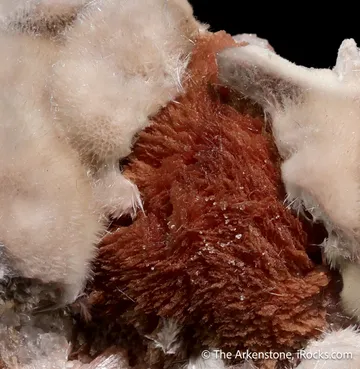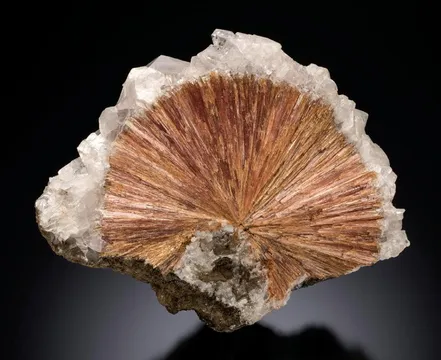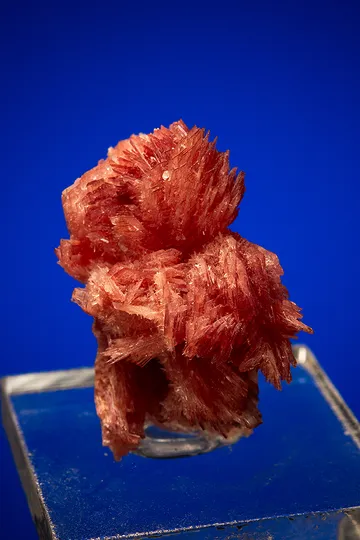
Inesite: salmon-pink radiating crystals on white host, prized for color, luster, and sculptural form; notable localities include Kalahari, Broken Hill, Långban.
Key facts
Inesite is a hydrous calcium-manganese silicate prized for its delicate salmon to rose-pink color and elegant crystal habits. It typically forms as radiating sprays, hemispherical clusters, and parallel to bladed prisms; on top material the individual crystals can be surprisingly stout, lustrous, and up to several centimeters long. Aesthetic contrast is a hallmark: vivid pink inesite often sits on stark white calcite or snowy quartz, or against jet-black manganese oxides like hausmannite—compositions that “read” beautifully in a display case. Associations commonly include rhodochrosite, rhodonite, bustamite, manganite, hausmannite, gaudefroyite, and calcite, reflecting inesite’s affinity for low- to moderate-temperature manganese-rich hydrothermal and skarn environments.
Visually, the best inesites are all about color, luster, and form. The finest Kalahari Manganese Field pieces show saturated peach-rose hues and sharply terminated, glassy crystals in radiating bouquets. Classic Broken Hill and Långban specimens add historical depth for provenance-focused collections. While many thumbnails and miniatures remain affordable, exceptional cabinet display pieces from the Kalahari mines can command strong prices due to scarcity of undamaged clusters and the difficulty of extraction.
Inesite enjoys a devoted following among collectors of manganese minerals and those who appreciate delicate, sculptural sprays in soft pink tones. The Kalahari Manganese Field (South Africa) brought inesite to the fore beginning in the late 20th century, when pockets at Wessels and N’Chwaning produced dramatic radiating clusters and prismatic fans that redefined the species’ potential. These discoveries raised market awareness; even today, the top Kalahari pieces are considered reference specimens.
Beyond the Kalahari, historic localities like Broken Hill (Australia) and Långban (Sweden) add pedigree—specimens from these districts are not always as showy, but they carry historical significance and are sought for locality suites. Overall, inesite balances attainability (many good small pieces exist) with the thrill of the spectacular (truly great matrix clusters are uncommon and quickly placed into advanced collections).
While inesite has been reported from multiple manganese-rich districts worldwide, a handful of mines are renowned for producing the best and most distinctive specimens. Below are several benchmark sources with verifiable IDs.
Wessels Mine (Hotazel, Kalahari Manganese Field) is a premier inesite locality, famous for saturated salmon-pink sprays and robust bladed prisms in radiating “firework” clusters. The best pieces show high luster and sharp terminations, with crystals commonly perched on or penetrating white calcite or quartz, or contrasting dramatically with black hausmannite or gaudefroyite. Some pockets yielded intertwined bouquets of inesite with rhodochrosite or calcite, producing exquisite color harmony.
Collectors prize Wessels for:
Production was episodic; truly top, unrepaired matrix clusters are scarce, and competition for fine pieces remains strong.
The N’Chwaning mines—part of the same Kalahari district—produced inesite of equal renown, generally as lustrous pink sprays, bow-tie clusters, and parallel growths, often on calcite or manganese oxide matrix. Many specimens exhibit elegant, finely radiating fans with particularly glassy terminations. The mine’s reputation for producing world-class manganese species extends to inesite: when pockets appeared, they set a high bar for sharpness and form.
Collectors look for:
As with Wessels, clean, unrepaired matrix clusters from N’Chwaning are uncommon and locate swiftly into advanced collections.
Broken Hill (New South Wales) is a classic manganese-bearing district where inesite occurs as pink sprays and aggregates, commonly with rhodonite, bustamite, and manganite. While many pieces are more modest in scale than Kalahari examples, Broken Hill adds important historical provenance. Typical specimens show pastel to medium pink hues on contrasting matrix and are valued by locality collectors and those assembling manganese suites.
What stands out:
Color:
Luster and Clarity:
Crystal Form and Aesthetics:
Size and Impact:
Condition:
Associations and Provenance:
Repairs/Reattachments:
Stabilizers/Coatings:
Polishing/Cosmetic Work:
Inesite is moderately hard (about 5.5–6 Mohs) but brittle and often delicately crystallized. Treat it gently.
Handling:
Light and Temperature:
Cleaning:
Storage:
By prioritizing saturated color, sharp and lustrous crystal form, thoughtful composition, and excellent condition, you can assemble a standout suite of inesite—from classic Kalahari showpieces to historically rich Broken Hill and Långban examples.