Grossular — calcium-aluminum garnet with emerald to tsavorite greens and hessonite oranges; dodecahedra/trapezohedra in skarns, prized for color and rarity.
Key facts
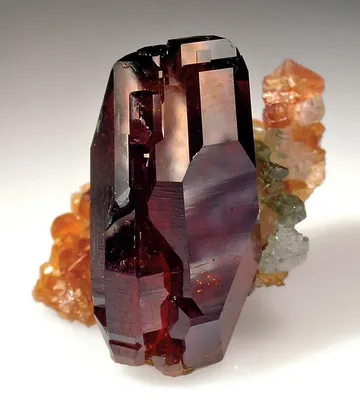
Grossular is the calcium–aluminum member of the garnet group (Ca3Al2(SiO4)3), celebrated by collectors for its wide chromatic range and sparkling crystal habits. Colors span vivid emerald to mint greens (chromium/vanadium-bearing “tsavorite”), warm cinnamon to honey-oranges (“hessonite”), chartreuse yellow-greens (“Mali garnet” across the grossular–andradite boundary), plus pinks, colorless, and rare brown/amber tones. Crystals commonly form as sharp dodecahedra and trapezohedra—often with bright, glassy luster—and occur in contact-metamorphic skarns and calc-silicate rocks with classic associates like diopside, clinochlore, vesuvianite, wollastonite, and calcite.
Aesthetic benchmarks include apple-green Jeffrey Mine clusters on pale diopside, saturated tsavorites from East Africa (Tanzania/Kenya), treacle-textured cinnamon hessonites from the Italian Alps, and luminous chartreuse crystals from Mali. While many grossulars are thumbnail or miniature in size, their clarity, color saturation, and brilliant luster give them disproportionate visual punch. Top crystals on attractive matrix are highly competitive and, in the case of fine tsavorite, can approach elite price levels.
Grossular holds a unique place in collecting because it bridges display specimens and the gem world. Tsavorite, long prized in jewelry, also occurs as superb crystals that thrill mineral collectors—clean, saturated greens are perennial show-stoppers. The warm glow and internal “swirl” typical of classic hessonite from the Alps has charmed collectors since the 18th–19th centuries. Meanwhile, modern finds from Mali re-energized interest with their distinctive chartreuse/yellow-green tones and superb form.
Availability ranges from abundant small Jeffrey Mine greens and widespread hessonites to scarce, high-end tsavorite matrix pieces (most gemmy crystals were cut). As with many skarn minerals, mining is intermittent and often incidental to industrial operations, so supply can shift unexpectedly. This mix—historic classics, modern highlights, and color diversity—keeps grossular perennially desirable, with accessible entry points and true top-end trophies.
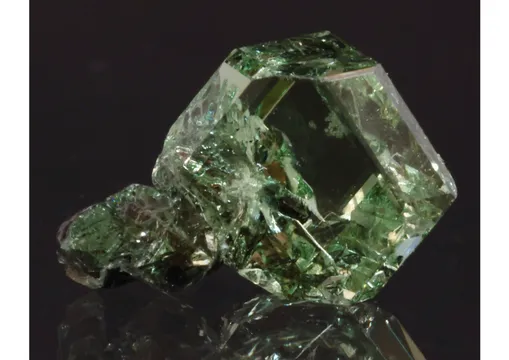
The legendary Jeffrey Mine (Asbestos, Québec) produced some of the most iconic green grossulars ever found. Typically small but razor-sharp crystals from translucent to gemmy apple-green grew in dense clusters on pale diopside or serpentine-rich skarn, often with dramatic color contrast and a glassy luster. Crystals are usually dodecahedral/trapezohedral, sometimes with frosted or slightly etched faces that sparkle in cabinet lights. The mining era that yielded these pockets has ended; fine, undamaged clusters—especially those with exceptional luster, uniform color, and balanced compositions—are now connoisseur targets.
Merelani is famous for tanzanite, but it also yields superb tsavorite grossular. These crystals, colored by vanadium and chromium, range from vivid emerald to neon green, commonly as sharp, highly lustrous dodecahedra and combinations. Many are gem-clear single crystals; true, stable matrix pieces are unusual because the host graphite schists are crumbly. The finest examples show saturated, even color, water-like clarity, and crisp, reflective faces—specimens that can compete aesthetically with the best green minerals from anywhere.
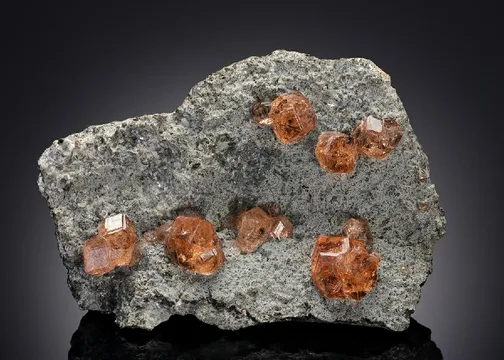
The Val d’Ala in Piedmont is the archetype for classic hessonite: warm cinnamon to honey-orange grossular crystals on green diopside or silky clinochlore. These timeless Alpine pieces often show the characteristic “treacle” or roiled internal texture, with gemmy edges, sharp forms, and exquisite color contrast. Larger, cleanly terminated crystals on aesthetic matrix are old-European classics that anchor many garnet suites.
With its breadth of colors, elegant crystallography, and classic localities spanning centuries of collecting, grossular offers a lifetime of pursuit—from affordable thumbnails with gemmy sparkle to museum-level classics that define a collection.