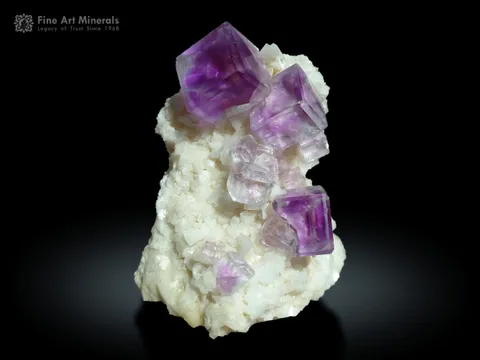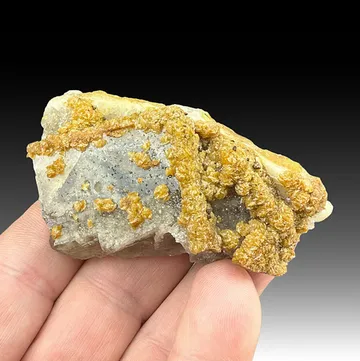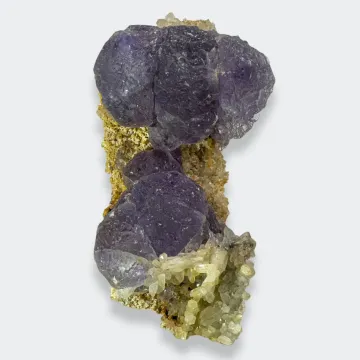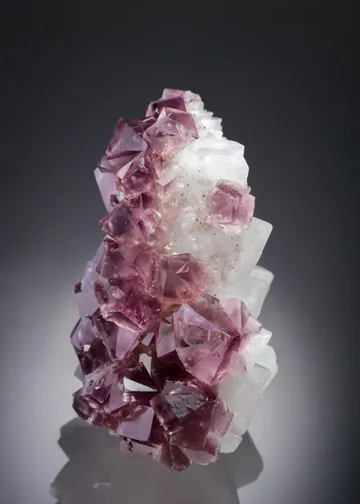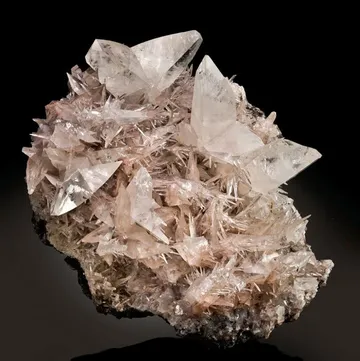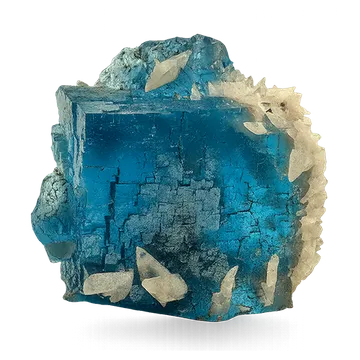
中国・上宝鉱山の蛍石: 建築的で光沢のある結晶、内部のファントムと鮮やかなゾーニングを有する現代のクラシック。収集家に高く評価されている。
Key facts
Shangbao fluorite is one of the unmistakable Chinese fluorites: sculptural, stepped, glassy, and often lit from within by purple, violet, teal-blue, or sea-green zoning. The finest pieces have a character quite unlike the big flat cubes of many classic fluorite localities. Shangbao crystals commonly look architectural—cubes modified by dodecahedral and octahedral faces, or cuboctahedra whose faces are broken into hundreds of tiny terraces. Under good light the best specimens show internal phantoms, violet corner zones, purple edge bands, green or bluish interiors, and a water-clear body that lets the color float inside the crystal rather than merely sit on the surface.

Photo: Wikimedia Commons
The locality is the Shangbao Mine, near Leiyang in Hengyang, Hunan Province. It is also known in older specimen labels as the Shangbao Pyrite Mine or Shangbao Pyrite mine. Geologically it is a skarn-type polymetallic deposit at the contact between Carboniferous–Permian limestones and a Jurassic granite stock, with iron, tungsten, tin, niobium, and tantalum significance in addition to its specimen fame. Fluorite, CaF2, occurs in open cavities with dolomite, quartz, pyrite, calcite, and accessory sulfides and skarn minerals. That setting explains the collector appeal: the fluorite is rarely alone, and the very best pieces are complete mineral compositions—transparent fluorite perched on pearly white dolomite, frosted quartz, brassy pyrite cubes, or cream-to-golden calcite.

Photo: Wikimedia Commons
Historically, Shangbao is a modern classic rather than a nineteenth-century one. The deposit was explored as an ore locality in the mid-twentieth century, but the fluorites that collectors prize today entered the western mineral market in quantity only from the late 1980s through the 1990s and early 2000s. The mine’s specimen reputation was built on a relatively small number of productive pockets, culminating in the celebrated late-2000s finds that produced some of the most complex and colorful examples. Today, the mine is not a normal producing specimen source in the way collectors sometimes imagine. Much of the material circulating now is older stock, deaccessioned collection material, or occasional pieces recovered from old workings.コレクターが最初に重視するのは「商宝( Shangbao )ルック」: 角晶を3角柱状から立方体・8面体状へと改変した結晶、階段状の面、透明から半透明の内部、強い色帯、そしてエレガントなマトリックス。 ダロマイト上の1個の無傷で2.5–4 cmの結晶は、より大きくてもくすんでいたり傷ついているキャビネットピースよりも望まれることがある。 飽和した紫、紫 Phantomを伴う青緑、鋭く分離した紫の縁、基質に埋もれていない自立結晶はすべてプレミアムを伴う。 早期生産に由来するもの、公表例、または既知のコレクションを持つ品も同様にプレミアム対象となる。## 特集標本
Search for specimens: View all fluorite specimens from Shangbao Mine, China
The Shangbao Mine lies near Leiyang, in Hengyang, Hunan Province, at the edge of the Cailun Bamboo Sea region. Mindat gives the locality as Shangbao Mine, Leiyang Co., Hengyang, Hunan, China, with the local-language name 上堡矿. Older labels often read “Shangbao Pyrite Mine,” reflecting its early mining identity, while current tourism-oriented references may call it the Shangbao Crystal Mine.
The deposit is a skarn-type polymetallic system developed where Carboniferous and Permian carbonate rocks were intruded and altered by a Jurassic granite stock. In collector terms, that means Shangbao is not merely a fluorite vein locality: it is a mixed skarn and hydrothermal environment where fluorite formed with quartz, dolomite, calcite, pyrite, chalcopyrite, sphalerite, bismuthinite, cassiterite, scheelite, and other minerals. The important ore commodities recorded for the locality include iron, tungsten, tin, niobium, and tantalum. Exploration in 1959–1964 found the iron skarn, but early work focused strongly on pyrite and did not fully recognize the broader polymetallic potential. Later granite studies in 1969–1971 identified niobium-tantalum mineralization in weathered granite crust, and subsequent exploration drilling intersected tungsten-tin skarn mineralization.
For specimen collectors, the decisive chapter came after the ore history. Fluorite specimens began appearing on western mineral markets in the late 1980s and became much better known through the 1990s and early 2000s. The mine was eventually run in a notably specimen-oriented way by former miners rather than as a major industrial ore producer. Reports from collectors who visited the locality in the 2010s describe a relatively small mine with underground levels, a formal entrance portal built around the original adit, and a fenced property near the bamboo-forest tourist area.
Collecting access should be treated as closed unless arranged locally and explicitly. The site is now associated with the Cailun Bamboo Sea tourist circuit, where “Shangbao Crystal Mine” is listed as an attraction. Older workings have been used for tourist visits, and recent dealer descriptions make clear that the mine is not producing major new commercial specimen material. Occasional recoveries from old tunnels or old stock do occur, but they should not be confused with an active, accessible collecting locality.最も notable specimen-production period spans the late 1980s through the 2000s. Early material includes green, purple, and color-zoned modified cubes and cuboctahedra, often on dolomite or quartz. The mid- to late-2000s material is especially prized for complex stepped faces, strong purple-and-green zoning, and handsome dolomite, quartz, calcite, or pyrite associations. A 2008 find is repeatedly singled out in collector accounts as a peak moment for Shangbao fluorite-dolomite-quartz specimens and as the find that fixed Shangbao’s status among the great Chinese fluorite localities.## Shangbao鉱山(中国)産フ fluorite の特性
Shangbao産フ fluorite は単純な立方体だけでなく、修正等方形の結晶形で最もよく知られています。Mindatは結晶の産地を、最大5 cmの立方体、十二面体、正八面体として記録しており、スピネル双晶も指摘されています。実物標本では、結晶が頻繁に双方体-十二面体の組み合わせとして現れ、多くは密に段階的成長を示します。これらの階段状の表面はこの産地の特徴の一つであり、単一の平面がある代わりに結晶表面が小さなテラス状に構築され、丸みを帯びた、連続した城壁のような輪郭を作りつつ、鋭い幾何学的秩序を保っています。
色は魅力の大きな要素です。Shangbaoの結晶は薄いラベンダー色、中~濃い紫、ブドウ色、青紫、緑、海緑、やや青味がかった緑、無色〜水晶の透明、またはこれらの組み合わせであることがあります。最も望まれる標本では内部の帯状が見られます:緑がかった結晶の内部に紫色の核、角の紫の幽霊、薄い外側面の下に紫の縁帯、または透明なフ fluorite の内部に浮遊する正八面体の幻影などです。日光源の違いによって色の変化を示す標本もあり、日光やLED照明下では冷たい青紫に移動する紫色域が、暖色の照明下ではよりマゼンタ色になることがあります。
典型的な個別のフ fluorite 結晶は約1–5 cmの範囲で、良質なミニチュアおよび小型キャビネット標本では2–4 cmの結晶が一般的です。より大きい結晶も存在し、特にマトリックスに半分埋もれているのではなく、露出している場合には熱心に求められます。8–15 cm程度のキャビネット板が最も馴染みの展示フォーマットです。非常に大きなキャビネット標本と5 cmを超える孤立結晶はかなり希少で、真の通好みの領域へと入ります。
クラシックなマトリクスは白〜クリーム色のドロマイトで、菱形状または鞍状の集合体を形成することが多いです。石英は別の決定的な随伴物で、特に霜降り〜ガラス状の柱状結晶と、この産地特有の「アーティチョーク」または「キャンドル」型の石英の結晶を特徴とします。黄鉄鉱は真鍮色の立方体として現れ、淡いフ fluorite と白いマトリックスと強い視覚的対比を作ります。方解石はスケレノヘドラ状または小さな輝く外皮を形成することがあり、時にはクリーム色、白、はちみつ色、または金色になることがあります。珍しいが鉱物学的に重要な随伴物には、閃亜鉛鉱、黄銅鉱、ビスマスニット、錫石、スケーライト、その他の走砲鉱物(ダイオプサイト、角閃石族鉱物、トレモライト、ベスビオリナイト、エピドート、磁鉄鉱など)があります。シャングャオのフ fluorite の品質は、結晶構造、透明度、色の配置、基質成分のバランスで決まります。トップピースはシャープな幾何学、美しい光沢、内部のゾーニングがはっきり見えること、エッジや角の欠けが最小限であることが求められます。紫色が緑色や青色のゾーニングと重なる配色は特に注目されます。基質も重要です。白いドロマイト、石英、黄鉄鉱の上に小さく、バランスの取れたフ fluorite がある場合、巨大な結晶が不格好で破損したり見た目が重たくなる基質よりはるかに価値が高くなることがあります。コレクターはまた“浮遊物”やほぼ全周が完了している作品も評価しますが、シャングャオの最も強力な標本は、黄鉄鉱やドロマイトの上に蛍石が清潔に浮き上がっている基質作品であることが多いです。## Collector Notes
Shangbao fluorite is common enough that ordinary pieces still appear regularly, but fine classic material is no longer easy. The market today is dominated by older production: late-1990s, early-2000s, and late-2000s pieces from collections, dealer back stock, and occasional old stashes. Recent auction records show small miniatures and modest matrix pieces selling in the low hundreds of dollars, while better small-cabinet and cabinet examples with strong zoning, good condition, and provenance commonly sell for several hundred to a few thousand dollars. Exceptional published or “best of locality” pieces can be priced far beyond normal cabinet-specimen levels.
The main authenticity issue is not a widely documented Shangbao-specific treatment industry, but locality confidence. Many Hunan fluorites exist, and some green, purple, or color-zoned Chinese fluorites can be casually mislabeled or over-attributed. True Shangbao material should be judged by the whole specimen: stepped modified cubes or cuboctahedra, purple-green or purple-blue internal zoning, dolomite/quartz/pyrite/calcite matrix, and a style consistent with known Shangbao production. Pieces on white dolomite with brassy pyrite and artichoke quartz are easier to place than loose single crystals with no provenance.
Condition is critical. Fluorite has perfect octahedral cleavage and is vulnerable at corners, bevels, and stepped faces. Shangbao crystals often have many tiny terraces, so small bruises can hide in the architecture until viewed under magnification. Inspect the high points of the stepped faces, cube corners, attachment points, and any areas where quartz or dolomite contacts the fluorite. Repairs are possible on larger crystals and matrix plates; look for unnatural seams, excess glue, mismatched luster across a break, or a crystal sitting too perfectly on a fresh-looking matrix contact.
Natural etching and stepped growth should not automatically be read as damage. Many Shangbao faces are naturally complex, with growth terraces, frosted zones, or subtle dissolution textures. The collector’s task is to separate original growth character from later abrasion. A fine Shangbao fluorite should still have life: glassy windows, crisp edges where they ought to be crisp, and internal zoning that remains visible without harsh backlighting.
For buying, provenance adds value. Ex-collection labels, older dealer labels, publication history, and dated find references are useful because the locality’s best period has passed. Descriptions such as “1990s find,” “early 2000s,” or “2008 find” should be backed by labels or a credible dealer chain rather than taken as decoration. As with many Chinese classics, the safest purchases are from dealers who understand the locality and can explain why the piece is Shangbao rather than merely “China fluorite.”## Stories & Field Notes
Mario Pauwels’s 2015 visit gives Shangbao a setting that is almost too vivid for a mineral label. The mine sits near the small village of Zhushan, at the margin of the Hunan Leiyang Cailun Bamboo Forest, a green landscape of bamboo-covered hills. From Leiyang, Pauwels described the last 40 kilometers to the mine as more ordeal than commute. He reached Leiyang from Changsha by high-speed train, then hired a taxi for the remaining hour-plus drive. Before leaving town, the driver stopped at a local garage and had the tires checked and inflated, then passed the bill to Pauwels with a look that seemed to say: “Yes, you wanted to go to Shangbao, didn’t you?”
The road followed lower banks of the Leishui River, passing small worn villages, many no more than a few houses or a single street. Rice plots lined the roadside. The weather was beautiful and tropically warm, but the rural roads were in poor condition, turning distance into time. Pauwels contrasted the lush green landscape with nearby areas that seemed scarred by pollution, possibly from coal mining. It is a reminder that Shangbao’s airy pastel fluorites came from a real working district, not from the tidy abstraction of a mineral cabinet.
The mine’s early story is also more complicated than the elegant specimens suggest. It was discovered and developed after Chinese government prospecting in the first half of the 1960s. Early names included Shangbao Huang Mine and later Shangbao Pyrite Mine. The plan to profit from iron in pyrite did not succeed as hoped, and the fluorite itself was not well suited to industrial use. The specimens, however, were another matter. Geologists from the Geological Institute of Hunan began commercializing notable fluorite specimens at larger western mineral shows at a time when the Chinese domestic market for mineral specimens barely existed.
According to Pauwels, the mine was never truly profitable, despite that specimen initiative, and was closed by the Chinese government in 1995. That same year it was sold to five former miners, who kept the mine open for specimen recovery—a relatively unusual model in China at the time. Even at its peak, Shangbao employed only about one hundred people, tiny by comparison with great Hunan ore mines such as Yaogangxian. Yet this small mine produced a mineral identity strong enough to stand beside China’s famous fluorite names.
The physical mine Pauwels saw had about two kilometers of tunnels distributed over different levels, reaching roughly 300 meters deep. The original entrance had been little more than a tunnel cut straight into a green bamboo-covered hillside. In 2010 the owners built a more formal entrance portal, giving the mine a public face. A high wall and new wrought-iron gate enclosed the site. From the road around the bamboo park, the mine itself was not visible.地下ツアー訪問と鉱物採取を組み合わせる計画もあり、毎年カイルン竹林を訪れる観光客を活用するつもりだった。パウウェルズは、計画が完全には発進していなかったことを示すサインを見つけた。観光客用に改造された旧鉱山 trolley が現地に残っていたが、その錆びた車輪と鉄道は長年動いていなかったことを示している。その光景は、今やさらに意味深いものになっている。観光案内にはシャングボー水晶鉱山がカイルン竹海体験の一部として挙げられ、業者がこの産地をアクティブな標本鉱山というよりは観光鉱山として繰り返し語るからだ。
入口周辺のダンプには、現場採集者を一時停止させるだけの鉱物の生命力がまだ視覚的に残っていた。パウウェルズは、瓦礫と1 cmを超える小さな蛍石結晶、わずかに虹色に輝く黄鉄鉱の立方体、そして約4 cm程度の結晶良好な方解石と方解石の菱面体を太陽の下で輝く様子を描写した。シャングボーの残骸にも、特徴的な共伴鉱物組み合わせが残っていた。蛍石、黄鉄鉱、方解石、方解石、石英—偉大な標本を有名にしたのと同じ鉱物構造の小片が散らばっている。
コレクターが今も語る発見は、2008年の蛍石-方解石-石英の産出だ。パウウェルズは、それを「鉱山の歴史の中で最良の蛍石/方解石/石英の発見」と呼び、シャングボーを世界地図上の産地として確立した発見だと述べた。その発見以降、類似の重要性を持つ採掘物はほとんど回収されていないという。これがシャングボーの現代的なコレクション物語の核だ。小さな鉱山、顕著なポケットの短い時期、そしてその後、最良の標本の私的コレクションへの徐々の移動、今では時折しか再登場しない。## 鉱物学的記録と刊行物
Berthold Ottens, “The Shangbao mine, Hunan Province, China,” The Mineralogical Record, Vol. 43, No. 5, September–October 2012, pp. 587–603 — Shangbao標本と鉱物学の主要な英語地域記事。
Chen Xiaojun (John), “A recent visit to the Shangbao mine,” The Mineralogical Record, Vol. 43, No. 5, 2012, pp. 604–605 — 2012年のShangbao地質記事と対をなす、現地訪問の短い field-visit 記事。
Zeheng Lei, Yusheng Qiao, and Yiming Xu, “W-Sn Mineralization Characteristics and Exploration Potential of the Shangbao Mineral District, Hunan Province,” Geology and Exploration, Vol. 45, No. 2, 2009, pp. 44–52 — テン素-錫の鉱化特性と広範な多金属背景の地質的参照。
Dengfeng Tu, Dizhi Lumping, Vol. 30, No. 3, 1984, pp. 270–274 — Mindat地質記録におけるShangbaoの蛍石と黄鉄鉱の初期引用文献。
Liu, Yang; Guo, Qingfeng; Liu, Liangyu; Zhang, Sixue; Li, Qingling; and Liao, Libing, “Comparative Study on Gemological and Mineralogical Characteristics and Coloration Mechanism of Four Color Types of Fluorite,” Crystals, Vol. 13, No. 1, 2023, article 75 — Shangbao蛍石に関連して引用された現代の宝石学・鉱物学研究。
Flawless Beauty: The Mineral World of Will Johnson, supplement to The Mineralogical Record, January–February 2023 — Will Johnsonコレクション所蔵の蛍石 on calcite標本(Shangbao)、Tom Spann撮影。
EarthWonders specimen record: Fluorite on Calcite, Shangbao Mine, 9.5 cm, Will Johnson collection — Flawless Beautyに掲載されたShangbao標本(ページ166)を記録。
dmb0173 Fluorite, Shangbao Mine, China — Crystal Classics — 輪転する映像で、光沢・透明度・形状を動きで観察できるShangbao蛍石標本。
Fluorite with calcite, Shangbao Mine, Hunan Province, China; 9.5 cm across — exclusiveminerals2 on Flickr — Stephen Smaleコレクションに以前あった暗紫色Shangbao浮遊標本のJeff Scovil写真記録、説明に動画参照リンク。
FLUORITE - Shangbao Mine, Hengyang, Hunan, China — SZ Minéraux archive — 青 - 紫色のShangbao蛍石の在庫ページ。埋め込み標本ビデオ付きのアーカイブ販社メディア頁。## 更なる読書と外部リンク
Mindat ローカリティページ: Shangbao Mine, Leiyang Co., Hengyang, Hunan, China — 広範なローカリティデータベースエントリ。座標、鉱物リスト、地質ノート、参考文献、写真リンクを掲載。
Mindat 蛍石の産出場所: Shangbao Mine — 蛍石に特化した産出ページ。形状ノートと大規模な写真ギャラリー。
Mario Pauwels, “De Shangbao Mine, Leiyang, Hunan, China” — 2015年の訪問に基づく詳細なオランダ語のフィールドレポート。アクセス、歴史、鉱山サイトの観察が豊富。
Wikimedia Commons: Fluorite-234903.jpg — Rob Lavinsky による、海のような緑色の Shangbao 蛍石と鮮やかな内部紫色を示すオープンライセンス画像。
Wikimedia Commons: Fluorite-Dolomite-235533.jpg — 白色 Dolomite 上の蛍石の古典的な組み合わせを示すオープンライセンス画像。
Wikimedia Commons: Fluorite-Quartz-Pyrite-235604.jpg — 紫色の Shangbao 蛍石と水晶、黄鉄鉱、 Dolomite のオープンライセンス画像。
湖南省文化観光庁: Cai Lun Bamboo Sea — 公的観光情報。蔡倫の竹海と Shangbao クリスタル鉱山が蛍石結晶を産出することを記載。
Mineral Auctions: Fluorite with phantoms on Quartz, Shangbao Mine — 最新のオークション記録。初期産物、状態、サイズ、現在の市場動向を記録。
Mineral Auctions: Fluorite on Dolomite, illustrated Shangbao specimen — older material、観光鉱山状態、ハイエンドの色分帯例について詳述した市場情報。
Heritage Auctions: Fluorite, Shangbao Mine — 2008–2009頃と推定される博物館品質の Shangbao 皿のオークション説明。