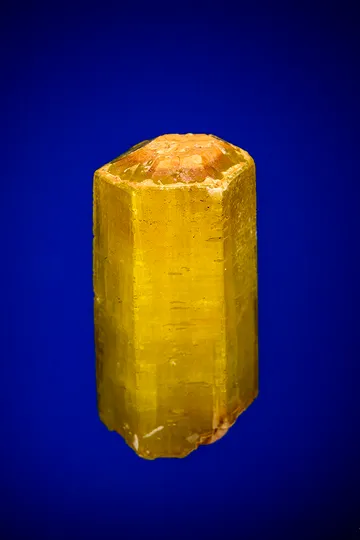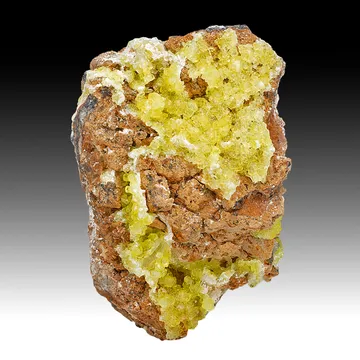
Ettringite: lemon-yellow hexagonal prisms; a fragile hydrated sulfate with notable localities like Kalahari and Eifel, Crestmore, prized by collectors.
Key facts
Ettringite is a hydrated calcium aluminum sulfate, Ca6Al2(SO4)3(OH)12·26H2O, celebrated by collectors for its luminous lemon-yellow color and elegant hexagonal prisms. Crystals range from delicate acicular sprays to stout, glassy prisms with flat pinacoidal terminations. The Kalahari Manganese Field (South Africa) set the world standard, producing saturated yellow columns with brilliant luster on contrasting black manganese-oxide matrix. Type-locality material from the Eifel Volcanic Field (Germany) shows classic silky radiating needles, while historic finds from Crestmore (California) and Monteponi (Sardinia) offer fine, often colorless to pale-yellow sprays.
Despite its beauty, ettringite is a fragile, highly hydrated sulfate. Prisms chip easily, and the species can be sensitive to heat and prolonged water exposure. Intact, lustrous crystals with strong yellow color—especially on aesthetic matrix—are scarce and command the highest interest.
Ettringite’s appeal is anchored in its color and form: a glowing, cheerful yellow uncommon among sulfates, paired with crisp hexagonal geometry. It fills an important niche in collections focused on the Kalahari Manganese Field, hydrated sulfates, or type-locality suites. While micro-sprays and small radiating clusters are widely attainable, truly top cabinet pieces—undamaged, saturated yellow prisms, ideally on contrasting matrix—are quite rare and keenly sought. Because crystals are brittle and mining environments can be rough, many notable specimens are repaired; unrepaired matrix pieces with multiple perfect terminations are prized and can be surprisingly expensive relative to the species’ overall abundance.
Wessels Mine (Kalahari Manganese Field, Northern Cape) is the benchmark for world-class ettringite. It produced exceptionally sharp, lemon-yellow hexagonal prisms—often 1–5 cm, sometimes larger—with glassy to silky luster and textbook flat terminations. Jet-black manganese-oxide matrix provides striking contrast, and associations can include fellow Kalahari rarities such as sturmanite and charlesite. Top Wessels pieces display radiating clusters or freestanding prisms perched just-so on sculptural matrix. Because of extraction stresses, repairs are common; unrepaired, undamaged matrix specimens command premiums.
N'Chwaning II is another Kalahari icon, yielding vivid yellow to canary ettringites—often as elegant, elongated prisms with excellent translucency and silky luster. Clusters may show subtle color zoning and robust, sharp terminations. The best pieces feature airy, three-dimensional arrangements on dark matrix, with crystals spaced to highlight form and color. While overall production was not immense, the consistent quality from this mine makes N’Chwaning II ettringites staples of advanced Kalahari suites.
Color and saturation:
Crystal size and form:
Luster and clarity:
Matrix and composition:
Condition:
Rarity and provenance:
Repairs and reattachments:
Polishing and coatings:
Assemblies:
When in doubt, buy from reputable sources and ask specifically about repairs and any stabilizers used.
Ettringite is a hydrated sulfate and comparatively fragile. Proper care preserves color, luster, and integrity.
Handling:
Environment:
Light:
Cleaning:
Storage:
With mindful handling and a stable environment, fine ettringites—especially the luminous Kalahari classics and well-preserved type-locality sprays—will retain their beauty for generations.