






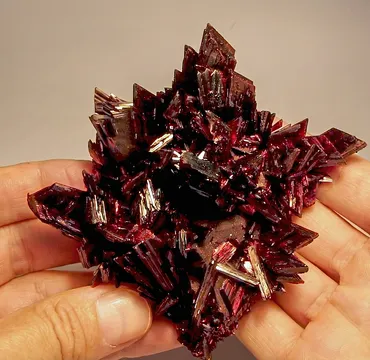
Erythrite — vivid crimson-to-magenta acicular crystals, radiating sprays on calcite; prized for color, rarity, and historic Moroccan Bou Azzer finds.
Key facts
Erythrite is a vivid cobalt arsenate, Co3(AsO4)2·8H2O, best known for its striking crimson-to-magenta color that can verge into royal purple. Formed in the oxidation zones of cobalt–nickel arsenide deposits (skutterudite, safflorite, cobaltite, nickeline), it typically occurs as silky to glassy acicular crystals, radiating sprays, sheaves, and crusts, and more rarely as thin tabular prisms with sharp faces and bright luster. On contrasting white calcite or pale dolomite, erythrite “explodes” visually—one of the most instantly recognizable and photogenic secondary minerals.
While small velvety coatings (“cobalt bloom”) are common, fine specimens with long, lustrous, well-separated crystals are far scarcer and highly sought after. The modern benchmark comes from Morocco’s Bou Azzer district, which has produced world-class magenta sprays and gemmy, elongated blades on pale carbonate matrix. Historic European classics from Schneeberg (Germany) and Jáchymov (Czech Republic) provide unmatched pedigree. Erythrite is soft and fragile (Mohs ~1.5–2.5), yet its color and forms make it a perennial collector favorite, with exceptional pieces commanding strong prices relative to size.
Erythrite’s popularity rests on color, contrast, and history. Early European cobalt districts gave the species its old nickname, “cobalt bloom,” treasured on antique matrix specimens alongside skutterudite and cobaltite. The late-20th and 21st-century revival of Bou Azzer, Morocco, dramatically raised the bar: intense magenta sprays and lustrous blades on chalk-white calcite revived global interest and set modern aesthetic standards.
Collectors at all levels engage with erythrite:
Supply can be sporadic, and the species’ fragility means pristine pieces are uncommon. The best examples—large, undamaged, three-dimensional sprays with top color and balance—are limited and compete well against other top aesthetic secondaries.
The world’s modern reference for erythrite. Bou Azzer’s cobalt–nickel arsenide deposits yield spectacular magenta to royal-purple sprays and sheaves, often perched on snow-white calcite or pale dolomite for dramatic contrast. Classic pockets from mines like Aït Ahmane, Aghbar, and Bouismas produced lustrous elongated blades to several millimeters or more, as well as dense radiant clusters forming exquisite bouquets. Associated species can include skutterudite, safflorite, cobaltite, quartz, calcite, roselite, and wendwilsonite—combinations that enhance both color harmony and scientific interest.
Collectors value Bou Azzer erythrite for saturated color, brightness of luster, and three-dimensional crystal groupings. Fine, intact matrix pieces with elegant composition and little or no damage are considered benchmark specimens for the species.
Repairs and stabilization occur due to erythrite’s fragility:
Erythrite is soft (Mohs ~1.5–2.5), brittle, and hydrated—handle and store with exceptional care.
Handling:
Light and temperature:
Humidity and environment:
Cleaning:
Storage:
Safety:
By prioritizing vivid color, lustrous and well-separated sprays, excellent contrast, and top condition—with careful handling—you can curate erythrite specimens that rival the finest modern and historic examples from around the world.