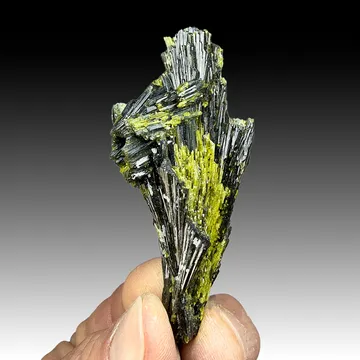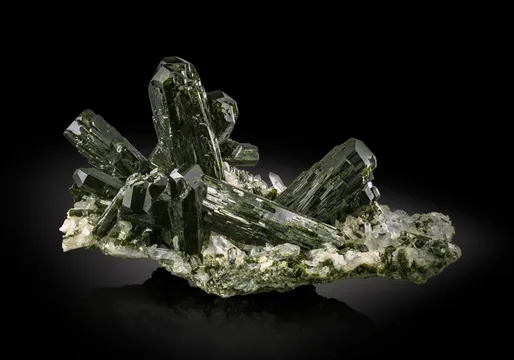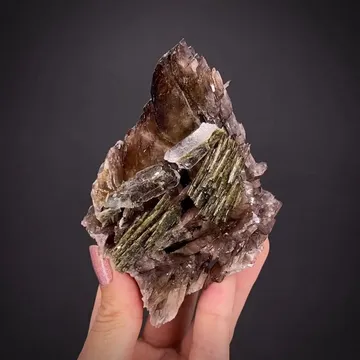
Epidote - vibrant pistachio to bottle-green crystals with prismatic forms, Alpine fissure and skarn varieties, and diverse collecting localities worldwide.
Key facts
Epidote is a calcium aluminum iron sorosilicate most often seen in vibrant pistachio to bottle-green hues, occasionally brownish or nearly black in thick crystals. It forms prismatic, striated crystals with steep, wedge-like terminations, and occurs both as isolated singles and in radiating sprays or elegant clusters. Classic “Alpine-type” fissure specimens can show sharp, lustrous prisms perched on white adularia and quartz; skarn and metamorphic occurrences produce stout, darker crystals with a glassy sheen. Though common as a rock-forming mineral, fine cabinet specimens are far from ordinary—top pieces display crisp form, rich color, and striking contrast on light matrix. Collectors value epidote for its aesthetics, locality diversity, and the way it pairs beautifully with quartz, calcite, prehnite, and titanite.
Epidote has been sought since the 19th century by Alpine collectors, with Austria’s Knappenwand producing archetypal crystals featured in early European collections. In the 20th century, Alaska’s Prince of Wales Island yielded robust, gemmy prisms that cemented epidote’s standing in American mineralogy. The modern era brought waves of superb material from Pakistan’s high valleys and Mali’s metamorphic terrains—accessible yet frequently elegant, making epidote a staple for both beginners and advanced collectors. Prices range widely: attractive thumbnails and small sprays are affordable, while large, undamaged Alpine clusters or dramatic Pakistan matrix pieces with quartz can command strong premiums. The species’ enduring appeal lies in its variety of habits, colors, and world-class localities.
Famous for the Green Monster Mountain occurrences, Prince of Wales Island produced stout, bottle-green epidote prisms—some remarkably large and transparent. Many appear with quartz or calcite, creating dramatic contrast and giving a robust, “mountain-hard” look typical of metamorphic deposits. Older finds are widely dispersed among museum and private collections; fresh, undamaged matrix specimens are coveted and increasingly scarce on the market.
The Tormiq Valley in Gilgit-Baltistan has produced superb epidote since the 2000s. Crystals tend to be long, striated, and very lustrous, frequently with steep wedge terminations. Matrix specimens on quartz or schist are prized, and select pieces show fine transparency in the upper third of the crystal. The best Tormiq pieces rival Alpine classics for sharpness and sheen, yet often at more accessible sizes and prices.
From Peru’s central ranges, Pampa Blanca epidotes typically present as bright green, distinctly striated prisms associated with quartz and sometimes calcite. The locality is known for balanced cabinet specimens where several crystals rise from a contrasting light matrix. Color saturation ranges from fresh olive to richer greens; when paired with transparent quartz points, the aesthetic can be exceptional for the size.
With mindful selection and care, epidote offers excellent value and variety—from historic Alpine classics to modern, lustrous crystals from Pakistan and Mali—making it a rewarding species for collections of all levels.