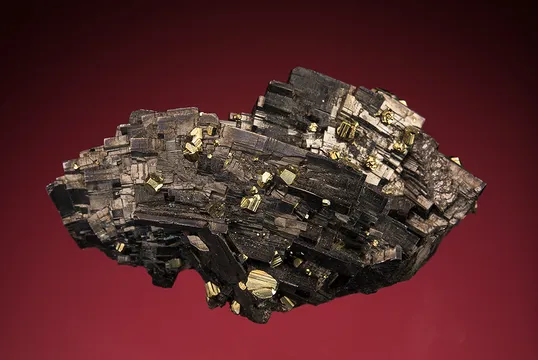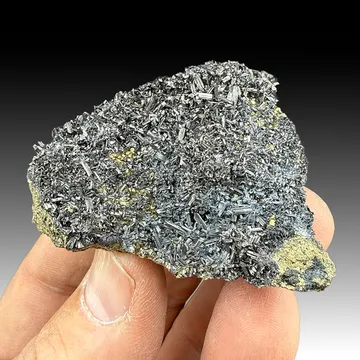
Enargite: sharp metallic prisms, gunmetal color with iridescent tarnish; rare top specimens on quartz or pyrite from classic mines like Butte, Bingham.
Key facts
Enargite (Cu3AsS4) is a copper-arsenic sulfosalt celebrated by collectors for its sharp metallic prisms, rich gunmetal to steel-gray color, and dramatic associations with quartz, pyrite, and other sulfides. Crystals commonly form as stout to slender prismatic blades with striated faces and stepped growth, often in radiating sprays or parallel bundles. The luster is typically bright metallic to submetallic, sometimes showing attractive iridescent tarnish. Exceptional specimens display large, well-terminated prisms rising from snow-white quartz or brassy pyrite, creating striking contrast.
Enargite occupies a unique niche in the hobby: it is not a “pretty” gem mineral, but top pieces have a commanding presence. Historically tied to major copper deposits (Butte, Bingham, Cerro de Pasco, Quiruvilca), enargite also has scientific importance as an indicator of high-sulfidation systems. Collectors value it for sharpness, luster, crystal size, and classic provenance. Fine, damage-free clusters on contrasting matrix are surprisingly scarce; the species is brittle and many old-time pieces were either trimmed hard or saw plenty of mine-life handling. As a copper-arsenic mineral, it should be handled and stored with care.
Enargite’s appeal rests on bold geometry and history. It starred in some of the world’s most storied ore districts, and fine cabinet specimens from these classic mines are pillars of sulfide collections. Butte, Montana set the benchmark with brilliant, architectural clusters over a century ago; Peru later supplied elegant, often more slender crystals on quartz; Japan’s Toyoha produced refined, highly lustrous pieces in smaller sizes.
While general availability exists for small fragments and massive ore, truly top-quality, undamaged crystals on good matrix are rare and in steady demand. The market favors:
Prices vary widely. Affordable thumbnails and small clusters are common, but major matrix pieces with pristine terminations, fine luster, and pedigree can command serious premiums.
Below are renowned sources that produced specimens defining the species’ aesthetics. Each locality is included only if a verified ID exists.
Butte is the world’s classic enargite locality. Historic specimens show stout, razor-sharp prisms and blocky clusters, often on quartz with pyrite and other sulfides. Many pieces display beautifully striated faces and mirrorlike metallic luster. The scale ranges from elegant thumbnails to large, architectural cabinets. Associations with pink rhodochrosite are less common but highly prized when present.
Collectors seek Butte for its combination of size, sharpness, and provenance—few localities match the overall presence of these old-timers. Damage-free terminations are unusual; unrepaired, pristine crystals carry a premium. Tarnish can create appealing iridescence, but uniform, fresh metallic faces are most coveted.
Quiruvilca produced elegant, often slender enargite prisms with very bright luster, commonly perched on white quartz. Many form radiating sprays or parallel bundles; intergrowths with luzonite (a polymorph) are known. The best pieces show rich contrast, sharp tips, and minimal etching. Sizes tend to be small to medium; composition and aesthetics are the draw.
Crystal sharpness and habit:
Luster and surface quality:
Size and composition:
Condition:
Associations and locality:
Special interest:
Repairs:
Stabilization and surface “enhancements”:
Fakes:
Enargite contains arsenic; treat it with respect.
Handling and safety:
Cleaning:
Environment:
Storage:
Long-term appearance:
By focusing on sharp crystal form, bright metallic luster, contrasting matrix, and classic provenance—while practicing sensible safety and gentle care—you can build a standout suite of enargite that honors both the science and the history of this archetypal ore mineral.