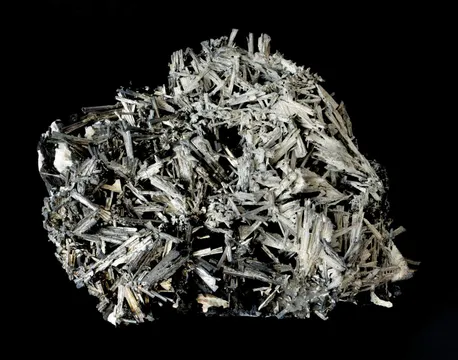
Dyscrasite Collectors Guide
Dyscrasite is a classic silver antimonide (Ag3Sb) and one of the quintessential “old European” silver species. It forms in hydrothermal silver veins, typically as bright metallic crystals embedded in calcite and/or dolomite, often accompanied by native silver, acanthite, proustite, pyrargyrite, and a suite of sulfides and sulfosalts. Crystals range from stout prisms to slender, striated blades and “feathery” or reticulated aggregates; sharp, free-standing crystals on snow-white calcite are the dream. With a high specific gravity and mirror-like metallic sheen, fine dyscrasite has a presence similar to native silver but with its own distinctive habits and associations.
Collectors prize dyscrasite for its historic pedigree and sculptural aesthetics: silvery lances piercing calcite, radiating sprays, or elegant intergrowths with native silver. It tarnishes naturally to gunmetal-gray or iridescent tones, which can be attractive if even and undisturbed. Though not as common as native silver or acanthite, the species has produced superb specimens from several legendary mining districts, most famously central Europe and the classic Cobalt Camp in Canada.
Dyscrasite has long held a niche allure among connoisseurs of silver minerals. Nineteenth-century cabinets in Europe featured choice pieces from Příbram, Jáchymov, Freiberg, and Schneeberg, and many of the finest known examples still trace their provenance to historic collections. In North America, the Cobalt Camp produced recognizable, desirable specimens—typically crystals or metallic masses perched in calcite with native silver—cementing the species’ place in silver suites.
While it is less commonly encountered than acanthite or proustite, well-crystallized dyscrasite is distinctly collectible and often commands strong prices. Thumbnails and miniatures from classic mines remain accessible, but large, sharp crystals on contrasting matrix are scarce and hotly pursued. Because few modern discoveries rival the old European finds, the species’ market is fueled by recycled collections, and fine, undamaged matrix pieces with provenance are especially sought after.
Below are renowned sources of dyscrasite. Each locality is represented in many major collections, with characteristic styles and associations that help define what “great” looks like for the species.
Příbram is arguably the most famous dyscrasite locality. Historic veins here yielded crisp prismatic crystals and superb radiating sprays embedded in snowy calcite, sometimes with native silver, acanthite, proustite, pyrargyrite, and arsenides. Many pieces show sharp striations along the prism faces; some clusters have a feathery, reticulated aspect but still retain brilliant metallic luster.
Collectors value Příbram for textbook form, contrasting calcite matrix, and old labels. Classic specimens display great “architecture”—silvery blades crossing over sparkling calcite—and a rich, dark patina that accentuates crystal edges. True cabinet-size matrix examples with multiple undamaged crystals are rare and highly coveted.
- Crystal form and size: The gold standard is sharp, well-terminated prismatic or bladed crystals, preferably free-standing or as radiating sprays on calcite/dolomite. Larger, distinct crystals are uncommon and bring premiums. Feathery or reticulated aggregates can be highly aesthetic if the luster is fresh and the grouping is well-defined.
- Luster and patina: Dyscrasite should exhibit a bright metallic sheen. Even, natural patina—from light gunmetal to subtle iridescence—can be attractive; heavy oxidation that dulls faces will detract. Avoid pieces with abraded, “smeared” surfaces or etched-looking crystal faces unless the overall composition compensates.
- Contrast and matrix: Snow-white calcite or dolomite dramatically sets off dyscrasite’s silver tone. Balanced compositions with crystals perched or penetrating the carbonate, and harmonious associations (native silver, proustite/pyrargyrite) enhance desirability. True, intact matrix specimens with crystals well-exposed but not over-etched are preferred.
- Association and provenance: Dyscrasite paired with native silver, proustite, pyrargyrite, or acanthite from classic districts is especially compelling. Historical labels (Příbram, Jáchymov, Freiberg/Schneeberg, Kongsberg, Cobalt) add significant cachet.
- Condition: The species is brittle (Mohs ~3.5–4; high SG). Inspect terminations and edges for chips; watch for cleaned or broken crystals reattached into etched calcite cavities. Ideally, the main crystals are pristine and front-oriented, with any contacts or minor bruises hidden toward the back.
Price factors tend to follow: crisp form > strong luster/patina > matrix balance/contrast > associations > provenance > size. A small, razor-sharp Příbram cluster on bright calcite can outshine a larger but dull aggregate.
- Acid etching of carbonates: Many specimens have been etched to reveal crystals. Light, skillful etching is common and acceptable, but over-etching yields unnatural, “pitted” calcite or undermines stability. Compare the calcite texture to known natural cleavage/growth; overly sugary or deeply undercut surfaces can indicate aggressive prep.
- Reattachments: Look for hairline glue seams where crystals meet matrix or along breaks within aggregates. Use a loupe to check for slight misalignments in striations and any glossy adhesive residue. Some epoxies fluoresce under LW UV.
- Artificial patination: Occasionally surfaces are darkened to unify color. Uneven coloration tucked into recesses or a waxy sheen can be clues. Natural patina tends to follow edges uniformly; artificial treatments can collect in pores and look blotchy.
- Composite matrices: Beware of mismatched carbonates or dissimilar mineral associations for the locality. Knowledge of typical assemblages helps spot “marriages.”
Disclosure is standard for major repairs or heavy etching. Modest, well-done prep is generally tolerated when the specimen is otherwise exceptional.
- Tarnish management: Dyscrasite slowly tarnishes in air. Display in a closed case away from sulfur sources (felt, certain foams, wooden cases with acidic vapors). Use archival, sulfur-free materials. For long-term storage, consider microclimate boxes with silica gel and a copper/silver corrosion interceptor.
- Handling: The mineral is dense and brittle; avoid grabbing by delicate tips. Support the matrix, not the crystals. When moving pieces, use padded trays and avoid vibration.
- Cleaning: Dust with a soft brush or air bulb. For fingerprints, use ethanol on a microfiber swab and dry immediately. Avoid ultrasonic cleaners and harsh chemicals. Do not soak in acids to “brighten” the metal—this risks over-etching matrix and altering natural patina.
- Stabilizing patina: Many collectors prefer natural, even patina. If you choose to protect surfaces, apply a very light coat of museum-grade microcrystalline wax (sparingly, and only if needed); test on a small area and avoid coating calcite. In general, less is more—overcoating can mute luster and look artificial.
- Light and temperature: Normal display lighting is fine. Avoid heat sources and rapid temperature swings that can stress calcite matrix or adhesives from prior prep.
- Mounting: If using mineral tack, keep it off metallic faces to prevent residues; seat the matrix securely. For earthquake-prone areas, use discreet stands or custom cradles.
With thoughtful care—low humidity, sulfur-free environment, minimal handling—dyscrasite will retain its crisp metallic character and continue to represent a high point in classic silver mineral collecting.