Duftite Collectors Guide
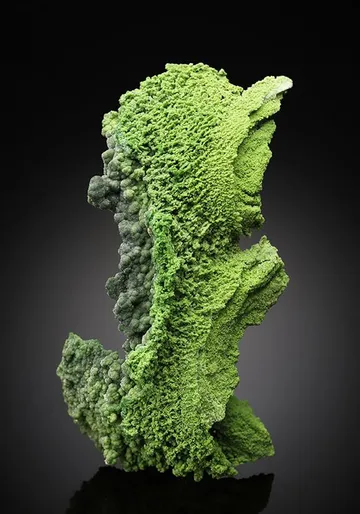
Duftite is a lead–copper arsenate, PbCu(AsO4)(OH), in the adelite–descloizite group best known to collectors for vivid green tones and sparkling drusy to botryoidal habits. Colors range from apple-green and pistachio to olive and mossy green, often forming velvety crusts, hemispherical aggregates, or tight druses of tiny prisms. True, well-formed discrete crystals are uncommon and typically small (micromount size), but when present, they can show sharp prism and wedge faces with bright luster. The species is most celebrated at Tsumeb (Namibia), where it occurs in a remarkable variety of forms and shades, sometimes overgrowing or replacing earlier minerals. Elsewhere—Mexico’s Ojuela Mine, Greece’s Lavrion district, Morocco’s Touissit, and Arizona’s Tiger—duftite provides superb color contrast on limonitic gossan, calcite, dolomite, cerussite, wulfenite, mimetite, or quartz.
In collections, duftite bridges two worlds: attractive cabinet pieces with bright, velvety green coatings, and the micromounter’s realm of exquisite, sharp microcrystals. Good specimens combine rich color, sparkling luster, and a pleasing, evenly distributed coverage on contrasting matrix. The best are far rarer than their general availability suggests, and top examples—especially from classic localities—are highly sought.
Duftite’s popularity rests on its eye-catching greens, classic provenance, and diverse associations. Collectors of Tsumeb, Ojuela, Lavrion, and Tiger minerals often seek duftite alongside adamite, mimetite, conichalcite, and wulfenite for complementary color palettes and paragenetic interest. While affordable examples are common, truly fine pieces—intense color, clean luster, even coverage, aesthetic composition, and classic locality labels—are scarce and command strong prices. Micromounters value duftite for its sharp microcrystals and textbook associations; cabinet collectors appreciate velvety botryoidal coatings with striking contrast on bright white calcite, stoic gray dolomite, or brown iron oxides. The species’ enduring appeal comes from this duality: it is widely collectible at many levels, yet elite specimens remain decidedly rare.
Tsumeb is the definitive duftite locality. The mine’s complex, multi-stage oxidation zones produced an astonishing range of habits: velvety apple- to olive-green botryoids, glittering drusy crusts, and occasional sharp microcrystals, all with rich, saturated color. Classic associations include calcite (often snowy white scalenohedra or rhombs), dolomite, cerussite, mimetite, malachite, azurite, and other arsenates/vanadates of the adelite–descloizite group. Many Tsumeb pieces show paragenetic overgrowths—duftite encrusting or partially replacing earlier species—adding scientific and aesthetic interest. Fine Tsumeb duftite displays even coverage, fresh luster, and intense color; matrix pieces with bright contrast are the most desirable.
- Color: Highly saturated apple- to pistachio-green is most prized. Olive or brownish-green can still be attractive if luster is good and contrast is strong. Uniform color across a coating is preferable to patchy or dull areas.
- Luster and Texture: Velvet-matte botryoids with a fine “nap” are classic, but sparkling drusy coatings with micro-faceting create superb visual pop. Avoid chalky, powdery surfaces; crisp textures indicate freshness.
- Coverage and Contrast: Even, complete coverage over a defined area is desirable. Strong contrast—green duftite against white calcite/dolomite, orange wulfenite, yellow mimetite, or dark gossan—greatly boosts aesthetics.
- Crystal Form: Discrete, well-terminated microcrystals are scarce and coveted by micromounters. On cabinet pieces, continuous botryoidal or drusy habits with crisp edges typically display better than sparse, isolated patches.
- Associations: Classic pairings (e.g., duftite on wulfenite from Ojuela; duftite with calcite/dolomite from Tsumeb; duftite with cerussite/mimetite from Lavrion or Touissit) add both beauty and provenance value.
- Size and Composition: A compact, balanced matrix with duftite covering the “prime face” often trumps a larger, awkward piece with scattered green patches. Look for a natural, harmonious composition that stands upright and presents a clear display angle.
- Condition: Duffty coatings are relatively delicate. Check for rubs or missing patches on high points, bruises along the edges of associated crystals, and trimming chips that intrude into the display area. Pristine surfaces and undamaged associations command a premium.
- Provenance: Labels from storied mines (Tsumeb, Ojuela, Lavrion, Tiger) and known historical pockets increase desirability. Original mine or dealer labels help anchor authenticity and value.
- Repairs: Duftite druses often occur with brittle species (wulfenite, cerussite). Inspect contact points where associated crystals meet matrix for epoxy fills or reattachments. A loupe may reveal glossy glue lines or slight misalignments.
- Cleaning: Acid cleaning can attack arsenates or their matrices. Over-cleaned specimens may show etched, dulled surfaces or unnatural color variation where coatings were thinned. Beware of friable areas stabilized with clear consolidants; look for “glassy” patches that don’t match surrounding texture.
- Coatings or Dyes: Rare for this species, but any unnatural, uniform neon hue or “plastic” luster is suspect. Compare luster and color under different lights; natural duftite should retain a mineral-appropriate reflectivity, not a varnished sheen.
- Assemblages: Ensure matrix and associations match known paragenesis for the locality. Mismatched mineral combinations or odd rock types can indicate artificial assemblages.
Duftite is a lead–copper arsenate with moderate fragility (hardness roughly 3.5–4). Its microcrystalline coatings and botryoids can rub or shed if mishandled.
- Handling:
- Support matrix with both hands; avoid touching the green surfaces directly.
- For micromounts, use soft-tipped tools and minimal pressure when repositioning.
- Cleaning:
- Prefer dry or near-dry methods: a soft artist’s brush, bulb blower, or gentle compressed air at low pressure.
- If necessary, use distilled water with a tiny drop of mild soap applied locally with a soft brush; avoid soaking. Rinse sparingly and air-dry thoroughly.
- Do not use acids, strong alkaline cleaners, or oxidizing agents; they can damage duftite or its matrix/associates.
- Avoid ultrasonic or steam cleaners—vibration and heat can loosen coatings or crack associated crystals.
- Environment:
- Normal display lighting is fine; prolonged direct sun is best avoided for any colored secondary minerals.
- Keep away from heat sources and large humidity swings; thermal shock can fracture matrix or associated species.
- Safety:
- Duftite contains arsenic and lead. It is safe to display, but avoid creating or inhaling dust. Wash hands after handling. Store micromount trimmings or debris responsibly.
- Storage and Transport:
- Cushion specimens individually in foam-lined boxes or drawers; prevent contact with harder minerals.
- Secure display pieces with museum putty on stable bases, especially in vibration-prone settings.
- Re-check long-term mounts; some putties harden over time and may need refresh to ensure stability.
With thoughtful selection and gentle care, duftite can be a highlight of any collection—combining vivid color, classic provenance, and engaging mineral associations in both cabinet and micromount formats.