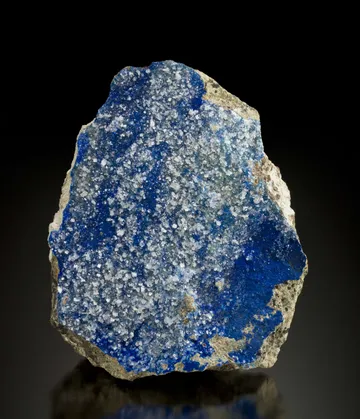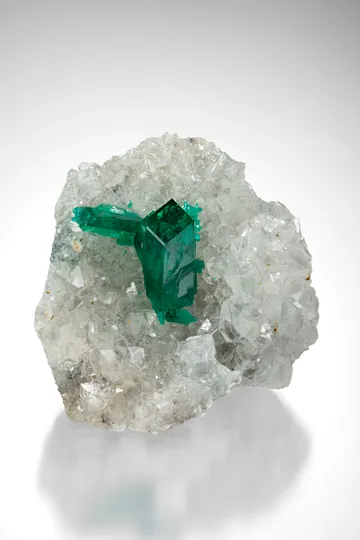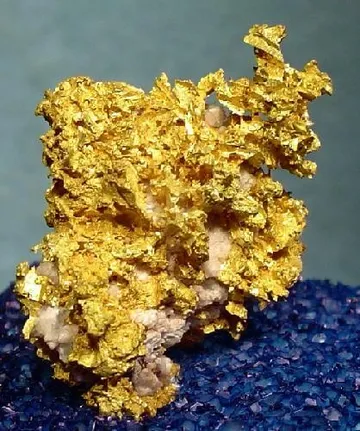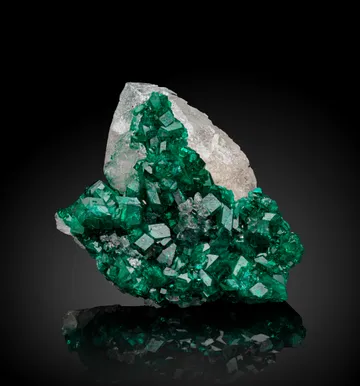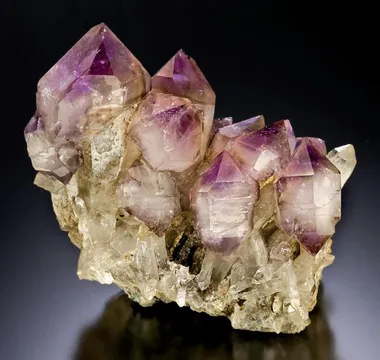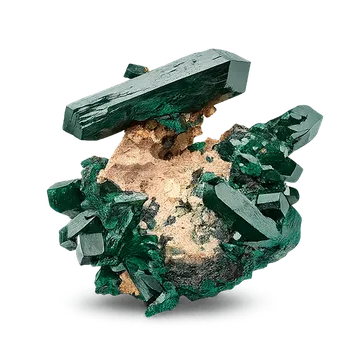
Dioptas vom Christmas Mine, Arizona — smaragdgrüne Mikrokristalle mit Kalkspat-Kontrast; eine klassische Kupfer-Lokalität, geschätzt wegen Herkunft und Charakter.
Key facts
Die Dioptase vom Christmas Mine ist eine der markantesten amerikanischen Erscheinungsformen der Spezies: nicht die großen, glasigen Rhomboeder von Tsumeb oder die tiefgrünen Cluster aus dem Kongo, sondern bright, intens coloriertes arizonisches Kupfer-Silikat-Material aus einem komplexen Skarn- und Porphyr-Kupfer-System in den Dripping Spring Mountains des Gila County. Die besten Stücke zeigen Smaragd- bis Blaugrün-Dioptase als funkelnde Mikrokristalle, strahlende Triebe, Halbkugeln, „Bogen-Tat“-Gruppen oder kleine Kugeln auf blassem Calcit, Chrysokoll, Apophyllit-Gruppe Mineralien, Cuprit, rotem Kupfer oder veränderter Skarn-Matrix. Die Kristalle sind gewöhnlich klein, aber der Kontrast kann hervorragend sein: Grün Dioptase gegen weißen Calcit, Blau Chrysokoll, Rot Cuprit oder blasses Apophyllit verleihen den Exemplaren aus dem Christmas Mine ihren ganz besonderen Charme.
Der Fundort ist genauso wichtig wie das Mineral. Die Christmas Mine ist ein klassischer Kupfer-Fundort in Arizona, eine frühere untertägige und offene Abbauanlage, die Kupfer mit Gold- und Silbernebenerzeugnissen produzierte, und wurde später unter Sammlern wegen seiner seltenen sekundären und retrograden Silikatesgefassungen berühmt. Sie ist der Typ-Standort für mehrere Mineralien, darunter Apachit, Gilalit, Junitoit und Ruizit, und hat seit Langem einen besonderen Ruf unter Mikrometern und Sammlern von Kupfer-Silikat-Mineralien. Die Dioptase passt natürlich in diese Geschichte: Sie ist eine der brillanten sekundären Kupferarten, die sich dort bildeten, wo oxidierende Flüssigkeiten durch zerbrochene, veränderte Karbonat- und Kalk-Silikat-Gesteine wanderten.
Sammler schätzen die Dioptase vom Christmas Mine für den Standortcharakter eher als für die bloße Kristallgröße. Ein erstklassiges Exemplar braucht nicht große Einzelkristalle; es braucht Funkeln, Abdeckung, Farbe und Zusammenhang. Das ideale Exemplar besitzt lebhaftes Grün, glänzende, gut voneinander abgegrenzte Kristalle oder radiale Aggregate, klare Kontraste mit Calcit oder Chrysokoll sowie eine solide alte Provenienz aus Arizona. Größere Tafeln mit dichten mikrokrystalline Beschichtungen können attraktiv sein, aber die befriedigendsten Stücke sind diejenigen, die bei Vergrößerung bestehen und eine scharfe Kristallform anstatt nur eines grünen Flecks zeigen.
Suchen Sie nach Proben: View all dioptase specimens from Christmas Mine, Arizona, USA
Die Christmas Mine liegt im Banner Mining District nahe dem ehemaligen Ort Christmas in der Grafschaft Gila, Arizona, grob nördlich von Winkelman und südlich von Globe, nahe Hayden. Die Mine ist inaktiv. Die Hauptarbeiten umfassten sowohl unterirdische Schächte als auch später Tagebau; historische Berichte beschreiben fünf Schächte, einschließlich eines Haupt-Schachts mit drei Kammern, der bis auf die 908-Fuß-Ebene erschlossen wurde. Die Mine wurde historisch auch unter Namen wie Red Bird shafts, Inspiration Mine und Hackberry shafts erwähnt.
Geologisch ist Christmas kein einfacher Oxide-Copper-Pocket-Lokalität. Es handelt sich um ein skarn-bezogenes Kupfersystem, das mit porphyrischem Mineralisierung verbunden ist. Paläozoische Karbonatgesteine, einschließlich der Martin-, Escabrosa- und Naco-Kalksteine, werden von einem Quarz-Diorit bis Granodiorit-Porphyr-System intrudiert und darüber von Kreide-Vulkaniten überdeckt. Erzbildungsflüsse zögerten durch Kalkstein-Kontakte, begünstigte Lager, garnetisierte Zonen und Brüche. Das Vorkommen wird charakteristisch als kontaktmetamorphisch oder Pyrometasomatisch beschrieben, mit starkem Skarnaufbau und später hydrothermaler sowie oxidativer Alteration. Diese geologische Komplexität erklärt die ungewöhnliche Sammler-Mineralogie der Lokalität: Granat, Diopsid, Wollastonit, Kalkbold, Apophyllit-Gruppe, Kinoit, Junitoit, Gilait, Apachit, Ruizit, Chrysokoll, Cuprit, Malachit und Dioptas gehören alle zu verschiedenen Kapiteln der Alterationsgeschichte der Mine.
Die Christmas-Geschichte beginnt mit Kupferfunden im späten 19. Jahrhundert. Frühe Ansprüche von Dennis O’Brien und William Tweed wurden 1880 erhoben, doch das ursprüngliche Gelände befand sich im San Carlos Apache Indianer-Reservat, und die Ansprüche wurden annulliert. Nachdem eine Grenzänderung das Gelände im Dezember 1902 wieder in den öffentlichen Bereich überführte, verlegte George B. Chittenden die Ansprüche am Christmas-Abend, wodurch der Mine und später der Ort ihren dauerhaften Namen erhielten. Ernsthafte Bergbauarbeiten begannen um 1905. Der frühe Betrieb kämpfte mit Abgeschiedenheit, schlechten Straßen und Schmelzlogistik; die Entwicklung verbesserte sich, nachdem ein Bahnhofsast und das Hayden-Schmelzwerk die Behandlung des Erzes praktikabler machten.
Von 1905 bis 1981 produzierte die Mine 25,8 Millionen Tonnen Erz und ergab 362,9 Millionen Pfund Kupfer, 55.000 Unzen Gold und 2,15 Millionen Unzen Silber. Kupfergehalte variierten stark, von niedriggradigem disseminiertem Material bis zu reichem Erz. Unter Tage dominierte der frühe und mittlere Zeitraum, doch in den 1960er-Jahren drängten unsichere Untertage-Bedingungen die Tätigkeit in Richtung Tagebau. Kupferbergbau wurde im Januar 1982 während des schweren Kupfermarktabschwungs dieses Zeitraums eingestellt.Für Sammler repräsentiert der Großteil des Christmas-Mine-Dioptasen Material, das historisch aus Bergwerksbetrieben, Halden oder damit verbundenen oxidischen Zonen gewonnen wurde, statt neu vor Ort gefördertes Material zu sein. Die Immobilie ging später in den Besitz größerer Kupfergesellschaften über und wird heute von Freeport-McMoRan kontrolliert. Es sollte als geschlossen für beiläufiges Sammeln behandelt werden. Modernes Christmas-Mine-Dioptase ist daher ein Markt- und Sammlungsort, kein öffentlicher Rockhounding-Zielort.
Bemerkenswerte Funde umfassen mehr als Dioptase. Die Mine ist der Typort für Junitoit, Ruizit, Apachit und Gilalit, und sie ist ein wichtiger amerikanischer Fundort für Kinoit, Stringhamit, Whelanit und andere ungewöhnliche Kupfer-Kalzium-Zinksilikate. Dioptase ist eines der visuell zugänglicheren Christmas-Minerale, aber sein echter Sammler-Kontext ist diese seltene, chemisch reiche, karbonat-hoste Kupfer-Silizate-Umgebung.## Eigenschaften von Dioptas aus der Christmas Mine, Arizona, USA
Die Christmas Mine-Dioptase ist typischerweise Material mit kleineren Kristallen. Einzelne Kristalle liegen gewöhnlich im Millimeterbereich oder darunter, können aber funkelnde Krusten, radiale Cluster, Bogen‑Reihen, kugelförmige Aggregate und Halbkugeln von mehreren Millimetern Durchmesser bilden. Händler- und Auktionsbeschreibungen betonen wiederholt Mikrokrystalle, funkelnde Oberflächen, 1 mm Kristalle, 3 mm Bälle, 5 mm Halbkugeln und Vug-Füllungen statt großer freistehender Kristalle.
Die Farbe reicht von Smaragdgrün bis Blaugrün und in einigen Beschreibungen auch blassgrün. Die attraktivsten Stücke zeigen eine reiche Sättigung und hohen Glanz, insbesondere wenn Kristalle auf weißem oder farblosem Kalzit sitzen. Einige Proben tragen Dioptase als strahlende Sprays, die Kalzit überziehen; andere zeigen isolierte grüne kugelförmige Cluster, verstreut über einer miniature Matrixplatte. Die Christmas‑Habit kann unter Vergrößerung fast „grob“ oder nadelig wirken, und Proben belohnen eine Inspektion mit einer Vergrößerungslupe.
Kalzit ist das klassische Kontrastmineral. Weißer bis farbloser Kalzitquader oder Krusten kann die grüne Dioptase heller wirken lassen, und kalzitreiche Stücke gehören zu den Display-fähigsten Christmas‑Dioptasen-Proben. Chrysokoll ist ein weiterer häufiger Begleiter, insbesondere als blaugrüne Matrix oder Kupfer-Silizat-Massen unterhalb der Dioptase. Weitere dokumentierte Assoziationen umfassen Apophyllit‑Gruppenmineralien, Hydroxyapophyllit-(K), Fluorapophyllit-(K), Cuprit einschließlich Chalkotrichit, Malachit, native Kupfer, Kinoit, Junitoit, Wulfenit, Quarz und Chalcanthit. Diese Begleitformen sind kein Zufall; sie sind das Fingerabdruck der Fundstelle.
Die beste Christmas Mine-Dioptase wird anhand von fünf Kriterien bewertet: Farbe, Glanz, Kristalldefinition, Kontrast und Lokalfärbung. Eine winzige, aber scharfe, funkelnde, gesättigte Gruppe auf Kalzit kann begehrenswerter sein als eine größere stumpfgrüne Beschichtung. Stücke mit Dioptase plus Kalzit, Chrysokoll, native Kupfer, Chalkopiryt oder seltenen Christmas‑Silikaten tragen zusätzliches Lokalfärbungs-Interesse. Ein Exemplar mit alter Kollektion Provenienz—insbesondere Arizona-Sammler-Provenienz—kann erheblich wirken, weil der neue Zugang schlecht ist und ein Großteil des besten Materials jetzt durch ältere Sammlungen zirkuliert.
Große cabinet‑size Beispiele existieren, aber viele sind visuell abhängig von der Mikrokrystalldurchdringung. Kleine Cabinets und Miniaturen können hervorragend sein, wenn die Dioptase hell und gut verteilt ist. Thumbnail-Stücke können ebenfalls wichtig sein, wenn die Kristalle scharf, glänzend und mit sauberem Kalzit verbunden sind. Unter Vergrößerung wird der Unterschied zwischen echter kristallisierter Dioptase und einem grünen Kupfersilikatfilm entscheidend.## Collector Notes
Christmas Mine Dioptase ist ein klassisches Lokalkolorit-Exemplar, aber es ist nicht in der Menge vorhanden wie Tsumeb, Mindouli, Kaokoveld oder modernes afrikanisches Material. Es taucht periodisch aus älteren Sammlungen, Händlerarchiven und Erbschaftsmaterial auf, statt einer stetigen Neuzufuhr. Marktbeispiele reichen von bescheidenen Miniaturen mit kleinen grünen Kristallen bis hin zu hochwertigen Begleitstücken mit Calcit, Chrysocolla, Cuprit oder Native Copper. Jüngste öffentliche Angebote umfassten preiswerte kleine Miniaturen, einige hundert Dollar teure Tiny bis Small-Cabinet-Stücke und teurere Begleitspezimen, wenn Kupfer, Calcit oder eine starke Provenienz beteiligt sind.
Authentizitätsbedenken beziehen sich meist auf Herkunftsgebiet und Identifikation, nicht auf aufwendige Behandlungen. Es gibt keine gut etablierte, Christmas Mine-spezifische Fälschungs- oder Behandlungs-kategorie, vergleichbar mit den berüchtigten Problemen, die man bei einigen gefärbten oder hergestellten dekorativen Mineralien sieht. Die realistischen Risiken sind falsch etikettierte Kupferproben aus Arizona, grüne Chrysocolla oder Malachit, die beiläufig als Dioptase verkauft werden, und alte Sammlungs-Labels, die abgekürzte Fundortnamen verwenden. Eine sichere Christmas Mine Dioptase sollte echte kristallisierte Dioptase zeigen—idealerweise scharfe, glänzende, trigonal wirkende Kristalle oder radiale Aggregate—und nicht nur eine grüne Beschichtung. Zugeordnete Calcit-, Chrysocolla-, Apophyllit-, Cuprit-, Native-Copper-, Kinoit- oder Skarn-Matrix können die Attribution stützen, beweisen sie jedoch nicht allein.
Der Zustand ist wichtig, weil die Kristalle klein und exponiert sind. Mikro-Absplitterungen, gedrückte Aggregatspitzen, abgenutzte Gipfel und Calcit-Verkratzungen gehören zu den häufigen Prüfpunkten. Geschliffene Basen sind bei Matrix-Stücken nicht ungewöhnlich und stellen kein grundsätzliches Problem dar, sofern sie offengelegt werden und die Anzeigefläche natürlich ist. Calcit-Assoziationen können attraktiv, aber zerbrechlich sein; vermeiden Sie Säure-Reinigung, es sei denn, die Mineralogie ist vollständig verstanden, denn Calcit und einige sekundäre Kupfermineralien tolerieren keine fahrlässige Behandlung. Dioptase selbst zeigt eine gute Farbstabilität unter normalen Display-Bedingungen, ist jedoch spröde und sollte als Kabinettsmineral behandelt werden, nicht als rohes Lapidarmaterial.
Zum Einkauf: Die begehrtesten Etiketten lesen über „Arizona-Dioptase“ hinaus. Achten Sie auf Christmas Mine, Christmas, Banner Mining District, Gila County, Arizona, USA, und achten Sie auf die Provenienz. Ex-Sammlungshinweise von anerkannten Arizona-Sammlern oder lang etablierten Mineralhändlern geben zusätzliche Zuversicht. Stücke, die nur als „Christmas Mine“ beschrieben sind, sollten immer mit dem tatsächlichen visuellen Stil abgeglichen werden: Kleine, leuchtend grüne Kristalle, oft mit Calcit oder Chrysocolla, sind viel plausibler als große isolierte Edelstein-Kristalle.## Geschichten & Feldnotizen
Der Name der Mine gehört zu den großartigen Ortsnamens-Geschichten im Arizona-Bergbau. Die frühen Ansprüche lagen innerhalb des San Carlos Apache-Indianerreservats, wodurch die ursprünglichen Standorte ungültig wurden. George B. Chittenden verbrachte Jahre damit, zu versuchen, die Grenze zu ändern, und als das Gelände im Dezember 1902 endgültig wieder in den öffentlichen Bereich überführt wurde, erreichte die Nachricht das Camp in dem perfekten dramatischen Moment. Chittenden und N. H. Mellor handelten rasch, indem sie die Ansprüche am Weihnachtstag anmeldeten. Ihre Gedenkzeile – „Wir füllten unsere Strumpfbeutel und benannten den Ort Christmas zu Ehren des Tages“ – gab der Mine einen Namen, den keine spätere Unternehmensbesitzschaft oder Offen-Pit-Ausdehnung wieder auslöschen konnte.
Die Stadt, die sich um die Mine herum bildete, trug den Witz in die amerikanische Postfolklore. Christmas, Arizona, hatte ein Postamt, das 1905 eröffnet wurde und dann mit dem Glück der Mine auf und ab ging. Während der Feiertage schickten Menschen im ganzen Land Karten und Pakete dorthin, nur um sie mit einem Weihnachtstempel erneut versandt zu bekommen. Die Bezahlung des Postmeisters hing stark vom Briefmarkenverkauf ab, daher war der Weihnachtansturm von Bedeutung. Das Postamt schloss dauerhaft am 30. März 1935, doch der Name hatte sich in der öffentlichen Vorstellung so festgesetzt, dass der Urlaubsbriefverkehr Berichten zufolge noch jahrelang ankam und über das nahe Winkelman weitergeleitet werden musste.
Eine der besten Sammler-Geschichten gehört einem Kabinettsstück, das 1984 von Bob Hauck als selbst gesammelt verkauft wurde. Die Beschreibung liest sich wie ein Trophy-Trophäe eines Feldsammlers aus alten Zeiten: „funkelnd, facettenreich und glänzend“ smaragdgrüne Dioptas-Kristalle, die mehrere Höhlenräume auf beiden Seiten eines dichten Erz-Matrix ausfüllen, mit blaugrüner Chrysokolla und Malachit als Ergänzungen. Das Stück maß 12,1 x 9,8 x 3,6 cm, ungewöhnlich groß für die Lokalität, und wurde bei einer Auktion 2011 auf 750–1.000 USD geschätzt. Die Überraschung des Catalogus ist aussagekräftig: „Ich persönlich habe hier noch NIE einen Dioptas gesehen.“ Diese Reaktion fängt ein, wie Dioptas aus der Christmas Mine jahrelang leicht außerhalb des Mainstreams lag – den Arizona-Spezialisten und Mikrominern bekannt, aber trotzdem schockierend, wenn ein reicher,展示großer Exemplar auftauchte.
Aktuellere öffentliche Auktionsbeschreibungen zeigen, wie Sammler den Stil der Lokalität zu erkennen gelernt haben. Ein 2024er Klein-Kabinett-Dioptas mit Calcit aus der Provenienz von Tom Hales und Alex Neufeld wurde beschrieben als ungewöhnlich glänzend und komplexe, funkelnde Kristalle von etwa 1 mm Durchmesser, durchsetzt mit weißem bis farblosem Calcit. Der Catalogist machte den Punkt, den jeder Arizona-Sammler versteht: Afrikanischer Dioptas mag leicht zu kaufen sein, aber ein gutes Arizona-Präparat ist eine ganz andere Sache. Ein 2025er „Schleifen“-Gruppensstück, ex George Loud und Dick und Joyce Willis, brachte die Christmas-Gewohnheit erneut in den Fokus: nicht riesige Kristalle, sondern charakteristische Sprays und Gruppen aus einer Lokalität, deren Reiz in Struktur, Geschichte und Verbindung liegt.## Mineralogische Aufzeichnungen & Publikationen
Briggs, D.F. (2021), „History of the Christmas Mine, Gila County, Arizona,“ Arizona Geological Survey Contributed Report CR-21-A, 45 pp. — Der beste moderne historische Überblick über die Mine, einschließlich Produktionszahlen, Eigentum, Bergbautechniken und Geologie.
Arizona Geological Survey, „Christmas Mine of Gila County, AZ — 1880s to 1982“ — Knapp gefasste AZGS-Zusammenfassung der Geologie, Produktion, Bergbaugeschichte und Schließung der Mine.
Peterson, N.P. and Swanson, R.W. (1956), „Geology of the Christmas copper mine, Gila County, Arizona,“ U.S. Geological Survey Bulletin 1027-H — Fundamentaler USGS-Wirtschaftsgeologie-Bericht basierend auf Bergwerksarbeiten und Diamantbohrungen.
Peterson, N.P. and Swanson, R.W. (1956), USGS Bulletin 1027-H PDF — Direkter Zugriff auf den Originalbericht.
Ross, C.P. (1925), „Ore deposits of the Saddle Mountain and Banner mining districts, Arizona,“ U.S. Geological Survey Bulletin 771 — Frühe districtweite Behandlung im Kontext des Banner Mining District.
Ross, C.P. (1925), USGS Bulletin 771 PDF — Direktes PDF des historischen USGS-Bulletins.
Perry, D.V. (1969), „Skarn genesis at the Christmas Mine, Gila County, Arizona,“ Economic Geology, 64(3), 255–270 — Schlüsseldokument zur Skarn-Entstehung des Christmas-Vorkommens.
Williams, S.A. (1976), „Junitoite, a new hydrated calcium zinc silicate from Christmas, Arizona,“ American Mineralogist, 61, 1255–1258 — Originalbeschreibung von Junitoit aus dem Christmas-Minenvorkommen.
Williams, S.A. and Duggan, M. (1977), „Ruizite, a new silicate mineral from Christmas, Arizona,“ Mineralogical Magazine, 41, 429–432 — Originalbeschreibung von Ruizit aus dem Christmas-Minenassemblage.
Cesbron, F.P. and Williams, S.A. (1980), „Apachite and gilalite, two new copper silicates from Christmas, Arizona,“ Mineralogical Magazine, 43, 639–641 — Originalbeschreibung von zwei seltenen Kupfer-Silikaten aus den Christmas-Taktiten.
Mindat type-locality report for Christmas Mine — Schneller Bezug für die Mineralien, für die die Christmas Mine der Typ-Standort ist.- Mindat Dioptas-Vorkommenseintrag für Christmas Mine — Arten-spezifische Vorkommensseite für Dioptas bei der Christmas Mine.
Mindat-Lokalitätenseite für Christmas Mine — Breite Lokalitätsseite mit Koordinaten, Mineralienliste, Referenzen und Foto-Datenbank.## Videos & Medien
„Cuprum mit Dioptas und Calcit — Christmas Mine, Arizona, USA,“ EarthWonders — Präge- bzw. Exponatseite mit einem Vimeo-Video einer naturreinen Kupfer-, Calcit- und Dioptas-Verbindung aus der Christmas Mine.
„Cuprit mit Calcit, Dioptas,“ Weinrich Minerals — Händlerarchivseite mit Exponatvideo für eine kabinettsgroße Christmas Mine Cuprit-, Calcit- und Dioptas-Verbindung.## Weiterführende Lektüre & Externe Links
Mindat — Christmas Mine, Christmas, Banner Mining District, Gila County, Arizona, USA — Wesentliche Fundortseite mit Mineralienliste, Referenzen, Karten und Probeaufnahmen.
Mindat — Dioptas aus der Christmas Mine — Fokusierte Dioptas-Fundstelle mit zugehörigen Mineralien und Galeriezugang.
Mindat — Christmas Open Pit Sublokalität — Nützliche Sublokalitätsseite für offene Erzgruben-Mineralverbindungen innerhalb des Christmas-Mine-Systems.
Arizona Geological Survey — Geschichte der Christmas Mine, Gila County, Arizona — Herunterladbarer moderner historischer Bericht von David F. Briggs.
Arizona Geological Survey — Christmas Mine von Gila County, AZ, 1880er bis 1982 — Kurzer, gut lesbarer Überblick über Produktion, Geologie und Minengeschichte.
US Geological Survey — Geologie der Christmas-Copper Mine, Gila County, Arizona — Offizielle USGS-Landing-Page für Bulletin 1027-H.
USGS Bulletin 1027-H PDF — Direkte PDF-Version des Berichts von Peterson und Swanson aus dem Jahr 1956.
Arizona Memory Project — Erzvorkommen der Saddle Mountain- und Banner-Bergbaureviere in Arizona — Zugangspunkt zum Ross’ Distriktsbericht von 1925.
USGS Bulletin 771 PDF — Direkte PDF-Version der frühen Banner-Distriktsstudie von Ross.
Mineral Auctions — Dioptas selbst gesammelt von Bob Hauck, 1984 — Archivierter Auktionsbericht über eine große, historisch interessante Christmas Mine-Dioptas.
Mineral Auctions — Dioptase mit Calcit, seltenes Fundgebiet — Archivierter Auktionseinstieg 2024, der hochglänzende mikro-kristalline Christmas-Mine-Material zeigt.
Mineral Auctions — Dioptase „Schwanzpeil“-Gruppen — Archiviertes Auktionsbeispiel 2025, das die Strahlungsform des Fundorts zeigt.
Marin Mineral — Dioptase mit Calcit aus der Christmas Mine — Händlerbeispiel eines Vorschaubildes mit grünen kugelförmigen Dioptas-Cluster und Calcit.
UC Minerals — Dioptase auf Chrysokolla — Händlerbeispiel einer kleinen radialen Dioptase-Kugel auf Chrysokoll-Matrix.- Weinrich Minerals Archiv — Dioptas aus der Christmas Mine — Händlerarchiv, das mehrere Christmas Mine-Dioptase-Einträge und Größen zeigt.