Datolite Collectors Guide
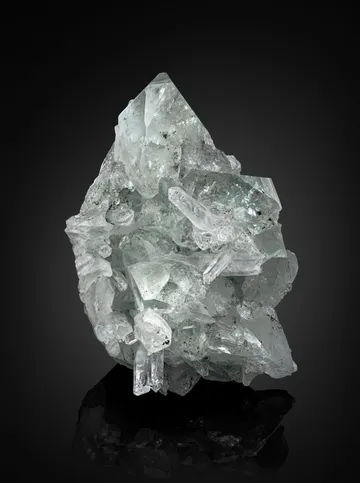
Datolite is a calcium borosilicate, CaBSiO4(OH), prized by collectors in two very different styles: lustrous, sharply formed crystals from hydrothermal and skarn environments, and the famed Keweenaw Peninsula nodules—colorful, patterned masses that are sliced and polished into striking cabochons and display plates. Crystals commonly form blocky to wedge-like habits with bright vitreous luster, often colorless to milky white, but also pale green, yellow, or pinkish. Associations vary by environment: in basaltic amygdules it occurs with prehnite, apophyllite, zeolites, and calcite; in carbonate/Skarn systems (e.g., Dalnegorsk), with calcite, quartz, fluorite, and sulfides.
Keweenaw datolite nodules are a world of their own: compact, sugar-grained aggregates showing subtle to bold colors (peach, salmon, green, rust), banding, and intricate veining, often due to copper- and iron-related inclusions. The finest nodules can be the centerpiece of a case even without crystals. On the crystalline side, sharp, glassy groups from New Jersey’s trap-rock quarries and Dalnegorsk, Russia, set the standard for aesthetics and form. Pricing spans broadly: modest New Jersey crystals and small polished nodules are accessible, while large, patterned Keweenaw plates or top-tier Dalnegorsk clusters can command serious premiums.
Datolite enjoys a dual fan base. Lapidary and Great Lakes collectors covet Keweenaw Peninsula nodules for their unique colors and patterns—an iconic byproduct of the historic copper mines—while specimen purists love the clean geometry and luster of trap-rock and skarn crystals. New Jersey produced classic crystals through the 19th and 20th centuries from construction and quarry operations around Paterson and Prospect Park. In the 1980s–2000s, Dalnegorsk exports introduced many to exceptionally glassy crystalline datolite, often on elegant calcite or quartz matrix.
Today, competition is particularly keen for:
- Polished Keweenaw nodules with large format, fine translucency, vivid color contrast, and dramatic patterning.
- Undamaged, sharply faceted New Jersey trap-rock crystals on contrasting matrix.
- Dalnegorsk clusters with clarity, symmetry, and balanced matrix composition.
This blend—lapidary art meets classic crystal aesthetics—keeps datolite perennially desirable.
While datolite is widespread, a handful of localities produce specimens and nodules of enduring importance to collectors.
Dalnegorsk is famous for razor-sharp, glassy datolite crystals—often colorless to faintly green—formed in hydrothermal carbonate veins. Crystals range from single, highly lustrous prisms to elegant clusters on calcite, quartz, and sulfide matrix. The best pieces show exceptional clarity, lustrous, crisp faces, and textbook wedge-like habits, sometimes in stacked or parallel groups. Production surged with the opening of Soviet sources to the West, making Dalnegorsk a benchmark for modern datolite crystals.
Collectors value:
- Pristine terminations, high-luster faces, and transparency.
- Strong composition with snowy calcite or sparkling quartz providing contrast.
- Balanced groups with minimal or no repairs.
For datolite, it helps to think in two lanes—crystals and nodules—as each has distinct value factors.
- Color and Transparency (Crystals):
- Most collectible crystals are colorless to milky or pale green; stronger natural color is a plus but uncommon.
- High transparency and glassy luster on faces add “sparkle” and visual depth. Slight internal veils are acceptable if the faces are bright and sharp.
- Crystal Form and Aesthetics (Crystals):
- Seek well-developed wedge/blocky habits with crisp, reflective faces and clean terminations.
- Matrix associations (prehnite, apophyllite, calcite, quartz) should provide contrast and balance. Clusters where crystals point at complementary angles often display best.
- Condition (Crystals):
- Tip integrity is crucial; nicks are very visible on glassy faces.
- Be mindful of extraction-related contacts; accept small hidden contacts if overall display is strong.
- Color, Pattern, and Translucency (Nodules):
- Polished Keweenaw nodules are judged on pattern (veining, banding), color contrast (peach/pink/green vs. cream), and translucency.
- Larger, symmetric nodules or slabs with strong design “flow” are most desirable. Fine grit polishing and even sheen indicate quality preparation.
- Size and Presentation (Both):
- Larger undamaged crystals or larger nodule plates command premiums—provided aesthetics remain high.
- Historical labels (e.g., Bergen Hill, classic Paterson quarries; named Keweenaw mines) significantly enhance value.
- Rarity and Provenance:
- Historic New Jersey pieces and fine Dalnegorsk clusters are scarcer than they once were.
- Keweenaw nodules from famous mines (Quincy, Central, Cliff, Delaware) with documentation are actively pursued.
- Repairs (Crystals):
- New Jersey and Dalnegorsk crystals may be reattached to matrix or rejoined across a clean break. Look for alignment discontinuities in striations, glossy glue films, or slight color/luster changes along a seam. Longwave UV can sometimes reveal fluorescent epoxy lines.
- Over-etch or Surface Prep (Crystals):
- Trap-rock pieces are often carefully etched to remove basalt. Over-etching can leave an unnaturally “melted” look or undercutting around crystals. Prefer natural-looking, conservative preparation.
- Polishing/Impregnation (Nodules):
- Keweenaw nodules are routinely cut and polished; that’s normal and expected. Stabilization with resin can occur for fractured material—acceptable if disclosed.
- Beware of artificially dyed nodules (uncommon but possible). Suspiciously vivid, uniform colors not typical of the district, color concentrated in cracks, or dye bleed under solvent swabs are warning signs.
- Reassembled Nodules:
- Rarely, smaller fragments are assembled into a larger “composite” plate—check vein continuity and micro-joins for clues. Provenance and dealer reputation help avoid surprises.
Datolite is moderately hard (about 5–5.5 Mohs) but brittle, with no prominent cleavage; treat it gently.
- Handling:
- Support matrix pieces with two hands; avoid pressure on crystal tips. Keep polished nodule faces from rubbing against harder specimens.
- Light and Temperature:
- Colors are generally stable under normal display lighting. Avoid prolonged high heat or direct sunlight on any resin-stabilized nodules. Keep away from rapid temperature changes to prevent cracking.
- Cleaning:
- Dust gently with a soft brush. For more thorough cleaning, use lukewarm water with a drop of mild soap; rinse and air-dry.
- Avoid acids and harsh chemicals—datolite can react in strong acids (e.g., HCl), and associated minerals/matrix may be vulnerable.
- Do not use ultrasonic or steam cleaners; vibrations/heat can fracture crystals or compromise repairs.
- For polished nodules, a light buff with a clean microfiber cloth restores sheen; avoid oils that can darken and attract dust.
- Storage and Display:
- Provide individual padding for each specimen; keep polished nodules separated from rough pieces that could scratch them.
- Secure display stands with museum putty if in vibration-prone areas.
- Maintain labels—provenance is especially important for historic New Jersey trap-rock pieces and Keweenaw nodules from named mines.
With thoughtful selection and care, both crystal specimens and polished nodules of datolite can provide enduring beauty—bridging fine mineral aesthetics and the unique lapidary artistry of the Great Lakes copper country.