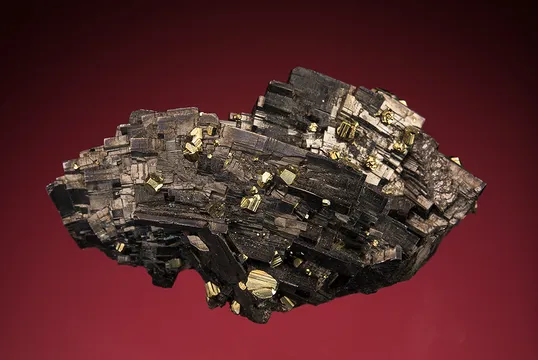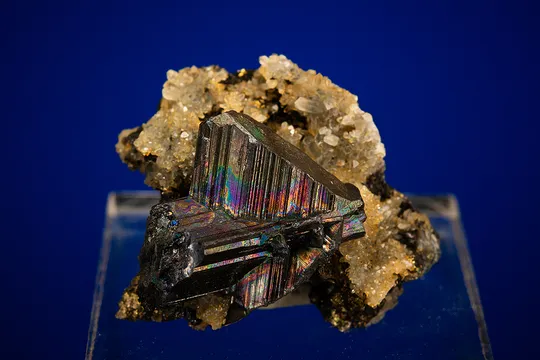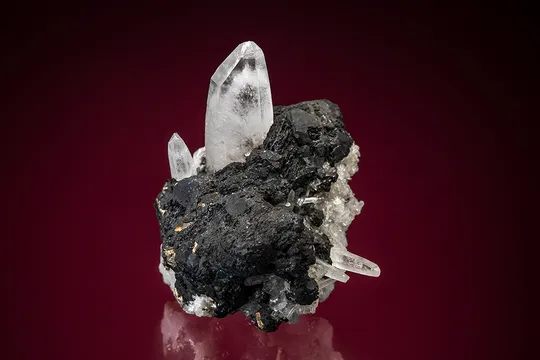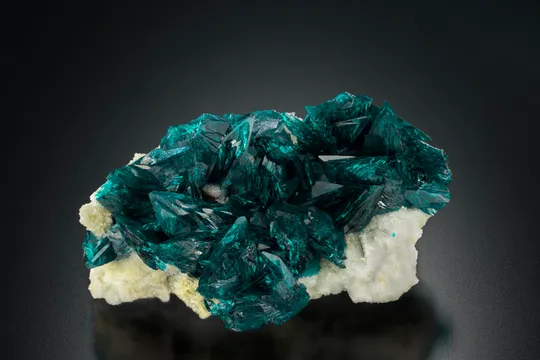
Covellite from the Butte Mining District, USA - a classic copper-sulfide with gunmetal to electric indigo iridescence, hexagonal blades on matrix, highly prize…
Key facts
Covellite from the Butte Mining District is one of the classic American copper-sulfide specimens: dark as gunmetal at first glance, then suddenly electric blue, violet, magenta, and peacock purple when the light catches the cleavage faces. The best Butte pieces are not merely “blue copper ore.” They are sculptural aggregates of thin hexagonal blades and foliated plates, commonly perched on pyrite or quartz-rich sulfide matrix, with the kind of iridescence that makes a specimen change character as it is turned in the hand.
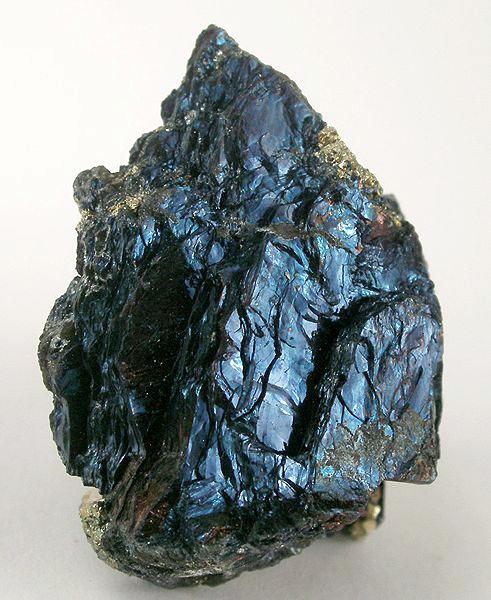
Photo: Wikimedia Commons
Butte’s covellite belongs to one of the great porphyry-related vein systems of North America. The district sits in and around the Butte Quartz Monzonite of the Boulder batholith, where early disseminated copper-molybdenum mineralization was overprinted by enormous Main Stage quartz-pyrite-sulfide veins. Those veins made Butte “The Richest Hill on Earth,” but they also made it one of the world’s definitive covellite localities. Unlike many copper camps prized for oxidized minerals such as azurite, malachite, or cuprite, Butte’s collector fame rests heavily on sulfides: enargite, chalcocite, bornite, pyrite, digenite, colusite, and covellite.
The Leonard Mine is the name most often attached to top Butte covellite, and for good reason. Leonard material ranges from rich, massive ore specimens to exceptional crystal groups with tabular blades. East Colusa specimens are also important, particularly for covellite on pyrite matrix, and the broader district has yielded covellite from several closely spaced mines and workings. The finest pieces show well-defined plate edges, open display surfaces, rich indigo to violet iridescence, and attractive contrast against brassy pyrite, white quartz, or dark sulfide matrix.

Photo: Wikimedia Commons
Historically, Butte covellite has an unusually strong collector pedigree. Specimens came out of working underground mines when Butte was still an industrial copper powerhouse, and old labels from Leonard, East Colusa, Kelley, Steward, and other district mines carry real weight. The best examples are now legacy specimens: old-time pieces from closed, flooded, or inaccessible workings, sometimes with collection histories that date to the mid-20th century or earlier.
Search for specimens: View all covellite specimens from Butte Mining District, USA
The Butte Mining District, also known historically as the Summit Valley district, lies at Butte in Silver Bow County, southwestern Montana. Its ore system is centered on the Butte Quartz Monzonite, part of the Boulder batholith, and is famous for a two-stage copper system: an earlier porphyry copper-molybdenum system and later Main Stage polymetallic veins. The Main Stage veins are the classic specimen source. They are quartz-pyrite-sulfide fissure veins and replacement bodies that carried chalcocite, enargite, bornite, covellite, digenite, colusite, sphalerite, galena, and many other species.
For covellite collectors, the most important names are Leonard Mine and East Colusa Mine. The Leonard Mine was developed in 1890 and became one of Butte’s great underground copper mines. By the 20th century it was linked operationally with nearby workings, including East Colusa, West Colusa, Tramway, Minnie Healey, and others, as old shafts were abandoned and deeper access shifted through major mine plants. The Leonard produced rich copper ores for decades, with chalcocite and enargite as principal ore minerals and covellite as a lesser but highly collectible copper sulfide.
The district’s mining history began with precious metals, shifted decisively to copper in the 1880s, and then grew into one of the most productive copper camps in the world. The Leonard Mine’s main operating life ran from its 1890 development through closure in 1958, followed by reactivations in the 1960s and early 1970s. It reopened in January 1972 to produce 4% copper ore at roughly 650 tons per day; its headframe was blasted down on September 18, 1973, to make room for the expanding Berkeley Pit, and the underground workings shut down in February 1975. The Leonard workings are now flooded and inaccessible.
Collecting access is therefore historical rather than field-collecting oriented. Serious Butte covellite is obtained through old collections, dealer inventories, estate material, and occasional specimens released from long-held local stock. The old underground mines are not open collecting sites, and the Berkeley Pit and active mine areas are industrial and environmental-regulated ground, not casual collecting localities. Labels and provenance matter, especially because specimens may be attributed broadly to “Butte” when the exact mine is unknown.
Notable finds include thin hexagonal covellite plates, rich foliated masses, covellite with pyrite, covellite with quartz, covellite associated with chalcocite or digenite, and rare combinations involving bornite, enargite, colusite, or luzonite. Historical reports also mention large masses of covellite ore, but cabinet-quality crystallized specimens are far more selective and much more prized than simply rich blue-black massive material.
Butte covellite is best known for thin, tabular, hexagonal to pseudohexagonal plates and foliated crystalline masses. Individual crystals may appear as flexible-looking blades or leaf-like plates, but the mineral is soft and cleavable rather than tough. The best crystals have sharp plate outlines, stepped or stacked growth, and lustrous faces that flash blue, violet, purple, magenta, and sometimes bronze or gold overtones.
The fundamental color is deep indigo-blue to blue-black. On display-quality pieces, the iridescence is not a superficial gimmick but a natural optical effect of covellite’s metallic surfaces, cleavage, crystal orientation, and tarnish. Some specimens look nearly black until angled into light; others show intense peacock colors across most of the exposed surface. Fresh-looking indigo, violet-blue, and magenta are especially desirable when combined with good crystal form.
Typical collectible specimens are thumbnails through miniatures and small cabinets. Fine small groups may show blades in the millimeter to centimeter range, while better Leonard pieces can display plates around 1 to 2 cm. Reported Butte crystals reached much larger dimensions, and historical summaries note thin hexagonal plates up to about 7.5 cm across, but sharp, undamaged, well-displayed crystals of that scale are exceptional. Massive and foliated ore pieces can be much larger than cabinet size, including old rich chunks valued more for locality and visual richness than for discrete crystal perfection.
Common associated minerals include pyrite and quartz, both of which are important visually. Pyrite gives many Butte covellite specimens their classic contrast: brassy metallic cubes or granular pyrite against blue-purple covellite. Quartz may be massive, drusy, or crystalline, and white quartz can set off the dark covellite sharply. Other important associations include chalcocite, digenite, bornite, enargite, chalcopyrite, sphalerite, galena, luzonite, calcite, and colusite. East Colusa material is particularly notable in the collector world for covellite on pyrite matrix, while Leonard specimens often carry the highest prestige for crystallized covellite.
Quality is judged by more than color alone. Serious collectors look for recognizable plate habit, intact edges, strong luster, natural iridescence, aesthetic spacing, and old provenance. A specimen with modest color but crisp, undamaged blades may outrank a brighter but battered ore chunk. Matrix also matters: covellite perched on pyrite or quartz is generally more displayable than a dense black-blue mass, although richly foliated massive Butte material has its own historic appeal.
Butte covellite is a classic locality material, but it is also delicate. Covellite has low hardness, perfect basal cleavage, and thin plates that bruise, cleave, rub, and chip easily. Many old pieces show contacted edges, broken blade tips, dull rubbed areas, or cleaved surfaces where the specimen separated from a pocket wall or ore face. This is common, but condition still strongly affects value.
The most important authenticity issue is usually not outright fakery but correct identification and locality discipline. Dark copper sulfides from Butte can be visually treacherous: covellite, chalcocite, digenite, bornite, and mixed copper-sulfide intergrowths may resemble one another, especially in massive or partially altered material. Fine crystallized covellite is easier to recognize by its platy habit and blue-violet metallic iridescence, but massive “covellite” should be treated cautiously if the label is vague. For high-value pieces, old labels, collection history, and, where warranted, analytical confirmation are meaningful.
The phrase “peacock ore” can cause confusion. In the broader mineral trade it is often applied loosely to bornite or even chemically treated chalcopyrite. Butte covellite should not be evaluated by “rainbow” color alone. Real Butte covellite tends toward indigo-blue, violet, purple, and magenta metallic flashes, commonly with a platy or foliated habit, and often with pyrite, quartz, or other Butte sulfides. Overbright, acid-treated chalcopyrite sold as “peacock ore” is not a substitute for covellite and should not command Butte covellite prices.
No recurring, well-documented fake industry is associated with Butte covellite in the way that heat-treated amethyst is associated with false citrine or acid-treated chalcopyrite with “peacock ore.” The larger concern is mislabeling: non-Butte covellite sold under a famous locality, massive mixed copper sulfide sold as crystallized covellite, or old Butte sulfide pieces assigned too confidently to Leonard Mine when the original label only says “Butte.”
Market availability is uneven. Small massive or foliated Butte covellite pieces still appear, including lapidary rough and modest cabinet specimens. Good crystallized Leonard or East Colusa pieces are much less common, and top-quality examples with sharp blades, strong iridescence, and old labels are genuinely competitive. The best Butte covellites belong in the same conversation as Summitville, Colorado, and Sardinia, Italy, for classic covellite specimens, but Butte’s combination of historic mining context, sulfide associations, and old American provenance gives it a distinct collector identity.
Storage should be gentle and dry. Avoid handling the faces, as skin oils and abrasion can reduce luster. Do not clean aggressively, do not scrub, and do not use chemical dips. A soft brush used sparingly is usually the upper limit of safe intervention. Thin plates are best protected in a box or display case where they cannot rub against harder minerals.
The Leonard Mine’s collector story begins in the darkness of an industrial copper mine, not in a weekend collecting pocket. By the 1950s the mine was already famous for crystallized enargite, pyrite, quartz, and occasional crystals of more than a dozen other species. Specimens were small enough to travel unofficially: miners brought them out in lunch boxes and sold them for extra income. The Anaconda Company eventually recognized what collectors already knew and called Leonard “a mineral collector’s paradise.” In August 1974, Anaconda went a step further and hired geologist Duane Johnson to collect specimens from the underground Butte mines and place them on the specimen market.
The Leonard workings were born in Butte’s era of enormous ambition. The mine was established on the Piccolo claim, originally located by J. N. Collins on January 24, 1879. A new shaft called the Leonard was developed in 1890 with a 95-foot headframe, and the mine soon outperformed the Colusa. In 1901, a 1,000-gallon-per-minute pump—the largest in the district—was installed on the 1,200-foot level. When underground warfare tied to the notorious apex litigation reached the Leonard’s neighbor, the Minnie Healey, the Leonard pumps became weapons as much as machinery: when their discharge pipes were turned into the Minnie Healey workings, flooding helped force Heinze’s men to stop underground sabotage.
The new Leonard No. 2 shaft of 1906 was built on a scale that matched Butte’s appetite. Its steel headframe weighed 346,425 pounds. The hoist used a 3,000-horsepower engine and 1.5-inch steel cable to lift 5-ton skips. The new shaft improved ventilation and lowered mine temperatures by 20 degrees, a detail that says more about underground Butte than any romantic mining postcard could.
Then came fire. In 1906, spontaneous combustion started a fire on the 1,100-foot level of the Minnie Healey Mine. It spread through the 1,300- to 2,000-foot levels of the Tramway, West Colusa, and Leonard mines, and rose to the 600 level in the Minnie Healey. The fire zones were sealed with bulkheads, stranding good ore behind them. On April 24, 1911, the Leonard suffered its worst day: a hoist dropped 14 men 1,500 feet to the bottom of the shaft. Five were killed, and the other nine were crippled by severe injuries.
The scale of the later fire-control work was almost geological. In 1917, Butte engineers began filling the fire zone with mill tailings from the Black Rock mill. Blasting near hot rock had to be minimized because of the danger that heat would prematurely detonate explosives. Water from the fill had to be drained and pumped away so hidden reservoirs would not break into lower workings and drown men below. About 1,700 tons of tailings per day were pumped into the Leonard. After five years, more than 4,000,000 tons of tailings had been placed, more than 200,000 feet of diamond drilling had been completed, and abandoned ground could be reopened.
Butte’s mineral specimens also carry the everyday human residue of the copper camp. A National Geographic account of a visit to Butte described covellite from the Leonard Mine as a stone that sparked “silver and gold, blue and then purple,” then pivoted to enargite, the arsenic-bearing copper sulfide so important at Butte. A local geologist explained the old pasty story: Cornish miners held the crimped crust of the meat pie as a handle, ate the filling, and threw the crust away because their fingers were dusted with arsenic-bearing ore. It is a perfect Butte detail—food, immigration, copper, poison, and practical habit all folded into one object.
The final chapter of Leonard as a collecting locality is not a romantic reopening but a disappearance. The mine closed in May 1958, reopened for periods in the 1960s, and was brought back again in January 1972 to produce 4% copper ore. On September 18, 1973, the Leonard headframe was blasted down to make way for the Berkeley Pit. By February 1975 the underground mine was shut down, and with the later abandonment and flooding of the Berkeley Pit system, the old Leonard workings became flooded and inaccessible. Every sharp covellite blade with an old Leonard label is therefore a survivor from a world that cannot simply be revisited.