Luc Yen corundum, Vietnam — marble-hosted rubies and sapphires with a well-documented modern pedigree, vibrant colors, and strong collector appeal.
Key facts
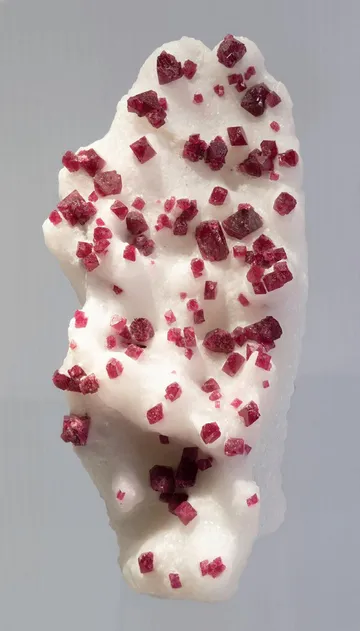
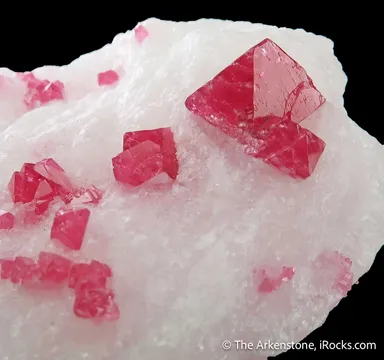
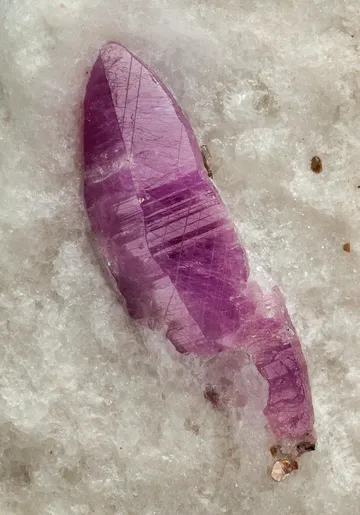
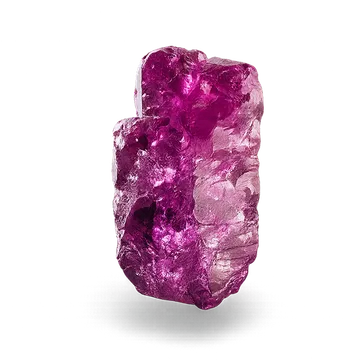
Luc Yen corundum is one of the great modern mineral-and-gem stories of Southeast Asia: ruby and sapphire from a marble country that can look, at its best, startlingly close in spirit to classic Mogok material, yet with a Vietnamese personality of its own. The collector appeal is immediate. Ruby crystals sit in sugary white calcite marble with a saturated pink-red to red body color, often waxy to lustrous on stepped and striated faces, the contrast between red corundum and white carbonate doing much of the visual work. Sapphires from the same district add a broader palette: pink, purple-pink, colorless, gray, blue, brownish, and occasional orange or fancy-toned stones, including bipyramidal crystals and star material.

Photo: Wikimedia Commons
Geologically, Luc Yen belongs to the marble-hosted ruby family that made parts of Central and Southeast Asia famous among gemologists: ruby and spinel formed in recrystallized carbonate rocks rather than in basaltic alluvium. The Luc Yen deposits lie in northern Vietnam’s Yen Bai Province, in the Lo Gam tectonic zone on the eastern side of the Red River shear-zone system. The corundum occurs both in primary marble and in secondary concentrations where weathering has released tough ruby and sapphire crystals into karst pockets, alluvial fans, and narrow valley gravels.
The locality’s historical importance is unusually recent and unusually well documented. After gem discoveries in 1987, Luc Yen rapidly changed from a quiet agricultural district into Vietnam’s best-known colored-stone trading center. In collector terms, it arrived late enough that good field photographs, gemological studies, dealer records, and specimen photographs exist from the early boom years onward. That gives Luc Yen material a more traceable modern pedigree than many older ruby localities.
Collectors tend to separate Luc Yen corundum into several overlapping categories. The finest mineral specimens are ruby crystals on white marble, particularly pieces with isolated, well-positioned crystals or clusters rather than a shapeless mass of corundum. Gem collectors prize clean, saturated red ruby and vivid pink sapphire, but facetable fine ruby has become scarce; cabochon-grade ruby, silky sapphire, star material, and attractive matrix specimens are encountered more often. The best specimens combine color, form, matrix contrast, and freshness: a red crystal should not merely be “ruby in marble,” but a crystal with readable geometry and a setting that lets it breathe.
Search for specimens: View all corundum specimens from Luc Yen Mine, Vietnam
Luc Yen Mine is recorded as a corundum occurrence in Lục Yên District, Yên Bái Province, northern Vietnam. In collecting and gemological usage, “Luc Yen” often refers not to one neat underground mine but to a mining district centered on Yen The town, with named deposits and working areas including Khoan Thong, An Phu, Minh Tien, Bai Da Lan, May Ha, May Thuong, Bai Gau, Bai Chuoi, Nuoc Ngap, and related alluvial or karst workings. That district-level usage matters: many mineral labels read simply “Luc Yen, Vietnam,” while better labels may specify “Luc Yen Mine,” “Luc Yen District,” or a more precise sublocality.
The deposit type is marble-hosted corundum with associated secondary placer concentration. Primary ruby occurs disseminated in marble, in veinlets, and in fissures. The characteristic primary assemblage includes calcite and dolomitic marble with phlogopite, dravite, margarite, pyrite, rutile, spinel, edenite, graphite, and locally pargasite and other amphiboles. In the weathered secondary deposits, resistant ruby and sapphire accumulate in karst pockets, cave-like hollows, alluvial fans, and narrow valleys bordered by rice fields and limestone hills.
Luc Yen’s landscape helps explain both the richness and the mining style. The district is a karst country of steep, jungle-covered limestone and marble hills separated by valleys. The gems are not distributed as a broad, mechanically simple orebody. They occur in pockets, crevices, lenses, marble blocks, and small gravel concentrations. That geometry defeated easy industrialization and favored small-scale miners with shovels, buckets, crowbars, drills, and intimate local knowledge.
The modern mining history begins in 1987, when high-quality gems were found by local farmers in the Luc Yen area. Formal exploitation followed in June 1988 with the establishment of VINAGEMCO, the Vietnam Gemstones Company. Mining began that September through a joint venture between VINAGEMCO and B.H. Mining Company of Thailand at the Khoan Thong Valley placer. From November 1989 to March 1990, Khoan Thong yielded 244 kg of gem-quality ruby and sapphire, much of it sold and cut in Bangkok. From 1990 to 1994, thousands of independent miners moved into the district, and the Luc Yen market became the key outlet for new finds.
Management shifted in 1995 to the Vietnam National Gems and Gold Corporation, VIGEGO. A later corporate merger created VIMICO, and by about 2000 state-directed control of the Luc Yen gem fields had largely given way again to small-scale local mining. The reason was practical: the best gem concentrations were too irregular, too karstic, too pockety, and too dispersed for efficient industrial-scale extraction.
Primary ruby has been worked in white marble at May Ha and May Thuong, names translated in GIA’s field account as Lower Cloud and Upper Cloud. At May Thuong, ruby follows bands in the marble parallel to foliation. Miners look for ruby itself or for phlogopite, a locally useful guide mineral; when they find encouraging signs, they drill and blast marble blocks, then trim or transport the ruby-bearing rock. Ruby-bearing blocks have ranged from hand specimens to massive pieces hundreds of kilograms in weight.
Collecting access should be understood as mining access, not casual recreational collecting. Luc Yen is a working gem district, and productive sites are controlled by local miners, families, landholders, or operators. Visiting is possible through knowledgeable local contacts, gem-trade channels, or organized field-gemology travel, but productive mining ground is not an open collecting area in the way some Western specimen localities are. For collectors, the realistic route is the Luc Yen/Yen The gem market, Hanoi dealers, international mineral shows, and reputable specimen dealers who can preserve meaningful locality information.
Luc Yen corundum is Al2O3 expressed chiefly as ruby and sapphire. Ruby from primary marble commonly forms hexagonal bipyramidal to barrel-like or prismatic crystals, often with stepped terminations, striated faces, waxy luster, and irregular resorption. Fine crystals are not always textbook-sharp; a certain rounded, sculptural, partly dissolved quality is common and, on good examples, attractive. Matrix specimens usually show red to pink-red ruby in white calcite marble, sometimes with graphite, phlogopite, amphibole, or other dark and greenish accessory minerals providing contrast.

Photo: Wikimedia Commons
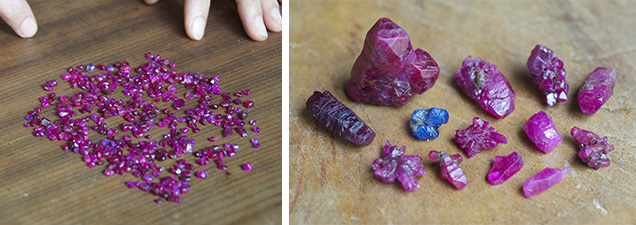
The finest ruby color is a saturated red to pinkish red, but Luc Yen material ranges widely: pale pink, purplish pink, medium to dark red, purple-red, and darker opaque red are all known. In cabochon and cut material, the low-iron marble-hosted character can produce a lively red response, especially in chromium-rich stones. Some rubies show blue zoning, swirled or angular growth structures, lamellar twinning, and rutile silk. The internal world of Luc Yen ruby and fancy sapphire has been studied in detail and includes rutile, calcite, apatite, zircon, pyrrhotite, phlogopite, spinel, diaspore or boehmite-group minerals, liquid-gas inclusions, and rare nordstrandite reported in early GIA work.
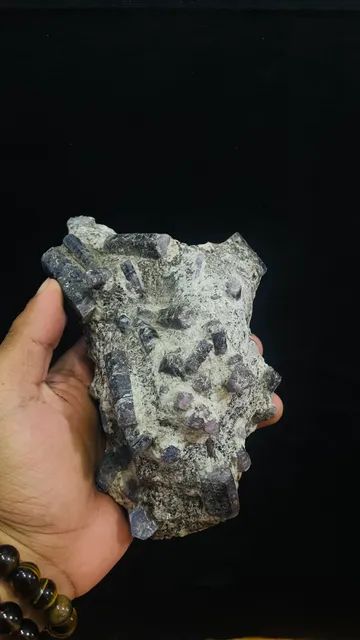
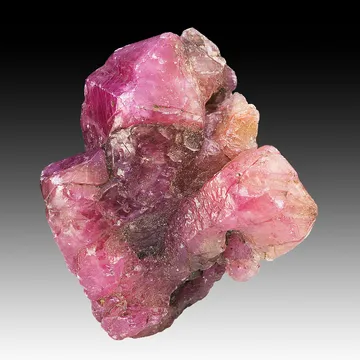
Sapphire from Luc Yen is not limited to blue. The district has produced colorless, gray, pink, purplish pink, light to dark blue, brownish, orange, and fancy sapphire. Pink sapphire and ruby form a continuum here; the ruby-versus-pink-sapphire distinction often depends on tone, saturation, and the language of the selling context. Some Luc Yen sapphires are bipyramidal, translucent, silky, or star-forming. Attractive specimen sapphires may be less famous than the ruby-on-marble pieces, but good pink sapphire crystals from Luc Yen can be sculptural, lustrous, and highly collectible.

Photo: Wikimedia Commons
Typical primary ruby crystals at active marble workings have been described in the range of 3 mm to 1.5 cm in diameter and 2 to 10 cm in length. Collector specimens vary enormously because corundum may be embedded as scattered crystals in marble blocks, trimmed into individual matrix plates, or recovered loose from secondary gravels. A sharp 2–3 cm ruby crystal in marble is already a desirable specimen; a larger crystal with good color, attractive exposure, and minimal damage is much scarcer.
Associated minerals are central to Luc Yen’s identity. White calcite marble is the classic host, while phlogopite is both a mineralogical associate and a practical field indicator. Graphite may appear as silvery to dark flakes or patches, adding visual contrast. Pargasite, humite-group minerals, spinel, tourmaline, garnet, rutile, pyrite, dravite, margarite, and amphiboles connect the corundum specimens to the broader Luc Yen marble system. In some samples, corundum is rimmed or associated with spinel, reflecting reactions between corundum and dolomitic marble components.
Quality in Luc Yen mineral specimens is judged less like a faceting parcel and more like a classic matrix-specimen problem. The questions are: Is the ruby exposed or buried? Is the color strong in ordinary light? Are the faces readable? Is the marble clean and not over-cut? Does the specimen have natural balance rather than a sawn-and-polished gift-shop look? Are the crystals repaired, bruised, or artificially emphasized by carving? The best Luc Yen pieces retain the natural drama of red corundum emerging from white marble without looking manufactured.
Luc Yen ruby in marble is popular enough that collectors should be disciplined about labels and treatment disclosure. “Luc Yen” is used broadly in the trade, sometimes for the district and sometimes for the specific Mindat-listed Luc Yen Mine occurrence. A specimen with a credible old label, a precise sublocality, or dealer provenance is preferable to a generic “Vietnam ruby” label. For high-value cut stones, a major laboratory report is the normal safeguard for natural origin, treatment status, and, where possible, geographic origin.
The main authenticity concern is market mixing, not a single notorious Luc Yen-only fake. The Luc Yen market has long offered natural Vietnamese gems, nonlocal gems, and synthetic material. Flame-fusion synthetic ruby and sapphire can appear convincing to casual buyers, particularly as loose stones. In matrix specimens, buyers should watch for dyed marble, glued-in crystals, assembled displays, repaired ruby clusters, and carved matrix that has been shaped to exaggerate the exposure of corundum. A sharply positioned crystal on a suspiciously prepared base is not automatically bad—Luc Yen specimens are often trimmed—but the boundary between skilled preparation and misleading enhancement deserves attention.
Heat treatment is relevant for faceted ruby and sapphire, and unheated Luc Yen stones command stronger interest when accompanied by reliable documentation. For mineral specimens, heat treatment is less often the central issue than damage, repair, polishing, and artificial matrix preparation. Avoid assuming that “in marble” guarantees untreated gem material or that “from Luc Yen” guarantees natural and unenhanced status in cut stones.
Common condition issues include bruised terminations, cleaved or broken crystal bases where the ruby was freed from marble, chalky or etched surfaces, and marble that has been heavily sawn, polished, or carved. Many attractive Luc Yen pieces are naturally irregular; do not reject every rounded crystal as damaged, because resorption is part of the locality’s look. Conversely, do not mistake a shapeless red patch in marble for a fine crystal specimen simply because it is ruby.
Market availability is steady but uneven. Small to medium ruby-in-marble pieces, cabochon-grade ruby, pink sapphire, and silky sapphire appear regularly. Fine, well-crystallized matrix specimens with vivid color, open presentation, and minimal damage are much less common. Facet-grade ruby from Luc Yen is scarcer than the volume of district material might suggest, and exceptional stones are normally filtered into gem channels rather than mineral-specimen channels.
Luc Yen’s modern story begins with farmers, not a mining company. In 1987, stones recovered from placers in Yen Bai Province proved to be ruby, sapphire, and spinel of real value. Within a year, Vietnam had created a state gem company, and by September 1988 a Thai-Vietnamese joint venture was working the Khoan Thong Valley placer. The early numbers explain the rush: in just the four months from November 1989 through March 1990, 244 kg of gem-quality rubies and sapphires came out of Khoan Thong, much of it entering the cutting and trading pipeline through Bangkok.
The landscape itself wrote the next chapter. Luc Yen was never an easy open-pit proposition. Karst pockets, marble pinnacles, narrow valleys, caves, rice fields, and steep jungle hills broke the deposits into small, stubborn targets. Heavy equipment could strip the easy ground, but it could miss gem-bearing material between marble pinnacles or in awkward crevices. After the big-company period waned, local miners returned with shovels, buckets, drills, crowbars, and the patient logic of people who know which hillside, stream, or marble seam might still hold a pocket.
At May Thuong, the Upper Cloud mine, a handful of men were observed working daily in 2011, living in a canvas-covered shack halfway up the mountain. Their equipment was modest: a generator, drilling machines, and crowbars. The ruby ran in bands through white marble, aligned with the foliation of the metamorphic rock. When miners saw ruby or phlogopite—the mica they regarded as a ruby indicator—they drilled, blasted, and opened the marble. Some blocks were small enough to trim into specimens. Others were serious burdens, with ruby-bearing marble blocks documented from 0.5 kg to 700 kg and dimensions up to 1.2 m.
The human carrying system was as memorable as the geology. To bring ruby-bearing blocks down from the hills, miners hired local people, commonly Man or Tay ethnic minorities, who carried the marble on their shoulders. The fee was reported as 2,000 to 3,000 Vietnamese dong per kilogram, about US$0.10–$0.15 at the time. On Luc Yen’s steep, rough terrain, a man or woman could carry 50–80 kg. That detail tells a collector something important: a fine Luc Yen ruby-in-marble specimen is not just a product of geology and trimming; it also passed through a human chain of difficult labor.
Thac Ba Lake adds a strange footnote to the district. The lake was created in 1970 for Vietnam’s first hydroelectric power plant, stretching about 80 km long, up to 10 km wide, and containing more than a thousand islands. It submerged a potentially gem-rich area between Tan Huong and the Luc Yen peninsula. During low water in spring 2005, local miners worked exposed ground along the lake margin, digging for rubies in a landscape that was neither fully mine nor fully lakebed.
The market at Yen The, also known as Luc Yen town, became the stage on which all these small discoveries met the trade. The market has operated daily since 1987. Its peak years were larger and louder, but even after activity diminished from the boom of the 1980s and 1990s, it remained northern Vietnam’s most important gem-trading center. Around the central lake and old market area, dealers, cutters, and families handled ruby, sapphire, spinel, tourmaline, feldspar, garnet, peridot, beryl, quartz, and synthetic stones. GIA’s field account noted the charming spellings painted in the market—“rubi,” “sapier,” “sitilen,” “phelydot,” and “siclin”—a small sign of a local trade translating itself into the global gem vocabulary in real time.
Luc Yen also found a use for material that the faceting trade would normally leave behind. Gemstone paintings became a local specialty: tiny grains of ruby, sapphire, spinel, garnet, peridot, pargasite, chalcedony, fluorite, amethyst, rose quartz, and calcite powder arranged into pictures. A worker could complete a 40 × 60 cm painting in a single day. About ten manufacturers were reported distributing these works to stores from Hanoi to Ho Chi Minh City. For miners, the craft mattered because it created a local market for daily low-grade production, helping cover costs while they waited for the occasional exceptional stone.
A later documentary account focused on that craft and on the women of Luc Yen. Documentary-maker Philippe Brunot and gemologist Vincent Pardieu saw not only miners and traders, but artisans turning stones “as tiny as rice grains” into images. Brunot was struck by the role of women: mining ruby fields, trading, managing enterprises, and holding households together. The gemstone paintings are easy to treat as tourist art until one understands their economic role. They absorb the fragments, cabochon-grade material, and color-rich grains that cannot become fine jewelry, turning the waste stream of the gem district into another livelihood.