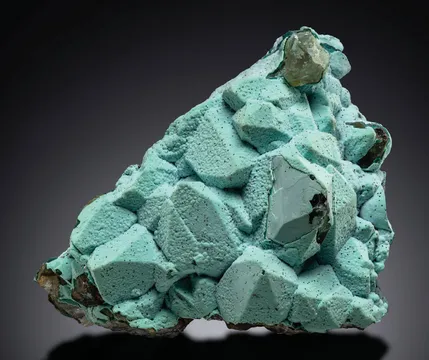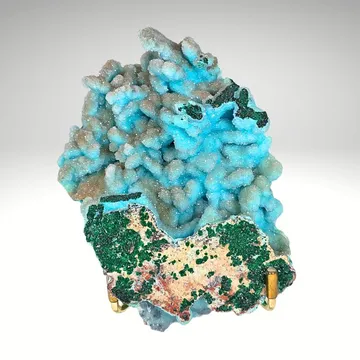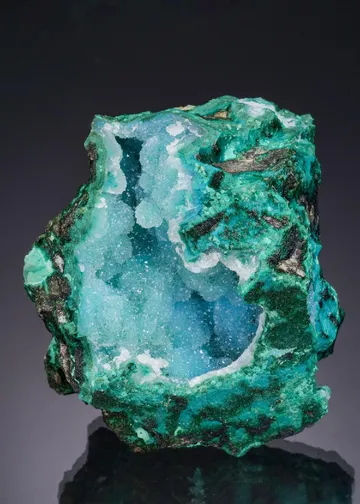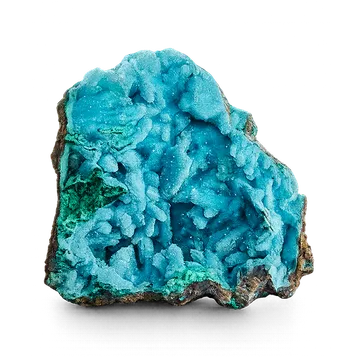
Chrysocolla from the Bagdad Mine belongs to the broad Arizona copper-oxide tradition, but the best pieces have a look of their own: robin’s-egg blue to greenish-blue botryoidal masses and coatings, commonly glazed or dusted with sugary quartz and, in finer specimens, contrasted by dark green malachite rosettes or seams. The appeal is not simply color. Bagdad material often has a softly rounded, pockety architecture—blue copper silicate tucked into vugs, seams, and fracture openings in oxidized porphyry copper rock—so the strongest specimens show depth, sparkle, and a geological story in a single piece.
Key facts
Chrysocolla from the Bagdad Mine belongs to the broad Arizona copper-oxide tradition, but the best pieces have a look of their own: robin’s-egg blue to greenish-blue botryoidal masses and coatings, commonly glazed or dusted with sugary quartz and, in finer specimens, contrasted by dark green malachite rosettes or seams. The appeal is not simply color. Bagdad material often has a softly rounded, pockety architecture—blue copper silicate tucked into vugs, seams, and fracture openings in oxidized porphyry copper rock—so the strongest specimens show depth, sparkle, and a geological story in a single piece.

Photo: Wikimedia Commons
The Bagdad Mine is a large porphyry copper-molybdenum deposit in west-central Arizona, in the Eureka Mining District near the company town of Bagdad. Its economic heart is copper and molybdenum: chalcopyrite and molybdenite in the primary system, chalcocite in the supergene enriched zone, and chrysocolla, malachite, and azurite in the oxidized zone. For collectors, chrysocolla records the late, near-surface weathering of that system—copper carried downward and outward along fractures, faults, and permeable zones, then fixed as blue-green silicate coatings, vein fillings, and bands.

Photo: Wikimedia Commons
The most desirable Bagdad chrysocolla specimens are the ones that preserve this oxidized-zone texture rather than merely presenting massive blue rough. Collectors look for saturated blue color, rounded botryoidal surfaces, a bright quartz druse that adds durability and sparkle, and attractive association with malachite. Some pieces are lapidary rather than specimen material: banded chrysocolla with malachite or darker copper oxides can cut into attractive polished faces, but the classic mineral-cabinet Bagdad look is quartz-coated chrysocolla on matrix.
Search for specimens: View all chrysocolla specimens from Bagdad Mine, Arizona, USA
The Bagdad Mine is in Yavapai County, west-central Arizona, roughly 100 miles northwest of Phoenix and west of Prescott. It is an open-pit copper and molybdenum mining complex operated by Freeport-McMoRan, in one of Arizona’s important porphyry copper districts. Modern descriptions identify Bagdad as a porphyry copper deposit containing both sulfide and oxide mineralization. Chalcopyrite and molybdenite are the dominant primary sulfides; chalcocite is the principal secondary copper sulfide; and chrysocolla, malachite, and azurite are the principal oxide-zone copper minerals.
The host and wall-rock story is unusually well documented. The Bagdad area includes Proterozoic metavolcanic and metasedimentary rocks correlated with the Yavapai series, intruded by multiple Proterozoic igneous bodies, and later affected by Late Cretaceous or early Tertiary intrusive activity. The ore body is hosted in a quartz monzonite stock; USGS mapping described the copper minerals as occurring in minor fractures and as disseminations in the quartz monzonite. Hypogene alteration produced quartz, orthoclase, albitic plagioclase, leafy biotite, sericite, pyrite, chalcopyrite, and molybdenite. Later supergene enrichment produced a chalcocite blanket, with chrysocolla and malachite forming in the leached and oxidized portions of the system.
The chrysocolla is therefore not an isolated curiosity; it is part of the mine’s weathered copper architecture. In the classic USGS description, chrysocolla is the most common of the bluish to green coatings on rocks in the oxidized zone of the Bagdad Mine. It occurs in bands alternating with lesser malachite, and locally along the Hawkeye fault it forms many veins each an inch or more wide. Malachite and chrysocolla were also noted along Copper Creek as conspicuous cementing material in terrace gravels, a vivid reminder of how copper-bearing solutions moved through fractures, faults, and near-surface sediment.
Mining history in the Bagdad area reaches back to the 1880s. John Lawler began locating claims in 1880 and helped organize the Eureka Mining District in 1884. The earliest significant mining was not the modern Bagdad copper operation but the Hillside mine, where oxidized gold-silver-lead ore was shipped in 1887. Copper mining at Bagdad began after a pilot mill was built in 1928, with production beginning in 1929. Large-scale copper mining began in the 1940s, accelerated by wartime demand, and the operation transitioned from underground methods toward open-pit mining in 1947. Today the Bagdad operation is a major industrial mine, with a concentrator, SX/EW production from stockpile leaching, and a pressure-leach plant for molybdenum concentrate.
Collecting access should be understood accordingly: Bagdad is an active, large-scale mine, not a casual collecting locality. Modern specimens on the market are typically old-stock pieces, material recovered during mining or from earlier collecting windows, dealer-held specimens, or lapidary rough that has moved through the mineral trade. Any present-day collecting would require explicit permission and compliance with mine safety requirements; collectors should treat the property as closed unless access is formally arranged.
Notable finds include blue chrysocolla seams and coatings in the oxidized zone, quartz-coated botryoidal chrysocolla pockets, chrysocolla-malachite bands, and chrysocolla associated with quartz, chalcedony, malachite, azurite, and rare micro-minerals. Mindat records olivenite as micro-crystals on chrysocolla from Bagdad, an association that rewards close examination under magnification even when the cabinet-scale visual impact comes from the blue copper silicate.
Bagdad chrysocolla is generally massive, botryoidal, crustiform, banded, or vein-filling rather than crystallized. Its collector value comes from surface, color, and association: rounded blue-green masses in pockets, bands alternating with green malachite, and thin to substantial seams along fractures in the oxidized quartz monzonite. The documented color range runs from bluish-white through greenish-blue to blue. In the best specimens, that color is brightened by a translucent to sugary quartz coating that gives the surface a sparkling, durable crust.
The most characteristic cabinet specimens show botryoidal chrysocolla coated by quartz druse. Sizes vary widely: thumbnail and small-cabinet specimens can show tight pockets and malachite accents, while larger examples reach cabinet size, such as documented quartz-chrysocolla pieces around 8.8 x 5.1 x 4.5 cm and 12.2 x 7.4 x 6.0 cm. Lapidary material may occur as larger massive or banded pieces, but mineral specimens with clean pocket form, rich color, and intact quartz sparkle are less common than rough or polished slices.
Associated minerals at Bagdad include malachite, azurite, chalcedony, quartz, cuprite, native copper, chalcocite, covellite, chalcanthite, conichalcite, olivenite, and numerous primary and alteration minerals tied to the porphyry system. For chrysocolla specimens, the practical associations collectors most often see are quartz, malachite, chalcedony, and iron-stained matrix. Malachite may appear as bands, patches, or rosettes; quartz may be a sparkling druse, milky coating, or clearer crystals; chalcedony may occur as thin veinlets with or without chrysocolla.
Quality factors are straightforward but strict. The best Bagdad pieces have saturated blue to greenish-blue color, visible botryoidal or pocket form, bright quartz sparkle that does not obscure the chrysocolla, and an attractive contrast with malachite or dark matrix. A dull, chalky, pale, or heavily iron-stained surface lowers appeal unless the piece shows strong locality character. For polished material, tight banding, clean color separation, and minimal fractures are important; for natural specimens, collectors usually prize undamaged pocket surfaces over sawn or polished faces.
Bagdad chrysocolla sits in a market category where labels matter. Blue-green copper silicate from Arizona is abundant enough that misattribution is always possible, and Bagdad pieces can be confused with material from Globe-Miami, Ray, Morenci, Bisbee, Ajo, Planet, and other Arizona copper localities. The strongest provenance indicators are old labels, documented dealer history, specimen photographs tied to the locality, and the classic Bagdad quartz-over-chrysocolla habit. A specimen that is simply labeled “Arizona chrysocolla” should not be upgraded to Bagdad without supporting provenance.
The common condition issue is surface bruising. Chrysocolla itself is relatively soft and can be porous or earthy; many Bagdad specimens gain protection from quartz druse, but exposed blue surfaces can still show rubs, edge losses, or powdery patches. Quartz-coated pieces should be checked for crushed sparkling surfaces, repaired pocket edges, and old glue along matrix breaks. Malachite rosettes and fibrous patches are especially vulnerable to bruising.
For lapidary material, stabilization is a normal concern with chrysocolla generally. Porous chrysocolla, chrysocolla-rich “gem silica,” and mixed copper-oxide rough may be resin-stabilized to improve cutting durability or polish. Stabilization is not automatically a defect if disclosed, but it matters greatly to collectors who want natural cabinet specimens. Polished Bagdad chrysocolla should be described as polished, and any resin, oiling, wax, dye, or backing should be disclosed. For natural specimens, a suspiciously uniform gloss on non-quartz surfaces, unnatural color saturation in fractures, or resin odor under gentle warmth may justify closer inspection.
Availability is intermittent rather than rare in an absolute sense. Bagdad chrysocolla appears in dealer inventories, auction archives, polished-material listings, and old collections, but top-quality natural quartz-coated specimens with strong color and no distracting damage are much less common. The market tends to separate into three lanes: affordable polished or rough chrysocolla-malachite pieces; mid-range natural small-cabinet examples with quartz sparkle; and premium old-stock specimens with strong aesthetics, provenance, or exceptional malachite association.
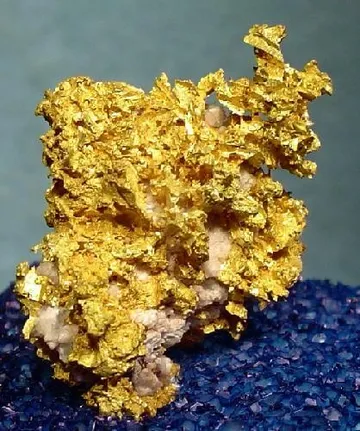
The first great Bagdad story begins before Bagdad was known to collectors for blue chrysocolla. John Lawler started locating claims in the district in 1880, and by August 16, 1884 he was one of the organizers of the Eureka Mining District. The early ore moved by muscle and distance. On June 29, 1887, oxidized gold-silver-lead ore from the Hillside mine was shipped by pack train to Wilders Camp, 18 miles away, then by wagon to Prescott, where it was sold to the Arizona Sampling Works and sent onward to El Paso for smelting. That first shipment weighed 4,006 pounds and assayed 3.15 ounces of gold per ton, 193.35 ounces of silver per ton, and 11.7 percent lead. It returned $408.49 net—$203.94 per ton—an extraordinary figure for a remote camp hauling ore across rough country. By the end of October 1887, 38 tons had been shipped for a net profit of $4,214.53.
The geography of transport kept changing as the district matured. A road was pushed to Camp Wood, where a sawmill supplied mine timber. Beginning November 26, 1887, ore went by wagon through Camp Wood to Garland, 84 miles from the mine, then onto the Prescott and Arizona Central Railroad. By 1896, a new road connected the Hillside mine to Hillside station, reducing the haul to 34 miles. The first shipment over that route left on March 26, 1896, and afterward the area’s production moved through Hillside. Long before collectors admired blue chrysocolla pockets, the district’s mineral wealth was being measured in wagon miles, railroad connections, and the cost of getting heavy rock out of the desert mountains.
Bagdad’s copper era began more cautiously. Exploration of the disseminated copper deposit started in the early 1900s; churn drilling began in 1909 and continued intermittently for years. A pilot mill built in 1928 led to the first copper production in 1929—277,501 pounds. An experimental block-caving stope followed in 1930, but operations paused during the hard years from 1931 to 1934. In 1935 the pilot mill was expanded to 300 tons per day, only to run into one of Arizona mining’s oldest enemies: lack of water.
World War II changed the scale. The Bagdad Copper Corporation obtained a $2,500,000 loan from the Reconstruction Finance Corporation, built a concentrator with 2,500 tons per day capacity, and brought water from Burro Creek, seven miles to the west. The new mill started on March 1, 1943. From 1943 through 1951, Bagdad produced 117,095,845 pounds of copper. Mining methods changed again in 1945, and open-pit mining was adopted in 1947. By 1951, production averaged 3,500 tons per day.
One specimen label preserves a much smaller, more intimate moment in the mine’s collecting history. A documented quartz-chrysocolla specimen from Bagdad carried a dealer label indicating that Claude Humber collected it himself at the mine in 1975. The specimen measured 12.2 x 7.4 x 6.0 cm and showed the combination collectors still associate with the locality: robin’s-egg blue chrysocolla covered by a sugary, sparkling quartz coating. That kind of detail—one named collector, one mine, one year—matters enormously now, because the modern Bagdad Mine is an active industrial operation and old-stock provenance often separates a true locality specimen from merely plausible Arizona chrysocolla.