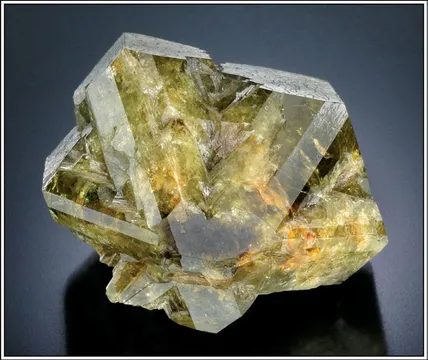
Chrysoberyl Collectors Guide
Chrysoberyl (BeAl2O4) is a hard, high-luster oxide prized by collectors for sharp twinned crystals and, in its varieties, world-famous optical effects. The species typically shows bright yellow to yellow‑green hues, strong vitreous luster, and textbook contact or cyclic (“sixling”) twins that display striking re-entrant angles. Two special varieties heighten its desirability: alexandrite (Cr-bearing chrysoberyl) with dramatic color change (green in daylight to red/purple in warm light), and chrysoberyl cat’s eye (chatoyancy from oriented tubular/needle inclusions), both celebrated in gem and specimen circles alike. Crystals often form as tabular to short prismatic wedges with crisp faces and are frequently found in granitic pegmatites and metamorphic rocks (mica schists, marbles). Fine, undamaged twins and true on-matrix alexandrite crystals are rare trophies.
Chrysoberyl has captivated collectors since the 1800s, when Urals alexandrite became the imperial gem of Russia. The species spans tastes: thumbnail enthusiasts chase perfect V‑twins or sixlings from the Urals and Madagascar; locality collectors seek matrix alexandrites from Malyshevo or Brazil’s Hematita/Medina field; and connoisseurs hunt cat’s-eye rough and crystals from Sri Lanka and Espírito Santo, Brazil. While yellow‑green chrysoberyl crystals can be moderately obtainable, vivid, transparent crystals with classic twinning are scarce. Alexandrite with strong color change and aesthetic crystal form is among the most contested material in the mineral hobby, with museum‑level pieces commanding prices on par with elite species.
Espírito Santo is renowned for cat’s-eye chrysoberyl. At Itaguaçu, both primary and alluvial occurrences yielded silky crystals and pebbles with strong chatoyancy. While much material is fashioned into gems, occasional uncut crystals and aggregates show the fibrous internal structure that produces the “eye.” Matrix pieces are very scarce; most specimens are waterworn. Collectors evaluate these for the sharpness and symmetry of the eye (when a crystal is rotated under a focused light), color saturation (honey to greenish), and luster.
- Color and Optical Effects:
- Chrysoberyl (non-alexandrite): Bright, saturated yellow to yellow‑green is most desirable; dull brownish or gray tones are less appealing.
- Alexandrite: Strength and balance of color change is paramount. Look for a distinct green (daylight/LED) to red/purple (incandescent) shift, not merely green to brown. Even small crystals with dramatic change are highly prized.
- Cat’s eye (chatoyancy): Assess the sharpness, centeredness, and continuity of the “eye” under a single point light. A razor‑sharp, bright eye that tracks smoothly across the surface is ideal.
- Clarity and Luster:
- Chrysoberyl often has excellent luster; mirror‑bright faces elevate a specimen. Transparent zones add life, especially near the termination.
- In alexandrite, inclusions are common; judge how they affect the look—some silk can even enhance color or chatoyancy, but large cracks or cloudiness reduce appeal.
- Crystal Form and Twinning:
- Classic contact V‑twins and cyclic sixlings are signature habits—clean, symmetric twins with crisp re‑entrant angles are especially collectible.
- Terminations should be sharp; flattened or etched tips are less desirable unless the piece is significant for size or association.
- Matrix presence (mica schist, pegmatite feldspar/quartz, calcite) adds context and value; true on‑matrix alexandrite is rare and commands a premium.
- Size and Composition:
- Chrysoberyl commonly occurs as thumbnails to small cabinets; larger, undamaged twins are uncommon.
- For alexandrite, medium crystals with top color change can outvalue bigger but weaker-change pieces.
- Condition:
- Inspect edges and twin junctions for nicks. Because twins concentrate stress, minor edge wear is frequent—minimize it if possible.
- Prefer unrepaired specimens; however, a discreet, single repair on a significant matrix piece may be acceptable at the right price.
- Repairs and Reattachments:
- Check twin junctions, base contacts, and terminations with a 10x loupe for straight glue seams or slight striation misalignments. Some epoxies fluoresce under LW‑UV.
- Malyshevo and Brazilian alexandrite matrix pieces are often reattached—request disclosure.
- Polishing:
- Polished faces (especially on cat’s-eye pieces) can appear unnaturally glassy and perfectly flat. Natural crystal faces typically have subtle growth textures or micro‑hillocks.
- Treatments:
- Heating/irradiation are uncommon for specimens (more for gems). Alexandrite’s color-change is intrinsic to Cr; beware pieces with suspiciously uniform neon colors and no natural growth features.
- Synthetics/Fakes:
- Synthetic alexandrite exists in the gem trade but is rare as “collector crystals.” Watch out for glass/plastic imitations—air bubbles, lack of striations, and mold lines are red flags. Buy from reputable sources and examine carefully.
Chrysoberyl is very durable (Mohs 8.5) with excellent chemical resistance, making care straightforward.
- Handling:
- Despite high hardness, twins can be brittle at re‑entrant angles; handle by the matrix or robust prism faces, avoiding pressure on thin edges and terminations.
- Light and Temperature:
- Colors (including alexandrite’s color change) are stable under normal display lighting. Avoid prolonged high heat or rapid thermal shock, which can induce fractures.
- Cleaning:
- Dust with a soft brush; for grime, use lukewarm water with mild soap and a soft toothbrush. Rinse and dry thoroughly.
- Avoid ultrasonic/steam cleaners—vibration and heat can exploit micro‑fractures or compromise hidden repairs.
- If iron staining is present on matrix, sodium dithionite (“Iron Out”) is generally safe for chrysoberyl, but test cautiously on matrix minerals.
- Storage:
- Pad specimens individually; chrysoberyl can scratch softer neighbors and can be scratched by corundum/diamond. Use mineral tack or stable stands for earthquake/security concerns.
- Label provenance—locality greatly influences desirability (e.g., Malyshevo vs. Medina vs. Murzinka).
- Display Tips:
- For alexandrite, keep a warm light source handy to demonstrate color change alongside daylight/LED lighting.
- For cat’s-eye pieces, a single, focused light (small LED spotlight) shows the “eye” best; rotate to center the band for display.