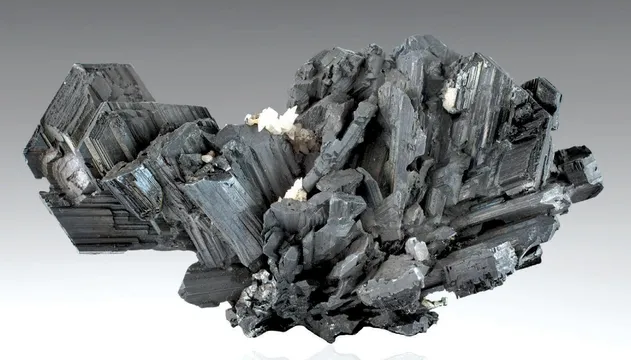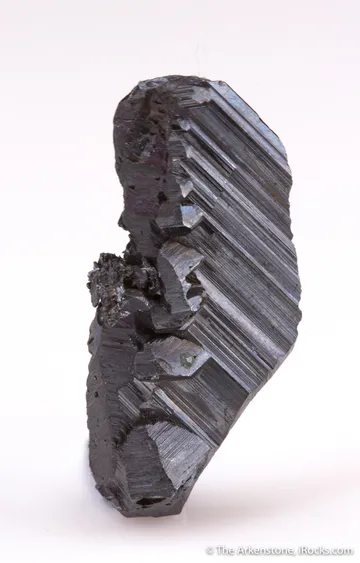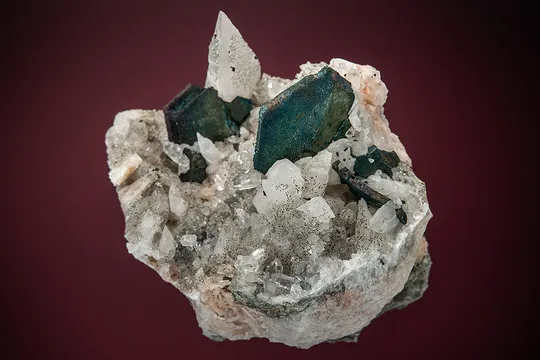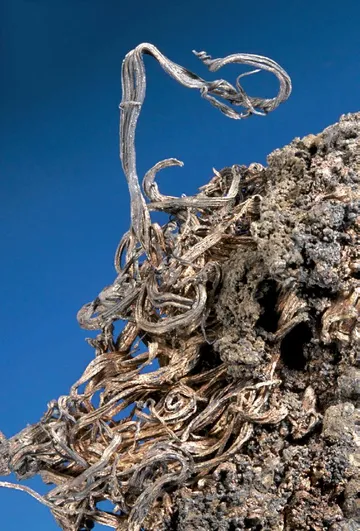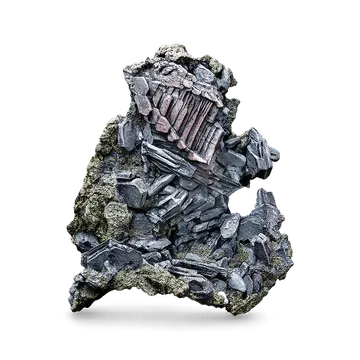
Chalcocite from Bristol Copper Mine, Connecticut — dark, tabular crystals on calcite; historic locality valued by collectors for its classic ore-crystal form.
Key facts
Bristol Copper Mine chalcocite is one of the great old American copper-sulfide classics: dark, metallic, sharply twinned crystals from a small Connecticut deposit whose finest specimens were saved before the modern specimen trade existed. The best pieces have the cabinet presence collectors love in 19th-century material—bluish black to charcoal-gray chalcocite, often in tabular or pseudohexagonal forms, set against white to pale cream calcite or milky quartz. When the contrast is good, Bristol material has a severity and elegance that is instantly recognizable: black copper sulfide geometry on New England vein gangue.

Photo: Wikimedia Commons — Alcinoe
The mine sat on the western border fault of the central Connecticut Mesozoic Hartford Basin, where red Triassic sandstone and adjacent crystalline rocks were mineralized by copper-bearing solutions. For collectors, the locality is especially important because its chalcocite was studied as primary, hypogene chalcocite rather than merely as a secondary enrichment product. That point made Bristol significant not only as a specimen locality but as a locality in the history of ore-deposit science.
The mine’s fame rests on a relatively brief period of exceptional specimen recovery in the mid-19th century. The Bristol orebody was rich enough to help feed Connecticut’s brass and clock industries, yet fragile enough as a collecting legacy that many superb crystals were almost certainly crushed for ore. The specimens that survived—particularly those preserved through Yale, Union College, Harvard, Wesleyan, and older private collections—are the reference standard for the locality.

Photo: Wikimedia Commons — Rob Lavinsky, iRocks.com
Collectors look first for form: tabular, pseudohexagonal, discoidal, cyclically twinned, or elongated chalcocite crystals with visible striations and crisp edges. Matrix matters greatly. A sharp black crystal group on calcite is more desirable than a dull mass on ore matrix, and old labels or museum provenance can add substantial historical value. Bristol chalcocite is not common on the market, and truly aesthetic matrix specimens are scarce.
Search for specimens: View all chalcocite specimens from Bristol Copper Mine, Connecticut, USA
The Bristol Copper Mine is an abandoned copper mine near the south end of Mine Mountain in Bristol, Hartford County, Connecticut. Its recorded coordinates place it near 41°43' N, 72°55' W, at the contact between red Triassic sedimentary rocks of the Hartford Basin and older crystalline rocks of the western upland. The deposit is best described as a copper vein and replacement deposit localized along faulted contacts and fractures.
The orebody followed a normal-fault contact between metamorphic rocks and younger sedimentary strata. Copper sulfides occurred both as vein material and as disseminated mineralization in the sedimentary rocks. Descriptions of the deposit record veins of copper sulfide reaching about 8 inches thick, with disseminated veinlets, blebs, grains, and pockets in sandstone. Chalcocite and bornite were the principal copper minerals, with subordinate chalcopyrite and smaller amounts of covellite, pyrite, sphalerite, galena, and barite. Quartz and calcite were abundant gangue minerals.
Historically, the story begins with a greenish copper-bearing spring at the base of Zack’s Mountain. Theophilus Botsford, a local farmer, investigated the spring in 1798 after noticing that the water was killing nearby vegetation. He plowed into the ground with oxen and exposed copper ore, but the discovery was not immediately developed into a commercial mine. Asa Hooker later became involved, and Luke Gridley worked the outcrop with hand tools, producing small amounts of copper in the early 1800s.
Commercial mining began in earnest in 1837 after George Bartholomew and associates developed the property. Early work included an open cut about 10 by 20 feet and 17 feet deep. Before 1847 the mine shipped about 125 tons of high-grade ore to England. From 1847 to 1853, the mine was worked much more aggressively: workings reached about 240 feet deep, and roughly 2,200 tons of picked ore averaging about 33% copper reportedly yielded nearly $200,000. A later reopening in 1888 involved a new sandstone shaft to about 378 feet and levels at 30, 40, 50, and 60 fathoms. Commercial activity continued intermittently into the 1890s, with the mine closing after 1895.
A final 20th-century attempt ran from 1947 to 1953, when Allen Hearst of Forestville formed the Connecticut Mining and Milling Company to recover copper and silver, including from tailings. That venture failed as copper prices declined from wartime highs. The underground workings are not a collecting opportunity today: shafts have been filled and sealed, the workings are inaccessible, and the property has been used for industrial purposes. Any serious modern collecting should be regarded as closed unless explicit legal permission is obtained from the landowner.
Bristol’s notable finds were made mainly in the 1840s and 1850s, when vugs and pockets yielded chalcocite and bornite crystals of a quality that drew the attention of Yale mineralogists and European-trained miners. Many important specimens passed into Yale, Union College, Harvard, Wesleyan, the Smithsonian, and old private collections. Some Bristol specimens were reportedly carried or sent back to Cornwall by Cornish miners, later acquiring misleading Cornwall pedigrees in old collections.
Bristol chalcocite is Cu2S and is most prized as lustrous to sublustrous, metallic, bluish black to dark gray crystals. Fresh surfaces can show a steel-blue metallic sheen, but many old specimens acquire a dull black or charcoal coating with age. This coating is part of the preservation history of many Bristol pieces and should not be confused with poor locality identity by itself.
Crystal habit is the heart of the locality. Bristol produced orthorhombic chalcocite crystals that commonly appear pseudohexagonal because of twinning. Tabular crystals are abundant in the classic material, and discoidal pseudohexagonal forms are well known. Elongated crystals also occur. Many crystals are singly or multiply twinned, and fine pieces may show repeated twinning, cyclic forms, striated faces, chevron-like surface markings, or platey stacks.
Typical individual crystals are small to moderate by world standards but exceptional for aesthetic quality. Well-formed crystals commonly fall in the millimeter to centimeter range, with classic descriptions noting crystals up to about 2 or 3 cm long. Dealer and museum examples show many desirable cabinet specimens where crystals of 8–10 mm are richly grouped on calcite. Larger, robust crystal groups occur but are much scarcer.
The most desirable matrix associations are pale scalenohedral or dogtooth calcite and milky quartz. Calcite provides the strongest visual contrast and is one reason the locality’s best specimens photograph so well: black metallic chalcocite against white or cream carbonate. Quartz matrix specimens tend to have a more rugged, ore-vein character. Massive chalcocite and bornite matrix is common in ore specimens but less prized unless it supports sharp crystals.
Associated minerals documented from the mine include bornite, chalcopyrite, calcite, quartz, barite, covellite, pyrite, sphalerite, galena, siderite, malachite, azurite, cuprite, chrysocolla, digenite, djurleite, native copper, and rare native silver. Bornite is the most important collector association after chalcocite and is itself a Bristol classic, though good bornite crystals are less common than chalcocite. Chalcopyrite from Bristol is usually massive or iridescent, but crystals are also known.
Quality is judged by four main factors: sharpness, twinning, matrix, and provenance. Aesthetic specimens with multiple sharp, striated chalcocites on contrasting calcite are the most desirable. Isolated crystals or crystal groups on ore matrix are still collectible but occupy a different tier. Old-time labels are especially important because Bristol material has circulated for more than a century and a half, and some old specimens were mislabeled as Cornwall.
Bristol Copper Mine chalcocite is a closed-classic locality material. The mine is not a modern productive source, so specimens reach the market mainly through old collections, museum deaccessions, dealer stock, and estate dispersals. As a result, labels and provenance carry real weight. A specimen with a credible old Bristol label, especially one tied to Yale, Union College, Harvard, Wesleyan, a known dealer, or a documented private collection, deserves more confidence than an unlabeled loose crystal.
Documented Bristol-specific fakes are not a prominent theme in the literature, but misattribution is a real concern. The most interesting historical confusion runs in the opposite direction from many modern locality problems: some Bristol chalcocites apparently entered Cornwall collections through Cornish miners and later carried Cornwall pedigrees. For collectors today, this means Bristol should be judged by a combination of form, matrix, provenance, and label history rather than by locality name alone.
The commonest condition issues are edge wear, broken crystals, dull surface coatings, and bruising on protruding tabs. Chalcocite is relatively soft and sectile compared with many display minerals, so sharp tabular crystals are easily nicked. Calcite matrix adds another vulnerability: attractive Bristol combinations may have cleaved calcite tips, bruised dogtooth crystals, or old repairs. Because the best material is old, minor historical damage is often tolerated, but undisclosed repairs, glued contacts, or reconstructed groups should be checked carefully under magnification.
Surface alteration is normal. Bristol chalcocite can acquire a black charcoal-like coating over time. Some mineralogical descriptions note that this coating can be removed with an agitated Alconox solution without harming the crystals or associated minerals, but collectors should be conservative. Cleaning may improve luster, yet an overly brightened surface, disturbed patina, or cleaned matrix can reduce the old-time character that makes Bristol specimens desirable.
Market availability is thin. Recent dealer and auction records show Bristol chalcocite appearing occasionally, including small-cabinet to cabinet pieces, but fine matrix specimens command strong prices. Aesthetic calcite combinations, sharp twinned crystals, and specimens with old labels are the strongest. Massive ore pieces and small loose crystals are more accessible, while major display specimens with historical provenance are genuinely scarce.
The Bristol story begins with a farmer, a sickly green spring, and a trail at the base of Zack’s Mountain. In 1798 Theophilus Botsford noticed greenish water coming from the ground and saw that nearby vegetation was dying. He read the sign correctly: copper was present. Rather than sink a formal shaft, he put a yoke of oxen to work and plowed into the ground near the spring. The blade cut into a vein of copper ore. Then, in one of the great pauses in American mining history, Botsford did not develop the discovery.
Two years later, Asa Hooker took up the idea. The land belonged to Sarah Yale, widow of Abel Yale and part of the same family line associated with Yale University. Hooker turned the work over to Luke Gridley, a blacksmith and fence inspector. Gridley’s agreement promised Sarah Yale one-thirtieth of the ore—or of any other valuable “treasure” found on the property. For eight years he worked the outcrop with hand tools, smelting small quantities in a nearby forge. When he died in 1810, the ground went quiet again for twenty-six years.
When George Bartholomew arrived in 1836, Bristol changed from a copper show into a mine. His first serious excavation was small enough to visualize: an open cut 10 feet wide, 20 feet long, and 17 feet deep. The ore was not yet described in modern mineralogical language by the miners. It was “variegated copper,” a rich mixture of sandstone and copper sulfides; Cornish miners later called such material “flucan.” Some accounts describe exceptionally rich ore, locally dominated by chalcocite and bornite, in a bleached sandstone setting where copper-bearing solutions had stripped the red color from the rock.
The deposit soon drew in the people who would save its mineralogical legacy. Benjamin Silliman Sr. visited in 1839 and recognized the scientific and economic promise of the locality. His son Benjamin Silliman Jr., Josiah Whitney, John M. Woolsey, and other Yale-linked figures became involved as stockholders or observers. Charles Moore Wheatley, only twenty-four years old when he became mine manager in the late 1840s, arrived just as the great chalcocite and bornite specimens were about to be found. His later name would become attached to the famous Wheatley lead mines of Pennsylvania, but at Bristol he stood at a narrow historical hinge: the mine could treat crystals as ore, or it could preserve them as specimens.
The Cornish miners—“Cousin Jacks”—understood both ore and crystals. They compared Bristol’s orebody with the copper districts of Truro, Redruth, and Penzance. Their presence may explain one of the strangest afterlives of Bristol specimens: more than a century later, fine Bristol chalcocites were reportedly observed in private collections in Cornwall, but carrying Cornwall labels. A Connecticut mineral had crossed the Atlantic in miners’ hands and, over time, absorbed a false English identity.
The most painful Bristol story for collectors is the argument over crystals in the 1850s. Owners and managers wanted valuable mineral specimens sent to the stamp mill because they were copper ore. The mineralogists objected. Hurlbert, writing about the 1855–1857 management period, recorded that chalcocite specimens of unusual form could have sold as cabinet pieces for hundreds of dollars, yet were crushed despite protest. The image is hard to forget: crystals now coveted as American classics being shoveled into the mill because the copper content mattered more than the geometry.
Silver adds a different kind of mystery. Old reports and memories suggest that silver specimens once existed at Bristol. George Bartholomew’s daughter described silver specimens shown in the windows of the Culver home beside the mine property, and reports placed fine silver on the window ledges of the small laboratory shack used by Ludwig Stadtmuller, the miner and assayer who sold specimens to Silliman at Yale. Yet crystallized silver from Bristol is almost absent today. Bob Jones examined more than 100 Bristol specimens across a dozen or more museum and private collections and found only one specimen with a small silver wire protruding from chalcocite crystals, in the Smithsonian collection. By 2000, Stadtmuller’s shack was still standing in ruin, held up largely by its old chimney—a fitting relic for a locality where so much was saved, and so much vanished.
The mine also belongs to Connecticut’s industrial story. Bristol copper helped reduce reliance on imported Cornish copper for local brass and clockmaking. Brass, a nonmagnetic copper-zinc alloy, was essential for clock mechanisms, and central Connecticut’s clock industry benefited from nearby copper at a time when imported metal had to cross the Atlantic and then move inland by wagon. In that sense, the black chalcocite crystals prized by collectors are also the mineral face of a regional manufacturing boom.