






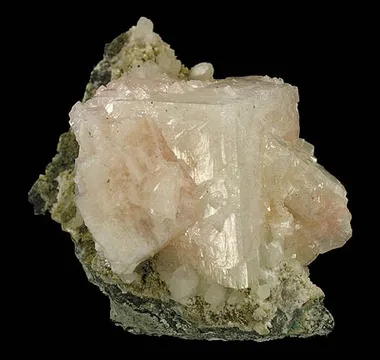
Chabazite - sharp rhombohedra with luster in colors from colorless to brick red; forms in volcanic vesicles and attracts collectors for geometry.
Key facts
Chabazite is a classic zeolite prized for its sharp, textbook rhombohedral crystals that can look almost “cubic” at first glance. Most crystals are small—millimeters to a few centimeters—but their bright luster, crisp edges, and frequent sprays or clusters make them exceptionally aesthetic. Colors range from colorless and white to honey, salmon, burnt orange, pink, and brick-red, depending on inclusions and trace chemistry. It typically lines vesicles in basalt and other volcanic rocks and is commonly associated with heulandite, stilbite, thomsonite, analcime, and calcite. Modern nomenclature distinguishes dominant-cation species (Chabazite-Ca being the most common), but collectors generally use the umbrella name “chabazite.”
Crystals often form penetration twins and complex intergrowths; the old varietal name “phacolite” refers to lens-like twinned crystals. The best specimens show glistening, razor-sharp rhombohedra on contrasting dark basalt, or delicate sprays on snow-white calcite. While most chabazite is affordable, select pieces—especially richly colored, lustrous clusters on attractive matrix from classic localities—are surprisingly competitive and sought after.
Chabazite has long been a favorite among zeolite collectors because it delivers “geometry you can see” in relatively small, affordable packages. Historic European and North Atlantic occurrences (Iceland, Faroe Islands, Scotland) provided early classics—crisp, pale rhombs with elegant associations. In the late 20th century, New Jersey traprock quarries yielded superb pocket pieces, and India’s Deccan Traps opened the floodgates for beautifully composed zeolite combinations, occasionally including vivid orange to red chabazite.
Today, chabazite remains popular because:
Below are renowned chabazite sources with strong reputations for well-formed, showy specimens. Each offers a distinct “look” or association that collectors value.
Upper New Street produced classic traprock vugs lined with zeolites. Chabazite here can be exceptionally sharp and lustrous, typically colorless to white or honey, sometimes perched on prehnite or delicate calcite. Quality matrix pieces with undamaged, mirror-bright rhombohedra are a benchmark for the district.
Color and saturation:
Luster and clarity:
Crystal form:
Size and composition:
Condition:
Repairs/reattachments:
Acid cleaning:
Polishing and coatings:
Handling:
Cleaning:
Environment:
Display and transport:
With careful selection focused on sharp form, lively luster, attractive color, and tasteful associations, chabazite can be a highlight of any cabinet—delivering classic geometry and charming aesthetics without requiring a museum budget.