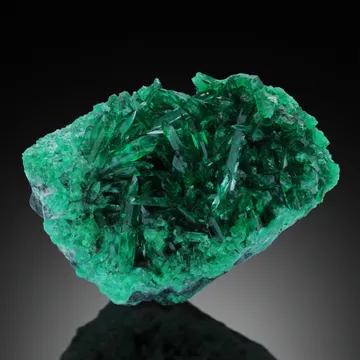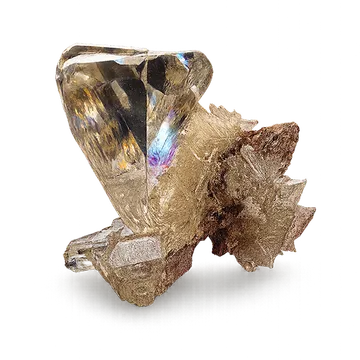
Cerussite from Tsumeb - glassy, architectural crystals with snowflake and honeycomb forms, superb transparency and quality from a famed ore deposit.
Key facts
Cerussite from Tsumeb is one of the indispensable classics of mineral collecting: a lead carbonate from a deposit that seemed almost engineered to produce glassy, intricate, display-grade secondary minerals. At its best, Tsumeb cerussite is not merely clear or lustrous; it is architectural. Cyclic twinning builds open “snowflake,” “honeycomb,” and reticulated lattices whose repeated angles make the specimen look lighter than a lead mineral has any right to look. The finest pieces combine adamantine sparkle, sharply striated crystal faces, pale smoky or colorless transparency, and enough three-dimensional openness to throw light through the whole structure.

Photo: Rob Lavinsky / Wikimedia Commons
The locality’s greatness lies in its geology. Tsumeb was a compact but extraordinarily rich Cu-Pb-Zn-Ag pipe-like orebody in dolomitized carbonate rocks of the Otavi Mountainland. Its primary ore carried not only copper, lead, and zinc, but also arsenic, cadmium, germanium, gallium, silver, and other elements. Later oxidizing groundwater penetrated deeply through karstic carbonate host rocks and breccia zones, producing not one simple gossan but three major oxidation zones. Cerussite, PbCO3, formed as a supergene lead carbonate in that system, commonly after galena and in close company with the mine’s famous secondary assemblages.
For collectors, Tsumeb cerussite sits at the intersection of abundance and excellence. Cerussite was the most abundant secondary lead mineral at the mine, and massive cerussite was once commercially important ore. Yet the great crystallized examples—the glassy V-twins, the thick reticulated “snowflakes,” the specimens on smithsonite, malachite, azurite, dolomite, or galena—are anything but ordinary. Tsumeb produced cerussite across all three oxidation zones, but the best early crystallized material came from the first oxidation zone between 6 and 9 Levels, while major later finds came from the second oxidation zone, including manto ore bodies and vugs in massive galena of the South Vein on 25 and 26 Levels.
The historical aura is just as strong as the mineralogy. Tsumeb was recognized very early as a specimen mine, not merely a source of ore. A test shipment sent to Germany in 1900 yielded crystallized secondary minerals worth preserving, and Wilhelm Maucher’s early work helped launch the scientific literature of the deposit. The mine later became a proving ground for collectors, mine geologists, dealers, and museum curators: the Klein, Kegel, Pinch, Sussman, and other major collections all helped shape the modern Tsumeb canon. Cerussite is woven through that story from the earliest oxide workings to the deep late pockets.

What collectors look for is a combination of geometry, brightness, and survival. Fine Tsumeb cerussite should show crisp natural faces rather than abraded edges, strong adamantine luster, visible twinning, and a pleasing relationship to matrix if present. Large reticulated groups are especially vulnerable: a perfect or nearly perfect snowflake is far scarcer than a repaired or edge-worn one. Color can add distinction—smoky amber from sulphide inclusions, rare green tones from malachite, and rare red tones from cuprite—but the classic colorless to milky white reticulated examples remain the standard by which many collectors judge the locality.
Search for specimens: View all cerussite specimens from Tsumeb Mine, Namibia
The Tsumeb Mine lies at the town of Tsumeb in the Oshikoto Region of northern Namibia, within the Otavi Mountainland. The orebody was hosted by thick Neoproterozoic carbonate rocks of the Otavi Group, particularly dolomites and limestones of the Tsumeb Subgroup. In plan and section it behaved as an irregular, subvertical, pipe-like mineralized structure, cutting through the carbonate sequence and modified by folding, bedding-slip shears, brecciation, and solution-collapse features.
The primary ore was polymetallic and unusually element-rich. Galena, sphalerite, bornite, chalcocite, tennantite, and other sulphides supplied the lead, zinc, copper, arsenic, and minor-metal chemistry that later fed the spectacular secondary mineral suite. For cerussite, the key precursor was galena. Oxidizing waters moving through cavities, fractures, and carbonate host rocks converted lead-bearing sulphides and other lead phases into lead carbonates, most importantly cerussite. The carbonate setting mattered: it supplied both chemical buffering and open space, allowing crystals to grow freely in vugs rather than only as dull replacement masses.
Tsumeb’s oxidation history is the reason the mine became mineralogically extraordinary. The first oxidation zone extended from the surface down to roughly 11 Level, with oxide minerals much diminished between 11 and 15 Level. A second oxidation zone was later encountered between about 24 and 35 Level, centered near the North Break Horizon intersection around 29 Level. A third oxidation zone was found still deeper, from about 42 Level downward. Cerussite was present in all three zones, with different habits, associations, and degrees of alteration.
The surface expression was the famous copper-stained “Green Hill,” worked for copper before European commercial mining. By the late nineteenth century, explorers had traced traded copper ore and smelted metal back to the Tsumeb outcrop. Otavi Minen und Eisenbahn Gesellschaft began development with trial shafts in 1900, but full commercial production waited until 1906, after the railway connection to the coast made large-scale mining practical. Production began with an open pit and shallow shafts, then moved underground as the surface ore was exhausted.
Mining continued for almost a century, interrupted by the World Wars and economic downturns. After World War II, operations resumed in 1947 under Tsumeb Corporation Limited, and deepening of the workings led to the second oxidation zone, the great 1960s–1980s era of dioptase and other secondary mineral discoveries, and eventually the third oxidation zone. By the time large-scale mining ceased in the mid-1990s, the workings had reached approximately 48 Level and about 1,700 m below surface. In 1996, labor conflict and pumping problems led to rapid flooding. Small-scale work in the upper levels continued briefly, and there was a short-lived specimen-mining effort between 1998 and 2002, but the great producing era was over.
For cerussite specifically, the classic production story has several chapters. The earliest oxide workings yielded abundant crystallized secondary minerals, including cerussite, azurite, malachite, and smithsonite. Fine well-formed cerussite crystals occurred through the first oxidation zone, with especially good examples from 6 to 9 Levels, about 150–250 m below surface. During the 1970s, fine cerussite crystals were found abundantly in the second oxidation zone, and very fine reticulated groups came from manto ore bodies. Many famous honeycomb cerussites were recovered from vugs in massive galena of the South Vein on 25 and 26 Levels. In the third oxidation zone, the 43 Level “Lead Pocket” produced cerussite crystals partly to completely replaced by hydrocerussite, and the deep workings also yielded rare red cerussite colored by cuprite inclusions.
Collecting access today should be understood as historical and commercial, not as a casual field opportunity. Tsumeb is a closed, flooded, industrial mine locality, and legitimate collector material comes from old mine recoveries, estate collections, museums, dealer inventories, and previously dispersed specimen stocks. Labels may read Tsumeb Mine, Tsumcorp Mine, Ongopolo Mine, or older geographic terms such as South West Africa; all can be legitimate depending on when the specimen was collected or labeled.
Tsumeb cerussite is orthorhombic PbCO3, but the collector’s eye usually reads it first as a study in twinning. Most Tsumeb crystals are twinned on (110), and cyclic twinning produces the mine’s famous reticulated structures. Trillings and sixlings are common; repeated twinning can build flat, radiating snowflakes, open latticeworks, honeycomb clusters, star-like groups, and more robust branching aggregates. V-twins, prismatic crystals, bladed crystals, complex reticulated clusters, and massive to crystalline cerussite all occur. Heart-shaped twins on (130) are much rarer and carry special interest when well developed.
The size range is wide. Small reticulated groups and miniature clusters are common enough to represent the locality well, while cabinet-size examples with open snowflake architecture are the classic collector pieces. Published records note crystals to 600 mm, though such giants are far outside the normal market experience. Most collectible examples encountered today range from thumbnails and miniatures with millimeter- to centimeter-scale twins up to small-cabinet and cabinet pieces several centimeters across. A large, sharp, lustrous, minimally damaged reticulated group remains a serious specimen even if the species itself is common at the mine.
Color is usually colorless, white, milky, or faintly smoky. Minute relict sulphide inclusions, especially galena, can produce yellow, brown, or smoky tones; heavier sulphide inclusions can darken cerussite to gray or black. Green cerussite is rare and owes its color to malachite inclusions, while red cerussite from the deep workings is colored by cuprite inclusions. The prized look for most collectors is either bright glassy colorless to pale smoky cerussite or a distinctly unusual included color that is still natural and visually attractive.
Luster is one of Tsumeb cerussite’s great strengths. Fine crystals are adamantine to highly vitreous and can be strikingly bright even when only translucent. Faces often show fine growth striations, especially on elongated and twinned crystals. On the best reticulated specimens, the contrast between sparkling face luster and the airy geometry of the twin network gives the species its distinctive presence.
Associations are exceptionally varied because cerussite is threaded through the whole supergene history of the mine. Common and significant companions include galena, smithsonite, malachite, azurite, dundasite, duftite, mimetite, calcite, dolomite, aragonite, goethite, cuprite, anglesite, phosgenite, hydrocerussite, and, in rarer parageneses, a long suite of Tsumeb arsenates, sulphates, carbonates, silicates, and lead minerals. Cerussite after anglesite is reported as common, while cerussite after galena, leadhillite, mimetite, and phosgenite is rarer. Conversely, hydrocerussite commonly replaces cerussite, and other pseudomorphs after cerussite include rare smithsonite, willemite, mimetite, rosasite, calcite, dolomite, and arsentsumebite.
Quality is judged more severely for Tsumeb than for most cerussite localities because the standard is so high. Important factors include completeness of the twin form, luster, transparency, sharpness, freedom from bruising, and visual balance. Matrix specimens carry additional appeal when the association is classic—cerussite on galena-rich matrix, on green smithsonite, over malachite, with azurite, with dundasite, or with contrasting dolomite and aragonite. Floaters can be superb if the twinned form is complete all around. For snowflake and honeycomb pieces, condition is paramount: broken tips, glued arms, flattened backs, or edge losses can dramatically change value.
The central collector issue with Tsumeb cerussite is not whether the species is rare—it is not—but whether the specimen preserves the locality’s best qualities. Cerussite is dense, brittle, soft, and easily bruised. Reticulated Tsumeb pieces are especially vulnerable because their beauty depends on thin, projecting arms and repeated crystal junctions. A small edge chip on a simple crystal may be acceptable; broken arms across the center of a snowflake are far more serious.
Repairs are common enough that advanced collectors should assume they need to inspect. Check junctions in reticulated groups under 10x magnification for glue lines, slight changes in luster, misaligned striations, or resin pooled deep in angles between twin members. Longwave ultraviolet light can sometimes reveal modern adhesives, though not all glues fluoresce. Old repairs may have yellowed slightly. Stabilization of fragile latticework is not automatically fatal if it is discreet and disclosed, but undisclosed reconstruction or assembly is a major value problem.
Published Tsumeb literature and museum records emphasize natural alteration more than fraudulent treatment. The 43 Level Lead Pocket is a good example: white, porcelain-like surfaces on twinned cerussite were recognized as hydrocerussite replacing cerussite, varying from a thin crust to complete replacement. Such surfaces are part of the mineral history, not a modern coating, but they change how a specimen should be understood. A collector buying “cerussite” from Tsumeb should be alert to partial hydrocerussite replacement, especially on pale, matte, chalky, or porcelain-like twins.
Color deserves care. Smoky, yellow-brown, gray, green, and red Tsumeb cerussites are real when caused by inclusions such as galena, malachite, or cuprite, but dramatic color should be examined in context. Natural included color follows growth, inclusions, or association with colored minerals; artificial staining or surface contamination tends to concentrate in cracks, damaged areas, or porous matrix. Green cerussite included by malachite and red cuprite-included cerussite are much scarcer than ordinary white or smoky crystals, so provenance matters.
Locality authenticity is usually supported by style, association, and label history rather than by a single diagnostic test. Tsumeb reticulated cerussite has a recognizable look, but other localities also produce twinned cerussite. Old labels reading Tsumeb, Tsumcorp, Otavi, or South West Africa can be valuable evidence, especially if tied to known collections. Specimens from the Wilhelm Klein, Kegel, Pinch, Sussman, Feinglos, or other documented Tsumeb-rich collections carry extra confidence and sometimes additional market value.
Market availability remains good in the broad sense because Tsumeb produced a large amount of cerussite and old stock continues to circulate. Modest thumbnails, miniatures, and small cabinet pieces appear regularly. Exceptional reticulated snowflakes, large transparent crystals, unusual color varieties, and high-quality matrix combinations are far less available and are often locked in long-term collections. The mine’s closure means the market is finite: better pieces generally come from old recoveries, estate dispersals, auction consignments, and the occasional dealer specimen with strong provenance.
Care should be conservative. Cerussite is a lead mineral; handle it sensibly, wash hands after use, and keep it away from children. Avoid acids and aggressive chemical cleaning. Avoid vibration, heat shock, ultrasonic cleaners, and unnecessary handling of reticulated groups. Store large snowflakes and delicate twins in a stable mount or padded box where the crystal arms cannot flex or knock against hard surfaces.
The Tsumeb story begins before the mine had a shaft, a headframe, or a catalogue number. Its surface expression was the copper-stained “Green Hill,” a patch of mineralized ground known through African copper working and trade before European commercial development. The Herero name Otjisume—“the place of the frog”—became, through colonial spelling and speech, Tsumeb. By the 1880s, European explorers encountered Africans transporting and trading copper ore and smelted metal, and those trails led back to the green hill that would become one of the most important mineral localities on Earth.
In January 1893, the British mining engineer Mathew Rogers arrived at the outcrop on behalf of the South West Africa Company. The sight impressed him so strongly that he wrote back to his employers, “I have never seen such a sight as was presented before my view at Soomep, (sic.) and I very much doubt if I shall ever see such another in any other locality.” It is one of the great early reactions to Tsumeb: not a collector admiring a cabinet specimen, but an engineer standing before an orebody so visibly rich that it seemed almost implausible.
A different kind of collecting story unfolded in 1900, before full production began. A large sample of ore was shipped to Germany for metallurgical testing. The engineer handling the material at the Bergakademie in Freiberg was Wilhelm Maucher, and he did something that changed Tsumeb’s mineralogical destiny: he recognized and preserved well-crystallized secondary minerals in the test material. Those early pieces were not afterthoughts in an ore shipment; they were the first hints that Tsumeb would be a specimen mine as much as a metal mine. Maucher later wrote the first detailed mineralogical description of the Tsumeb ore.
Cerussite appears even in the earliest named-mineral chapter of the mine. In 1906, otavite, CdCO3, was described as the first new mineral from Tsumeb, named for the Otavi mining field. A documented 75 mm specimen shows twinned cerussite with its arms encrusted by white to off-white otavite—an object that ties the mine’s first new species directly to one of its great classic species. Six years later, tsumebite itself was named for the mine. Ironically, those first two Tsumeb new minerals remain among the elusive prizes for modern collectors, while cerussite became both abundant ore and a world-standard display mineral.
The 1920s and 1930s gave Tsumeb another legacy: disciplined collecting by mine people who understood the value of labels. F.W. Kegel, Wilhelm Klein, W. Thometzek, and a shift-boss known only as Keller assembled important collections during the inter-war years. Klein’s contribution is particularly important because he recorded the mining levels for his specimens. When much of his collection was purchased by Harvard in 1954, it preserved not just beautiful objects but a vertical map of the upper mine’s mineralogy. For a collector holding a Klein-label Tsumeb piece today, the label is not decoration; it is geological data.
One of the vivid deep-mine cerussite episodes came in 1991, in the third oxidation zone on 43 Level. The so-called Lead Pocket was filled with about 30 white twinned cerussite crystals, cyclic twins to 5 cm across, developed as floaters with no matrix specimens observed. At first glance they were white and porcelain-like. Closer examination showed that hydrocerussite was replacing cerussite, from a mere superficial crust to complete replacement. The pocket was an austere lead-mineral chamber: litharge in blood-red coatings, yellow massicot, orange-red minium, and scotlandite, the only sulphite known from Tsumeb, were all associated with the altered cerussite. It was not the bright blue-green Tsumeb of postcards; it was a late, deep, chemically peculiar pocket of lead minerals at the edge of the mine’s life.
The most famous Tsumeb cerussite outside the specimen world is the Light of the Desert, the enormous faceted gem now at the Royal Ontario Museum. The rough came from Tsumeb and was cut in Arizona into an 898-carat stone, widely described by the museum as the world’s largest shaped or faceted cerussite gem. Cerussite is famously difficult to facet: it is soft, dense, brittle, and sensitive to heat and vibration. The gem’s transport from Arizona to Toronto became its own small drama. The stone had to travel from Arizona’s warmth into Toronto winter without cracking from shock or vibration, so it was packed in a box, wrapped in a thick wool scarf and a warm winter vest, and hand-carried for more than five hours. The courier could not keep opening the package to check on it. When the mineralogy team finally unwrapped it at the museum, the gem was intact.
The name Light of the Desert is not romantic excess. It refers both to the deserts of Namibia, where the cerussite formed, and Arizona, where it was faceted, and to the mineral’s exceptional dispersion—its fire. In a cabinet specimen, Tsumeb cerussite shows that fire as flashes from adamantine crystal faces; in the ROM gem, the same optical property becomes a rainbow engine. It is a reminder that Tsumeb cerussite belongs to two collecting worlds at once: the mineral cabinet and the gem vault.