






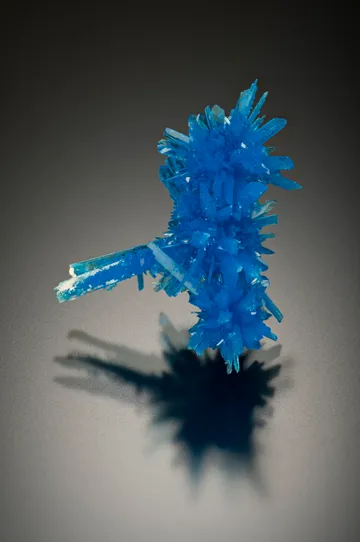
カヴァンサイト - 水和カルシウム・バナジル・シリケートの鮮やかなロイヤルブルーのロゼット状結晶。際立つ色、繊細な刃状の結晶、インドとオレゴンに限られた産地として高く評価される…
Key facts
Cavansite is a vivid blue, hydrated calcium vanadyl silicate, Ca(VO)Si4O10·4H2O, famed for its brilliant color and elegant rosette crystal clusters. Typically forming as radiating sprays and spherical to hemispherical “pom‑pom” aggregates of slender bladed crystals, cavansite occurs in basaltic amygdales of the Deccan Traps and other zeolite-rich environments. Its electric royal‑blue hue contrasts spectacularly against pale host minerals—especially white or peach stilbite and heulandite—creating some of the most eye-catching display pieces in modern mineral collecting.
カバンサイトは水和したカルシウム-バナジル系デ硅酸塩で、Ca(VO)Si4O10·4H2O、鮮やかな色と優雅なロゼット結晶の集塊で知られる。通常は放射状のスプレー状および細長い刃状晶の“ポンポン”型の球状〜半球状の集合体として形成され、カバンサイトはデカン・トラップの玄武岩質アメgダール(amygdales)内や他のゼオライト豊富な環境で産出する。その電気のようなロイヤルブルーの色調は、白色または桃色がかったスティルバイトやヒュランド石と驚くべき対比を作り出し、現代の鉱物収集において最も目を引く展示品の一部となっている。
Crystals are usually millimeter-scale blades, but rosettes can reach several centimeters across in the best Indian specimens. A classic companion is pentagonite, a dimorph with the same chemistry but different structure and habit; pentagonite’s spiky, starburst sprays can occur on the same matrix as cavansite, and both share the same intense blue color. Cavansite is relatively soft and brittle (roughly Mohs 3–4), so undamaged clusters, well-isolated on attractive matrix, are particularly prized.
結晶は通常ミリメートルスケールの刃状晶だが、最良のインド標本ではロゼットは数センチメートルに達することがある。古典的な伴生鉱物はペンタゴナイトで、同じ化学組成を持つが構造と形態が異なる二形鉱物である。ペンタゴナイトのとげ状・星状のスプレーはカバンサイトと同じ基質上に現れうるほか、両者は同じ強い青色を共有する。カバンサイトは比較的柔らかく脆い(モース硬度約3–4)のため、傷のないクラスターで魅力的な基質に分離しているものが特に高く評価される。
Once an extreme rarity known mainly from the type locality near Owyhee Dam, Oregon, cavansite became an international sensation when the Maharashtra (Pune District) quarry fields in India began producing in quantity during the 1990s–2000s. The best Indian finds—deep blue, lustrous rosettes on snowy stilbite or heulandite—instantly elevated the species to centerpiece status for contemporary collections. Production has been sporadic and subject to quarry closures and development pressures; as access has diminished, top-quality, unrepaired, well-composed matrix pieces have become harder to obtain and values have risen accordingly.
かつてはオワイエー・ダム付近の標本地のみで極めて稀少とされていたカバンサイトは、1990年代〜2000年代にインドのマハラシュトラ州(プネ地区)の採石場群が大量生産を始めたことにより、国際的な話題となった。最良のインド産標本は、深い青色で光沢のあるロゼットが雪のように白いスティルバイトまたはヒュランド石の上に現れ、現代のコレクションの中心的存在へと一気に引き上げた。生産は断続的で、採掘場の閉鎖や開発圧力の影響を受けてきた。アクセスが制限されるにつれて、修理のない高品質で良く構成された基質標本の入手が難しくなり、価値はそれに応じて上昇している。
Because cavansite combines unmistakable color, pleasing geometry, and strong contrast, it appeals to both new and advanced collectors. Beginners can find smaller rosettes at approachable prices, while advanced collectors compete for large, isolated “flowers” with perfect luster on dramatic, undamaged matrix—a recipe for cabinet-level showpieces.
カバンサイトは、独特の色、心地よい幾何学、そして強い対比を兼ね備えているため、新規コレクターと上級コレクターの双方に訴求する。初心者は手頃な価格で小さなロゼットを見つけられる一方、上級コレクターは劇的で無傷の基質上に完璧な光沢を持つ大きな孤立した“花”を競い合う。これはキャビネット級のショーピースとなるレシピである。
The Wagholi quarry complex produced the world’s finest cavansite specimens. Classic pieces show intensely saturated royal-blue rosettes—often 1–3 cm, rarely larger—perched on white to pale-peach stilbite or heulandite. The best are exquisitely isolated, with mirror-bright luster and symmetric radiating form. Variations include hemispherical “pom-poms,” flattened rosettes, and aesthetic groupings of several rosettes of differing sizes. Associations with apophyllite, mordenite, and occasionally pentagonite add interest and contrast.
ワグホリ採石場群は、世界で最も優れたカバンサイト標本を産出した。古典的な作品は、深く飽和したロイヤルブルーのロゼットを示すことが多く、1–3 cm程度で、まれにそれ以上の大きさのものがある。白色から桃色がかったスティルバイトまたはヒュランド石の上に載っている。最高の標本は非常に孤立しており、鏡のように光る光沢と対称的な放射形を備える。半球状の「ポンポン」、平坦なロゼット、大小異なる複数のロゼットの美的な組合わせといった変化も見られる。アポフィライト、モーデナイト、時にはペンタゴナイトとの関係が、興味と対比を加える。
Collectors favor Wagholi for its combination of color, size, and composition: a single, sharply isolated, deep-blue rosette on clean white matrix is the archetype. Because pocket extraction often broke clusters, expertly repaired specimens exist and should be disclosed; truly unrepaired pieces, excellent from all angles, command strong premiums. As quarry activity has waned, availability of top pieces has diminished, cementing Wagholi’s status as the definitive cavansite source.
コレクターは、色・サイズ・組成の組み合わせとしてワグホリを好む。清潔な白い基質上に鋭く孤立した深青のロゼット1枚が典型的な代表例である。ポケット掘り出しの際、クラスターが壊れやすかったため、巧妙に修復された標本が存在し、開示されるべきである。真に未修理の逸品は、あらゆる角度から優れており、高値を付けられる。採掘活動が衰えるにつれて最高品質の標本の入手可能性が低下し、ワグホリはカバンサイトの決定的な産地としての地位を確固たるものにしている。
色と彩度:
結晶形状と対称性:
光沢と表面品質:
基質と組成:
コンディション:
カバンサイト vs. ペンタゴナイト:
一般的な修復:
クリーニングと改変:
最善の実践:
取り扱い:
清掃:
光・熱・環境:
保管と展示:
飽和した色、はっきりとした放射状の対称性、強い母岩との対比、そして完璧な状態を重視しつつ、修復には警戒を怠らないことで、種の特徴である“電気の青い花”を捉え、どんなコレクションにも長く魅力を提供するカバンサイトを選ぶことができます。