Carrollite Collectors Guide
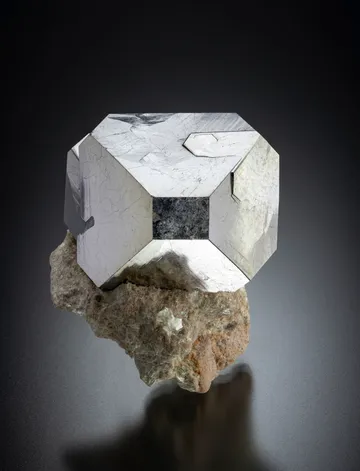
Carrollite, Cu(Co,Ni)2S4, is the cobalt-rich member of the thiospinel group and one of the most coveted cobalt minerals for collectors. Its allure comes from razor-sharp spinel-octahedral crystals with mirror-bright metallic luster, typically silver to steel-gray, occasionally showing subtle iridescent tarnish. Crystals from the Democratic Republic of the Congo (DRC) Copperbelt can be superbly formed—cubo‑octahedra with crisp edges, sometimes lightly modified by dodecahedral faces, and often perched on white dolomite, cream calcite, or striking pink cobaltoan calcite for dramatic contrast.
Individual crystals commonly range from 0.5–3 cm, with larger 4–6 cm examples being rare and prized. Carrollite’s combination of symmetry, lustrous reflectivity, and display contrast makes it a show-stopper in mixed sulfide suites. It is also the definitive, collectible cobalt sulfide: an essential species for thematic cobalt collections and a highlight in any suite of the DRC classics.
Carrollite enjoys enduring popularity thanks to a steady (though inconsistent) stream of high-quality specimens from the DRC over the last several decades. The Kamoya mines in Kambove and several Kolwezi-area deposits established the “look” collectors prize: bright, geometric crystals on carbonate matrix, often with pink cobaltoan calcite accents. While smaller singles are broadly accessible, the finest matrix pieces and crystals over a few centimeters are scarce, hotly contested, and have seen strong price appreciation.
Morocco’s Bou Azzer district also contributes attractive but typically smaller crystals and granular aggregates, providing entry-level options and locality variety. With cobalt minerals playing an increasingly visible role in modern tech narratives, visually elite carrollites—especially those with display-grade color contrasts—continue to command attention at major shows and in museum exhibits.
Below are key sources known for producing notable or world-class carrollite. Each locality is linked to a dedicated guide page.
Arguably the benchmark for the species, Kamoya South II (Kambove, Haut‑Katanga) is famous for razor-lustrous spinel-octahedral to cubo‑octahedral carrollite crystals, frequently nestled in snow-white dolomite or creamy calcite, and sometimes accompanied by blush-pink cobaltoan calcite. Crystals show crisp edges, reflective faces, and excellent symmetry. Fine singles and matrix placements are well known up to several centimeters, and the overall aesthetics—mirror-metallic silver set against white/pink matrix—have defined modern standards for carrollite.
- Color and Luster:
- Look for uniform, bright, mirror-like metallic luster—the signature of top carrollite. Dullness, heavy tarnish, or pervasive pitting reduce impact.
- Fresh, silvery steel-gray faces are ideal. Natural light iridescence can be attractive, but rainbow tarnish that obscures crisp reflections is less desirable.
- Crystal Form and Size:
- The best crystals are sharp spinel-octahedra or cubo‑octahedra with exacting symmetry and clean junctions between faces. Subtle dodecahedral modifications are a plus.
- Size matters, but only when edges remain sharp. A 2–3 cm crystal with perfect geometry typically trumps a larger, rounded or etched crystal.
- Condition:
- Chipped corners and abraded edges are common detractions. Inspect under a loupe; even tiny dings on metallic species can be conspicuous.
- Check for cleaved backs on “singles” and for pressure marks or matrix pry damage along edges.
- Matrix and Association:
- Aesthetic matrix presentations greatly elevate value. Classic pairings include:
- White dolomite saddles or crystalline dolomite
- Cream to white calcite
- Pink cobaltoan calcite (top contrast)
- Clean, balanced compositions with the crystal well-isolated and upright are preferred. Busy or crumbly matrix with many broken contacts is less appealing.
- Aesthetics:
- Aim for contrast and balance. A single, centrally placed octahedron on bright white or pink matrix is a proven recipe.
- Orientation is important: a display angle that shows maximum face reflectivity and symmetrical outline will “read” best in the cabinet.
- Repairs/Remounts:
- Acid-prep is commonly used to remove carbonates; this can undercut the matrix, and crystals may then be re-glued. Examine crystal/matrix junctions under magnification for glossy glue lines or a halo of etched carbonate.
- Reattached crystals may show slight misalignment relative to striations or a faint epoxy line along an edge. Some epoxies fluoresce under longwave UV.
- Polishing and Mechanical Enhancement:
- True natural carrollite faces have ultra-bright luster but still exhibit minute growth textures, micro-steps, or natural micro-pitting. A uniformly “plastic” or smeared sheen can indicate polishing.
- Buffed or polished edges may look rounded rather than crisply edged; natural edges are sharp and linear.
- Over-etch and Surface Attack:
- Overly aggressive cleaning (strong acids, oxidizers) can frost, pit, or “orange-peel” faces. Look for unnatural, sugary texture or etched channels cutting across faces.
- Fakes:
- Wholesale fakes are uncommon. Watch for unrelated sulfides glued onto carbonate from different mines, mismatched associations, or suspiciously perfect “made” compositions.
Carrollite is a sulfide (Mohs ~4.5–5) with good stability compared to some reactive sulfides, but it still benefits from thoughtful care.
- Handling:
- Support matrix pieces with two hands and avoid pinching crystal corners—sharp edges chip easily.
- Use soft trays or foam when moving pieces. Avoid stacking specimens where metallic faces can rub against other minerals.
- Environment:
- Store in a dry, stable environment. While carrollite is not notorious for “pyrite disease,” minimizing humidity (<50% RH) is a good practice for all sulfides.
- Avoid prolonged exposure to corrosive fumes (household bleach, acids) or high heat.
- Light:
- Normal display lighting is fine. LED case lighting is preferred over hot halogens. Prolonged direct sun can accelerate tarnish on many metals; avoid window sills.
- Cleaning:
- Dust gently with a soft brush or air bulb. Fingerprints can be removed with lukewarm water plus a drop of mild dish soap; rinse and dry thoroughly.
- Avoid ultrasonic cleaners; vibrations can propagate along edges and corners.
- If carbonate matrix requires touch-up, use very mild acid solutions only if you are experienced, and protect the carrollite faces. Over-etching causes permanent surface degradation or undercuts crystals.
- Do not use strong oxidizers or abrasive polishes on crystal faces; these will dull the natural mirror luster.
- Preservation:
- If you live in a humid climate, consider desiccant packs in closed cabinets.
- Some preparators apply a microcrystalline wax to slow tarnish; if present, avoid solvents that could streak surfaces.
With sharp geometry, bright reflectivity, and superb matrix contrasts, carrollite stands among the most aesthetic metallic species. Careful selection for crisp edges, mirror luster, and thoughtful composition will reward you with a centerpiece that anchors any sulfide or Congo Copperbelt display.