Brookite Collectors Guide
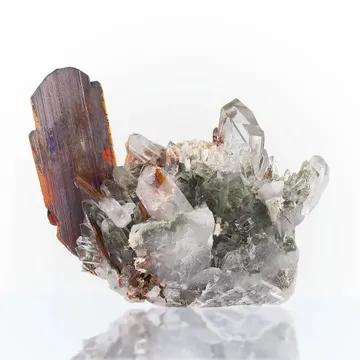
Brookite is one of the three primary TiO2 polymorphs (along with rutile and anatase) and the rarest in fine collector-quality crystals. It crystallizes in the orthorhombic system and typically forms sharp, wedge-like to tabular crystals with prominent striations and a brilliant, almost metallic adamantine luster. Colors range from deep chocolate-brown and black to fiery amber-orange; under strong backlighting, many apparently opaque crystals reveal a warm, transparent core that glows. The best specimens show bold contrasts: isolated, highly lustrous blades perched on pale albite or quartz, or dramatic singles rising from sandy or schistose matrix.
For collectors, brookite occupies a distinct niche: it is rarer than rutile, often more striking than anatase, and strongly locality-driven. Superb pockets in Pakistan (Kharan Desert and the Baltistan valleys), classic U.S. pieces from Magnet Cove (Arkansas), and razor-sharp Urals crystals have defined the species’ aesthetic. Fine brookite can be surprisingly photogenic, and top examples are centerpiece specimens in even advanced suites of oxide minerals.
Brookite’s popularity surged in the early 2000s with the arrival of large, lustrous crystals from Pakistan, which set a new standard for size and aesthetics. Prior to that, Magnet Cove (Arkansas) and the Polar Urals (Russia) were the main sources of collectible material, mostly in small to miniature sizes prized by micromounters. The Pakistani discoveries brought cabinet-sized, high-luster crystals with rich color and excellent contrast on matrix, elevating brookite from a connoisseur’s oddity to a mainstream must-have.
Today, demand remains strong for:
- Large, undamaged Pakistan crystals with translucent amber cores.
- Classic Magnet Cove specimens on quartz.
- Razor-sharp micro to small-miniatures from the Urals, often associated with anatase or rutile.
Because production is irregular and pockets are small, truly great brookites are scarce and hold value well. Collectors focused on TiO2 polymorph suites (anatase-brookite-rutile) also help sustain steady demand.
Kharan District (Balochistan) produced some of the most dramatic brookites ever found: stout, thick tabular to wedge-shaped crystals with mirror luster and superb chocolate-to-amber color. Many show a striking backlit glow through their cores. Crystals are typically isolated “showpieces,” perched on gritty, sandstone-like or drusy quartz matrix that provides excellent contrast. Sizes to several centimeters were found, with clean terminations and bold striations across faces. True matrix pieces with minimal damage are coveted; many were loose crystals or required careful stabilization due to the friable host.
- Color and translucency:
- Most brookite appears dark brown to black in normal display, but the finest show warm amber to reddish-brown translucency when backlit. Seek crystals that “light up” in the core or along edges while still appearing bold in ambient light. Purely opaque pieces can be attractive if luster and form are outstanding.
- Luster:
- Top brookite has an exceptional, almost metallic adamantine sheen. Greasy or matte faces reduce impact. Watch the largest face under a point light; it should reflect crisply without haziness.
- Crystal form and size:
- Desirable habits include stout wedge-shaped blades with well-defined terminations and strong striations. Pakistan localities can yield crystals >3–5 cm; Urals and Magnet Cove are typically smaller but celebrated for form. Twinning and complex growth can add interest.
- Clarity and zoning:
- While most brookite is not “gemmy” like quartz, internal clarity that reveals honey-brown tones adds significant appeal. Attractive internal zoning is a bonus; distracting internal cracks or cloudy cores are less desirable unless compensated by size or provenance.
- Matrix and composition:
- Matrix adds context and value. White albite or quartz creates striking contrast; chlorite-dusted matrix can emphasize crystal outlines. Single crystals (“floaters”) can be superb if pristine and balanced, but fine matrix pieces usually command a premium.
- Condition:
- Termination integrity is critical—chips on the tip are highly detracting. Examine edges for minute nicks that catch the light. Pakistan specimens can show extraction scuffs; Urals pieces may have delicate edges—prioritize minimal, non-distracting wear. Unrepaired examples carry a premium.
- Reattachments:
- Brookite crystals are often reattached to matrix where extraction was difficult. Inspect base junctions for glue sheen, misaligned striations, or continuous “wet-looking” seams. Some epoxies fluoresce under LW-UV.
- Composite matrices:
- Be cautious with unusually perfect crystals on mismatched or crumbly matrix. Compare associations to known parageneses (e.g., Pakistan brookite commonly on albite/quartz; odd lithologies can be a red flag).
- Polishing:
- Polished or lightly lapped terminations are uncommon but possible. Natural terminations usually show subtle growth marks; a perfectly featureless mirror can indicate work.
- Color alteration:
- Heat-treatment is not typical for specimens; irradiation is not used for brookite. Significant color changes are unlikely—if suspected, request provenance and dealer disclosure.
- Hardness and toughness:
- Brookite is moderately hard (about 5.5–6 on Mohs) but brittle. Avoid impacts or pressure on edges and tips. Support matrix pieces with two hands.
- Light and heat:
- Color is stable in normal display lighting. Avoid prolonged high heat; TiO2 polymorphs can transform to rutile at elevated temperatures—never bake or heat-clean.
- Cleaning:
- Dust with a soft brush or air bulb. For grime, use lukewarm water with a drop of mild dish soap and a very soft brush, then rinse and air-dry. Avoid ultrasonic or steam cleaners (risk of cracking, especially for repaired pieces). Iron staining on matrix may be reduced with sodium dithionite solutions (e.g., Iron Out)—test first and keep exposure short to protect delicate matrix.
- Chemicals:
- Avoid strong acids or bases on mixed matrices. Do not use HF-containing products.
- Storage and display:
- Use padded bases or mineral tack on sturdy matrix points—never on fragile crystal tips. Keep separate from harder species (quartz, corundum) that could scratch it. Secure shelves against vibration. Label thoroughly; locality provenance (e.g., Kharan vs. Magnet Cove) materially affects value.
By focusing on crisp luster, clean terminations, strong contrasty matrix, and proven provenance, collectors can assemble a compelling suite of brookite that showcases the species’ unique beauty across its world-class localities.