Amethyst
 Quartz
 Fluorite
 Tourmaline
 Malachite
 Azurite
 Rhodochrosite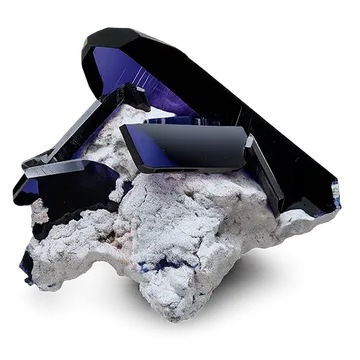
Azurite from Jacksons Crossroads is best understood first as a provenance problem, not as an established collecting classic. Jacksons Crossroads in Wilkes County, Georgia is a famous modern amethyst locality, widely known among collectors as the Jackson Crossroads Amethyst Mine or JXR Amethyst Mine. The verified mineral suite for the mine is quartz, especially amethyst, with calcite, lepidocrocite, and lokkaite-(Y) also recorded. Azurite is not part of the verified published mineral list for the locality.
That distinction matters. Azurite, Cu3(CO3)2(OH)2, is a secondary copper carbonate mineral, normally expected in oxidized copper-bearing environments. Jacksons Crossroads, by contrast, is celebrated for quartz pocket mineralization in weathered Piedmont host rocks, especially amethyst crystals in clay-filled cavities and quartz-lined pockets. A blue or violet specimen from this locality should not be assumed to be azurite; the visually famous blue-violet effect at JXR belongs to amethyst, not to copper carbonate mineralization.

Photo: Wikimedia Commons
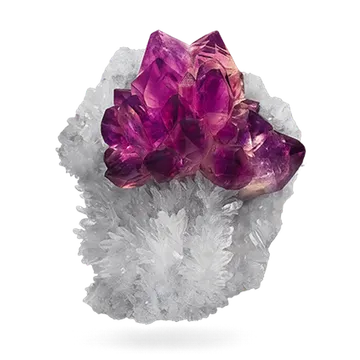
The collector significance of the locality rests on the beauty of its amethyst: lustrous, broad-faced, often stubby crystals with purple zoning, glassy faces, occasional “blue flash,” and, at the highest level, dramatic contrast against white to colorless quartz matrix. Fine pieces have been considered among the best amethyst specimens produced in the United States, and the locality became a modern American classic after notable production in the early 2000s.

Photo: Wikimedia Commons
For azurite collectors, the practical conclusion is clear: a specimen offered as “azurite from Jacksons Crossroads” should be treated as unverified unless accompanied by strong documentation, analytical confirmation, and a provenance chain explaining why a copper carbonate mineral is being attributed to a locality whose verified reputation and published record are quartz-centered.
Search for specimens: View all azurite specimens from Jacksons Crossroads, USA
Jacksons Crossroads is in Wilkes County, Georgia, near the small community of Jacksons Crossroads and west-northwest of Tignall. The mine is commonly listed as the Jackson Crossroads Amethyst Mine or JXR Amethyst Mine. Published coordinates place it near 33.88694, -82.85722, a short distance west-southwest of Jacksons Crossroads and a few hundred yards north of Clifford Grove Church.
The deposit is a semiprecious gemstone occurrence rather than a copper mine. The old geological literature for the Central Savannah River Area describes amethyst near Jacksons Crossroads in medium-grained granite, with small amethyst crystals projecting from vein walls exposed along a gullied woods road. Later collector and specimen literature emphasizes the more productive modern workings: quartz and amethyst crystals recovered from clay-rich pockets and decomposed host rock in the Georgia Piedmont.
The broader geological setting is the Piedmont of east-central Georgia, within the Appalachian crystalline terrane. Quartz veins, pods, and vuggy quartz bodies are widespread in the region. The Jacksons Crossroads material became especially important because it produced not merely pale amethystine vein quartz, but highly aesthetic specimens: broad, lustrous amethyst crystals, flower-like groups, doubly terminated crystals, and rare matrix pieces in which purple amethyst sits on colorless to white quartz.
The modern Jacksons Crossroads occurrence was reported as discovered in 1988, and significant production followed in the early 2000s. At the 2005 Tucson Gem & Mineral Show, hundreds of fine JXR specimens were offered, helping establish the locality’s reputation beyond the southeastern collecting community. The mine’s best pieces soon entered major private collections, dealer inventories, magazine articles, and public displays, including the American Mineral Treasures era of American locality collecting.
Collecting access has never been equivalent to a public roadcut or open public mine. The property is private, and access has varied over time through ownership, organized digs, commercial operations, club trips, and periods of closure or limited availability. Any collector considering a visit should verify access directly with the current landowner or authorized mine contact before traveling; the mere presence of historical directions or old collecting reports is not permission.
There is no verified mining history at Jacksons Crossroads for azurite. Regional Georgia mineral-resource studies do record copper minerals and copper prospects elsewhere in the Central Savannah River Area, including chalcopyrite and secondary copper traces in some districts, but those regional copper notes should not be transferred onto Jacksons Crossroads labels. Locality precision matters: Wilkes County copper potential is not the same thing as azurite from the JXR amethyst mine.
No dependable locality-specific habit can be described for azurite from Jacksons Crossroads, because azurite is not a verified species for the locality in the published and database records checked. There are no established Jacksons Crossroads azurite habits, crystal sizes, color variants, matrix associations, pocket names, or recognized quality tiers comparable to those known for Bisbee, Chessy, Tsumeb, Kerrouchen, Milpillas, or other real azurite localities.
What is well characterized from Jacksons Crossroads is amethyst. JXR amethyst ranges from pale violet through rich royal purple. The best crystals show strong luster, sharp quartz faces, gemmy interiors, and saturated purple zones that commonly intensify toward terminations. Many crystals are broad and equant rather than long and slender. Some specimens show doubly terminated growth, parallel growth, floater character, colorless central zones, or violet caps on clearer quartz. Matrix pieces with amethyst perched on white or colorless quartz are especially desirable because the contrast is strong and such matrix examples are much less common than loose or contact crystals.
Published descriptions and specimen records give useful scale. Colorless quartz crystals at the locality may be relatively small, while amethyst crystals can reach far larger dimensions; fine groups and cabinet pieces are known, and collector-market examples range from thumbnail crystals under 3 cm to cabinet and large-cabinet specimens. Especially aesthetic pieces show multiple amethyst crystals rising from a quartz druse or quartz plate, often with the “flower” habit that collectors associate with the locality.
Recorded associated minerals at the mine include calcite, lepidocrocite, lokkaite-(Y), quartz, and amethyst. Calcite is reported as yellow scalenohedra in open cavities with amethyst and rarely lokkaite-(Y). Lokkaite-(Y) is reported as small white spherical aggregates in cavities. Lepidocrocite is recorded from a specimen with a red strand. These associations reinforce the point: the documented mineralogy is not an oxidized copper-carbonate assemblage.
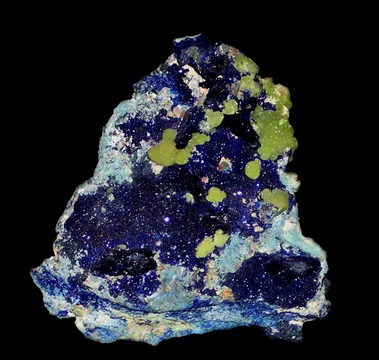
If a blue specimen is presented as Jacksons Crossroads azurite, the collector should ask what the blue is actually doing. Amethyst may appear blue-purple under certain lighting, and JXR cutters and miners have used the term “blue flash” for an optical effect in fine amethyst. That is not azurite. True azurite would be a copper carbonate, softer than quartz, with a very different paragenesis and typically a different set of companion minerals, most commonly malachite or other oxidized copper minerals.
The main authenticity issue is locality attribution. A label reading “azurite, Jacksons Crossroads, Georgia” should be considered suspect unless supported by older collection labels, direct mine-source documentation, and preferably analytical confirmation. The standard locality record does not support azurite from the Jackson Crossroads Amethyst Mine.
Mislabeling can happen in several ways. A seller may confuse the famous blue-violet “flash” of JXR amethyst with a blue mineral name. A specimen of azurite from another American locality may acquire a Jacksons Crossroads label through collection mixing. A quartz specimen from JXR may be described loosely as “blue” by a non-specialist. Or a marketplace listing may inherit an erroneous species-locality pairing from a database, old tag, or prior seller.
Condition concerns for verified JXR material are better documented for amethyst than for azurite. Many amethyst specimens show pocket contacts, edge bruising, broken terminations, clay staining, or separation marks where crystals detached from a group. Large clusters and matrix pieces can be vulnerable because the crystals occur in intergrown groups and may separate during extraction. Published gallery notes and market descriptions include examples of restoration, careful reattachment, and glue stabilization on some large JXR amethyst specimens, so fine pieces should be inspected under magnification and strong light.
For genuine azurite specimens in general, collectors watch for fragility, dulling, alteration toward malachite, repairs, and possible surface enhancement, but those are general azurite concerns rather than documented Jacksons Crossroads-specific treatments. At JXR, the more relevant warning is that no normal azurite “look” from the locality exists for comparison.
Market availability of true Jacksons Crossroads azurite should be regarded as effectively unconfirmed. Jacksons Crossroads amethyst, however, remains visible in the collector market through older finds, private-collection releases, dealer inventories, auction archives, and occasional newly surfaced pieces. The highest-demand amethyst examples are those with saturated purple color, sharp glassy faces, gemminess, intact terminations, strong display orientation, and especially purple crystals on contrasting white quartz matrix.
The Jacksons Crossroads story begins with a locality that might easily have remained just another Piedmont amethyst occurrence. Older Georgia mineral-resource work recorded amethyst near Jacksons Crossroads in medium-grained granite, along a gullied woods road where small crystals projected from vein walls. That sounds modest: a local occurrence, fair crystals, good terminations, the sort of note a field geologist would file among many. Yet the same district would later produce specimens that serious collectors would discuss as among the best American amethysts.
By the modern collecting era, the scene had shifted from a quiet woods-road occurrence to a named amethyst mine in a pine thicket off Hollis Norman Road. Directions published in the 2005 Mineralogical Record article are wonderfully specific: from Tignall, past the Kum Bak Café, along roads that change names through the Georgia countryside, then onto a dirt road, then roughly 300 feet to a new driveway marked by orange stakes, with pits about 750 feet in from the road. That level of detail belongs to a particular moment in specimen-mining history, when the locality was not just a dot on a map but a place collectors could imagine finding by landmarks.
The modern occurrence was reported as discovered in 1988, but its wider reputation surged after production in the early 2000s. By the 2005 Tucson Gem & Mineral Show, hundreds of fine Jacksons Crossroads amethyst specimens were being offered. For a locality in Georgia, that was a remarkable leap onto the international mineral-show stage. The pieces had what the market immediately understands: intense purple color, glassy luster, sculptural clusters, and the romance of a new American source producing world-class crystals.
The nickname “Wilkes County Jewels” was not empty promotion. It fit the best material: compact, broad-faced amethyst crystals that look less like ordinary quartz points and more like faceted objects grown by nature. Some fine examples show purple concentrated in the outer zones or terminations, with colorless to milky quartz beneath. Others form clusters that resemble blossoms, a habit later emphasized in the literature on lilac-colored amethyst “flowers.”
A particularly memorable 2015 collector’s note centered on “lilac-colored amethyst flowers” and illustrated two such flowers in a 7-cm matrix of colorless quartz and altered granite. That description captures the locality at its most delicate: not just big purple crystals, but small sculptural arrangements where hue, matrix, and form matter as much as size.
The American Mineral Treasures era gave the locality another public stage. Mindat’s gallery records one Jacksons Crossroads amethyst specimen photographed in the Jacksons Crossroads amethyst case at the American Mineral Treasures exhibit during the 2008 Tucson Gem and Mineral Show. That context is important. The exhibit celebrated American mineral localities that had achieved more than local fame, and JXR had done exactly that: a Georgia amethyst mine had joined the language of national specimen collecting.
Against that backdrop, “azurite from Jacksons Crossroads” becomes a different kind of field note: a warning about the power of famous names. Jacksons Crossroads is famous enough that labels travel, shorthand gets repeated, and color words can become species names in careless hands. The locality’s real story is already strong. It does not need azurite added to it.