






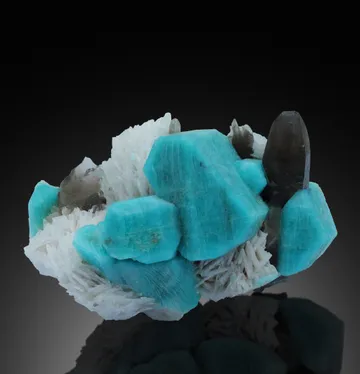
Amazonite - vivid blue-green microcline with checkerboard twinning and color; prized in smoky quartz and albite matrices, with Colorado and Urals localities.
Key facts
Amazonite is the vivid blue-green variety of microcline feldspar, treasured for its saturated color, checkerboard twinning pattern, and striking associations with smoky quartz, cleavelandite (albite), fluorite, and topaz. Crystals are typically blocky and sharply formed, often showing grid-like crosshatch twinning on their faces. The best specimens combine intense, even color with bright luster and dramatic contrast—think turquoise-blue feldspar framed by jet-black smoky quartz on a snow-white albite matrix. Classic examples from Colorado and the Russian Urals set the benchmark and remain centerpieces in many collections. While single crystals can be affordable, top matrix clusters and perfectly colored pieces are surprisingly rare and command strong prices.
Collectors have admired amazonite since the 19th century, when Colorado and the Urals produced crystals for European museums and American collections. Its enduring appeal blends bold color with iconic “Colorado-style” combinations—amazonite plus smoky quartz and snow-white cleavelandite is one of the hobby’s most recognizable aesthetics. Modern pocket discoveries at claims like Smoky Hawk and Dreamtime re-energized the market with world-class matrix clusters, while historic Russian pieces from Murzinka remain culturally significant. Today, beginners can start with attractive singles, while advanced collectors hunt for pristine, unrepaired clusters with exceptional color and composition. Fine matrix specimens are highly competitive, and truly top examples have become modern classics.
Below are renowned sources that have produced signature amazonite specimens prized by collectors.
Crystal Peak, in Colorado’s Pikes Peak Batholith, is synonymous with amazonite. Since the late 1800s, pockets here have yielded blocky, vividly colored crystals and iconic “Colorado-style” combos with smoky quartz and cleavelandite. The best pieces show saturated turquoise-blue color, crisp edges, and a pleasing grid-like twinning pattern, often arranged in balanced compositions with multiple crystal heights. While fine singles exist, matrix clusters are the show-stoppers—dramatic contrasts and three-dimensional arrangements define the best. Many pocket pieces suffered extraction damage, so pristine or minimally repaired clusters command premiums. Crystal Peak remains a cornerstone for anyone building an amazonite suite.
The Smoky Hawk claim produced some of the most exciting modern amazonite finds of the early 2000s–2010s, including museum-grade matrix clusters widely featured in media. Hallmarks include saturated, blue-green amazonite set against glossy black smoky quartz and white albite—often in sculptural, multi-tiered arrangements. The claim yielded pockets with exceptional crystal luster and color uniformity; in top pieces, the amazonite appears to glow even without backlighting. Due to brittle cleavage, repairs are common and should be expected, but well-done reattachments are acceptable on major pieces. Smoky Hawk clusters stand among the finest “Colorado-style” amazonites ever recovered.
Color and Saturation:
Luster and Surface:
Crystal Form and Composition:
Associations:
Size vs. Quality:
Condition:
Repairs/Reattachments:
Polishing/Cut Faces:
Dye/Coatings:
Handling:
Light and Temperature:
Cleaning:
Storage:
By focusing on saturated color, crisp form, strong luster, and thoughtful compositions—ideally with classic associations—you can build an amazonite suite that ranges from instructive to truly iconic.