


Profile cover
Fabian Wildfang
Fabian Wildfang
Muellheim, Germany
Collecting since 1976

I am a German collector of fine aesthetic minerals and operate a private mineral museum. Detailed information about my collection and visiting options can be found at www.thewildfangcollection.com.

Born in 1969 and raised in Müllheim, a small town in southwestern Germany near the Black Forest, my fascination with minerals began early, shaped by a region rich in geological history and long-abandoned mining sites. I started collecting at the age of seven, influenced by classic mineral literature and early exposure to specimens from academic collections.

A decisive turning point came at 18, when encountering world-class minerals shifted my focus from quantity to quality. Since then, my collecting philosophy has centered on aesthetic excellence, provenance, and integrity—fewer pieces, but uncompromisingly fine ones.

Over more than three decades, supported by a successful professional career, I have refined my collection and perspective through close relationships with dealers, collectors, and mentors—most notably Gerhard Wagner, whose guidance since 2011 has been instrumental.

Today, my collection reflects this long journey: shaped by experience, mistakes, and insight, and driven by a lasting fascination with the quiet, unnecessary, and undeniable beauty of minerals.

I welcome exchange with fellow collectors and informed visitors.

Watch here: Mineral Talks LIVE - Episode 28 - Fabian Wildfang - Private Collector; Müllheim, Germany

Why This Scheelite on Muscovite Works

Fabian Wildfang
Fabian Wildfang
21 Apr 2026 1 minute
Why This Scheelite on Muscovite Works

There are many good mineral specimens.

But only a few truly hold your attention.

This is one of them.


A Dominant Center

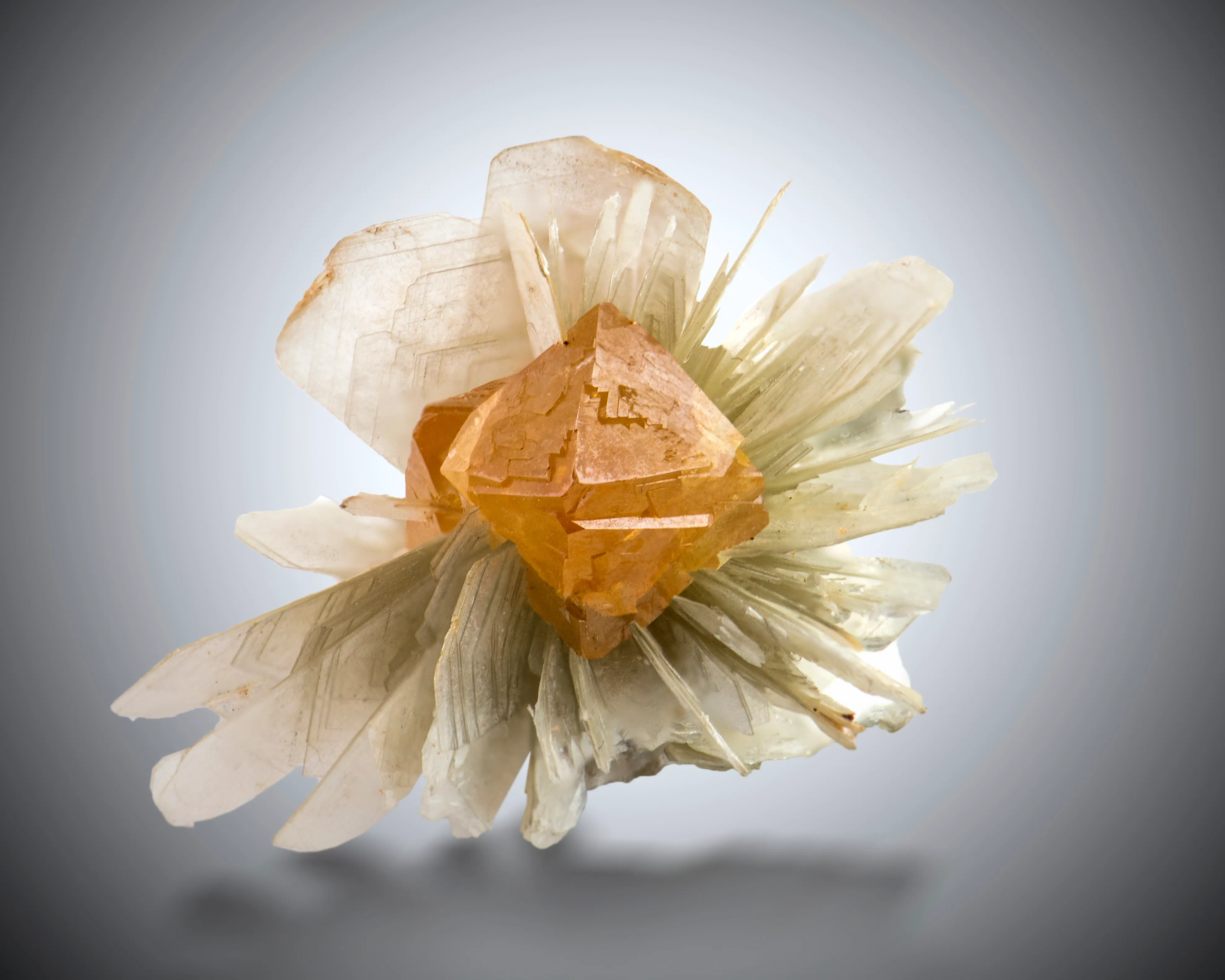
The eye immediately locks onto the orange-yellow scheelite at the center.

Its color is intense, almost luminous. Its geometry is compact and clearly defined.

It establishes a focal point that anchors the entire piece.

Everything else is secondary — and that is exactly what makes it work.


Contrast That Carries the Piece

The surrounding muscovite is pale, almost neutral in tone.

Its grey-white, layered structure spreads outward in a more diffuse, radial way. It does not compete with the scheelite — it frames it.

This creates a very deliberate contrast:

  • saturated color against restraint
  • solid form against layered texture
  • visual weight against lightness

Without this contrast, the central crystal would lose much of its impact.


Structure and Direction

The muscovite is not just a background.

Its plate-like crystals create direction. They guide the eye toward the center and reinforce the presence of the scheelite.

There is movement in the matrix — but it all resolves in a single point.


Balance Without Perfection

The composition is not symmetrical.

The scheelite is slightly offset. The muscovite spreads unevenly.

And yet, the piece feels balanced.

That tension between order and irregularity makes it feel natural — and keeps it visually alive.


Why I Chose It

I did not choose this specimen because of rarity or locality.

I chose it because it works.

Because the central crystal holds the eye. Because the matrix supports without distraction. Because the composition remains compelling, even after repeated viewing.

For me, that is the only criterion that matters.