The Korshunovskoe Fe-deposit
Collector’s Guide
Country View
Regional View
History:
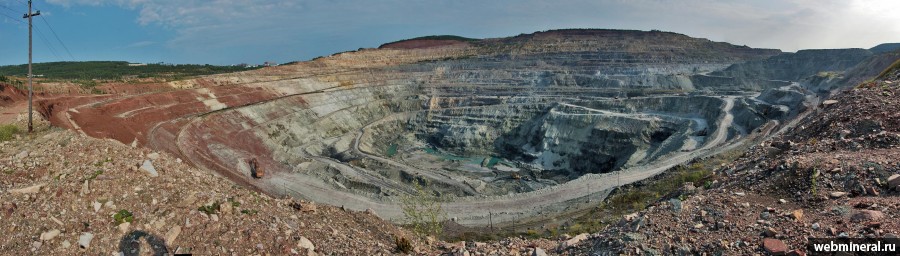
The Korshunovskoye deposit lies 430 km north of Irkutsk on the Taishet-Lena railway line, near the Korshunikha creek which flows out of the Ilim river. The main administrative and industrial center of the deposit is Zheleznogorsk-Ilimsky where about 21000 people live. It was founded in 1948, in connection with the beginning of exploitation of the iron deposits at Zheleznaya Gora (Iron Mountain). The deposit was known to local residents as early as the early 17th century. It was initially named Korshunikha, after prospector Shestak Korshunov who had discovered the Iron Mountain in 1655. In 1667, a state-owned blast furnace was built at the deposit. The first written description of the deposit was compiled by M. Kazitsky in 1844. Exploration began in 1931. The town was grantedurban-type settlement status in the 1950s, after a period of growth following the construction of the western section of theBaikal–Amur Mainline, and renamed Zheleznogorsk (Iron Mountain Town). With the completion of a major ore processing plant, town status was granted in 1965 under the present name, the suffix "Ilimsky" added to differentiate it from othertowns of the same name. The town's economy is mainly reliant on the mining complex (often called the Korshunov Mining Plant) with several open pits and a processing plant owned by the company Mechel which still focuses on iron ore but specimens are being recovered as a byproduct of the mine.
Geology:
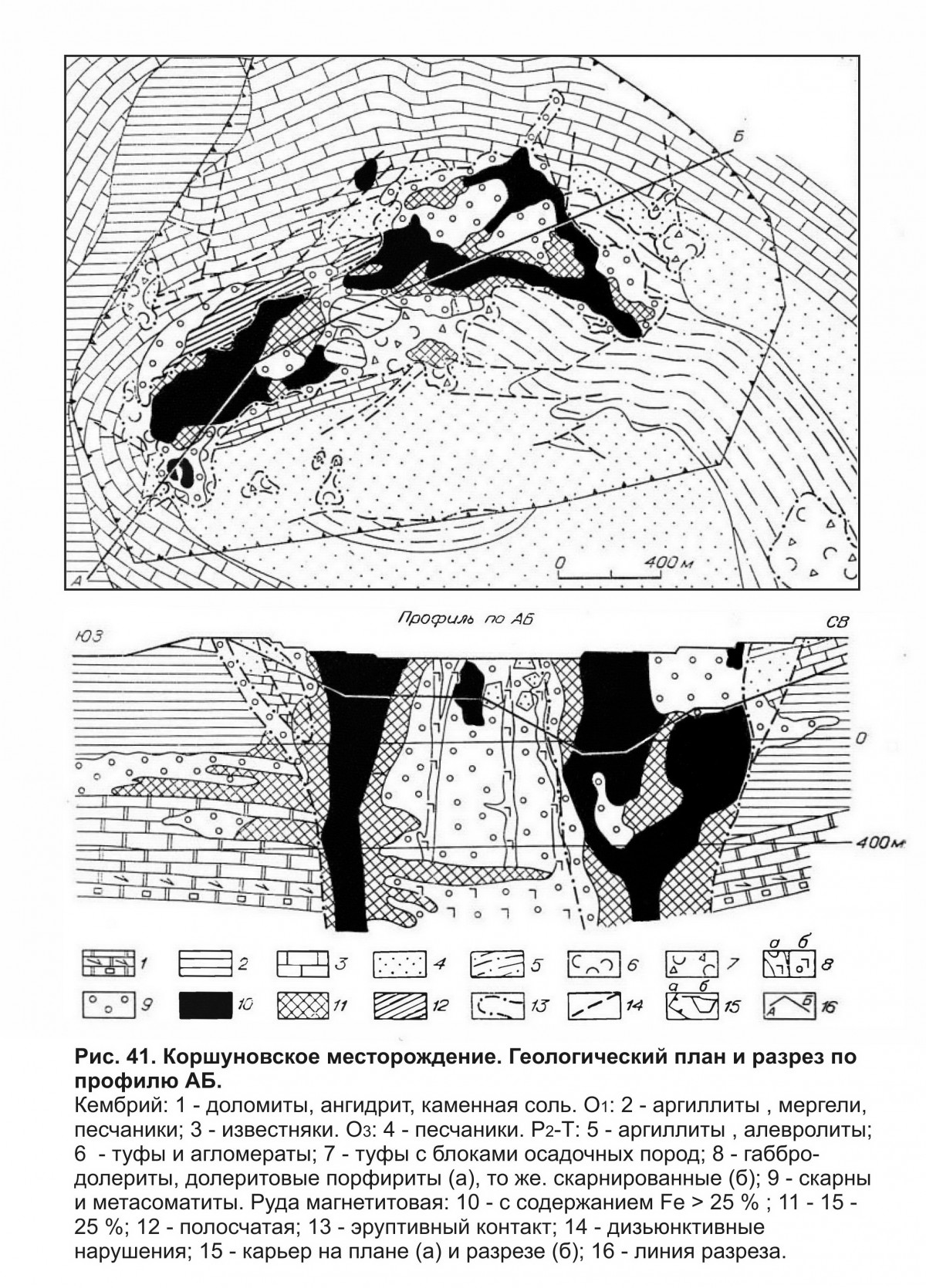
The deposit is located on the southeastern edge of the Siberian Platform, within the Angara-Ilim iron ore basin. The deposit consists of Cambrian and Ordovician sedimentary rocks and Permian-Triassic traps. Its plan dimensions are 2400 x 700 m and is mined in an open-pit. Mineralization has been traced by drilling to a depth of 1200 m, with a probable extension to a depth of 3 km. The ore bodies are steeply dipping, have a complex structure, subhorizontal metasomatic deposits at various stratigraphic levels, and vein bodies. Ores of the first type are mainly breccia-disseminated and massive, those of the second type are banded, and those of the third type are oolitic and massive. The iron content is calculated at 28%. Transitions are observed between them, which excludes their separation during mining.
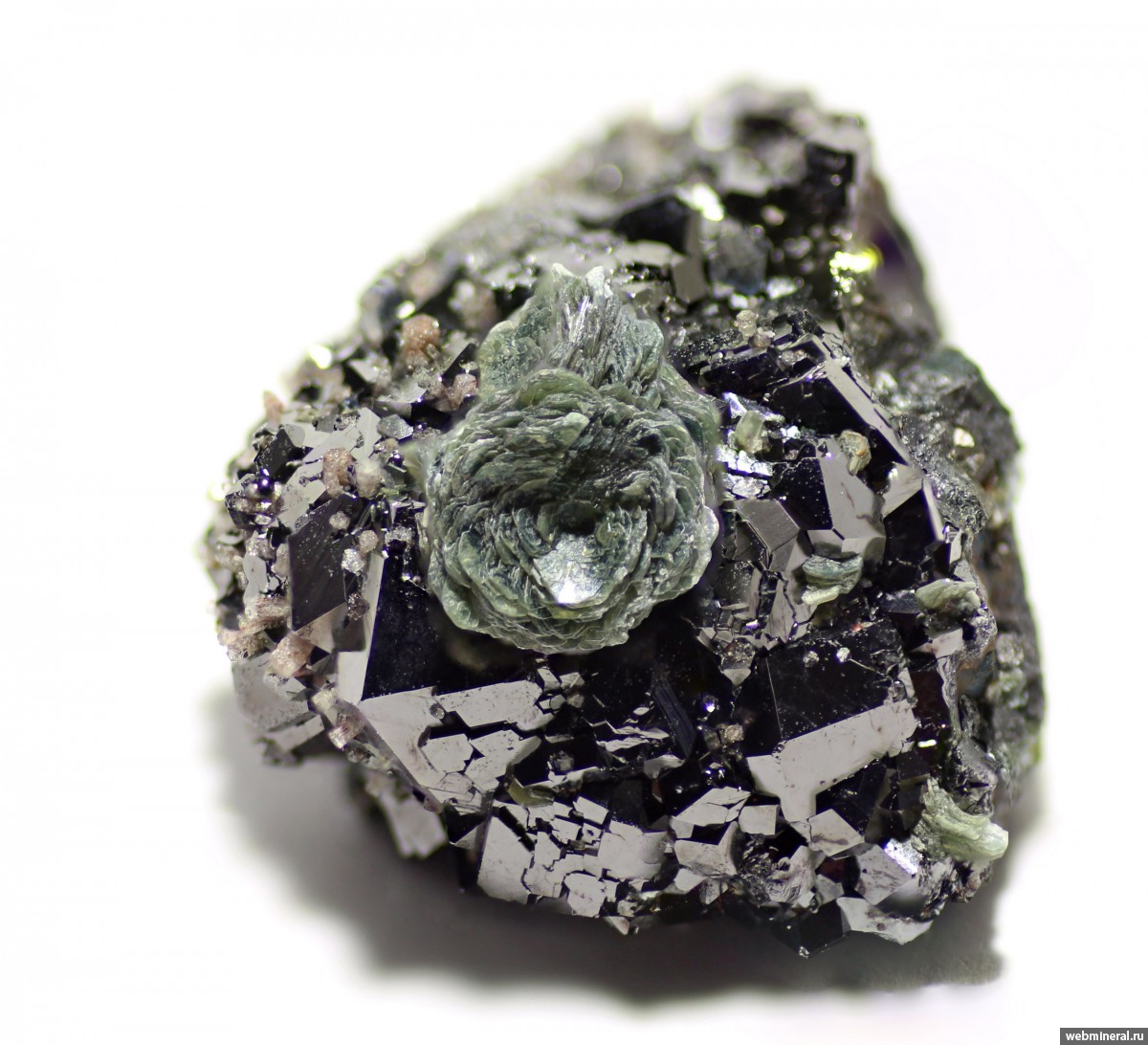
According to composition, the following are distinguished: magnetite (magnomagnetite), apatite-magnetite (sometimes with forsterite), forsterite-magnetite (with accessory picroilmenite, perovskite, pyrite, interstitial serpentine and clinochlore), calcite-magnetite and halite-magnetite ores; the latter were uncovered by boreholes at the level of halogen-carbonate deposits of the Middle-Lower Cambrian. The main ore-forming minerals are magnetite (which accounts for 82% of the iron in the deposit), magnomagnetite, alumino-magno-magnetite (with exsolution structures), alumino-magno-titanomagnetite (a titaniferous phase is present among the exsolutes), a siliceous-calcium variety of alumino-magno-magnetite, magnetite with dispersed inclusions of serpentine and chlorite, hematite and martite, and, rarely, pyrite and chalcopyrite. Apatite-magnetite ores (sometimes with forsterite or apoforsterite pseudomorphs) are common at the upper horizons of the deposit, while forsterite-magnetite vein ores are found at the lower horizons. During the transformation of ores and aluminosilicate detrital material, significant amounts of magnesium and aluminum are released, resulting in the formation of clinochlore in the skarns at high temperatures (approximately 600-400 degrees Celsius). It is often found as spherulites, brushes, and kidney-like formations and has a brown oxidized outside. Explored ore reserves exceed 310 million tons, the average annual ore production exceeds 9 million tons.
Mineralogy:
The locality has 26 mineral species of which four were first described here. It’s the type locality for Dashkovaite, Ekaterinite, Shabynite and Korshunovskite. The more interesting collectible species include Actinolite, Andradite, Calcite, Clinochlore (var. Seraphinite), Diopside, Epidote, Pyrite and most importantly Haematite and Magnetite. More rarely seen are Fluorapatite, Feldspars, Opal(ized crystals) Quartz (var. Chalcedony) and Titanite.
- Calcite has a honey-orange color and usually forms rhombohedrons and scalenohedrons and their respective distorted shapes reminiscent of the newer Indian production or the classic Swedish finds.
- Magnetite can be found crystallized as dodecahedrons and octahedrons or oolites.
- Andradite usually has a typical brown color but can be almost black too.
- Haematite appears as shiny blades up to a cm.
- Epidote is rather rare but can be found as tabular crystals reaching up to 2 cm.
- Pyrite comes as loose crystals up to a cm in veins.
Clinochlore:
Clinochlore deserves a separate paragraph because it’s clearly the star of the locality here.
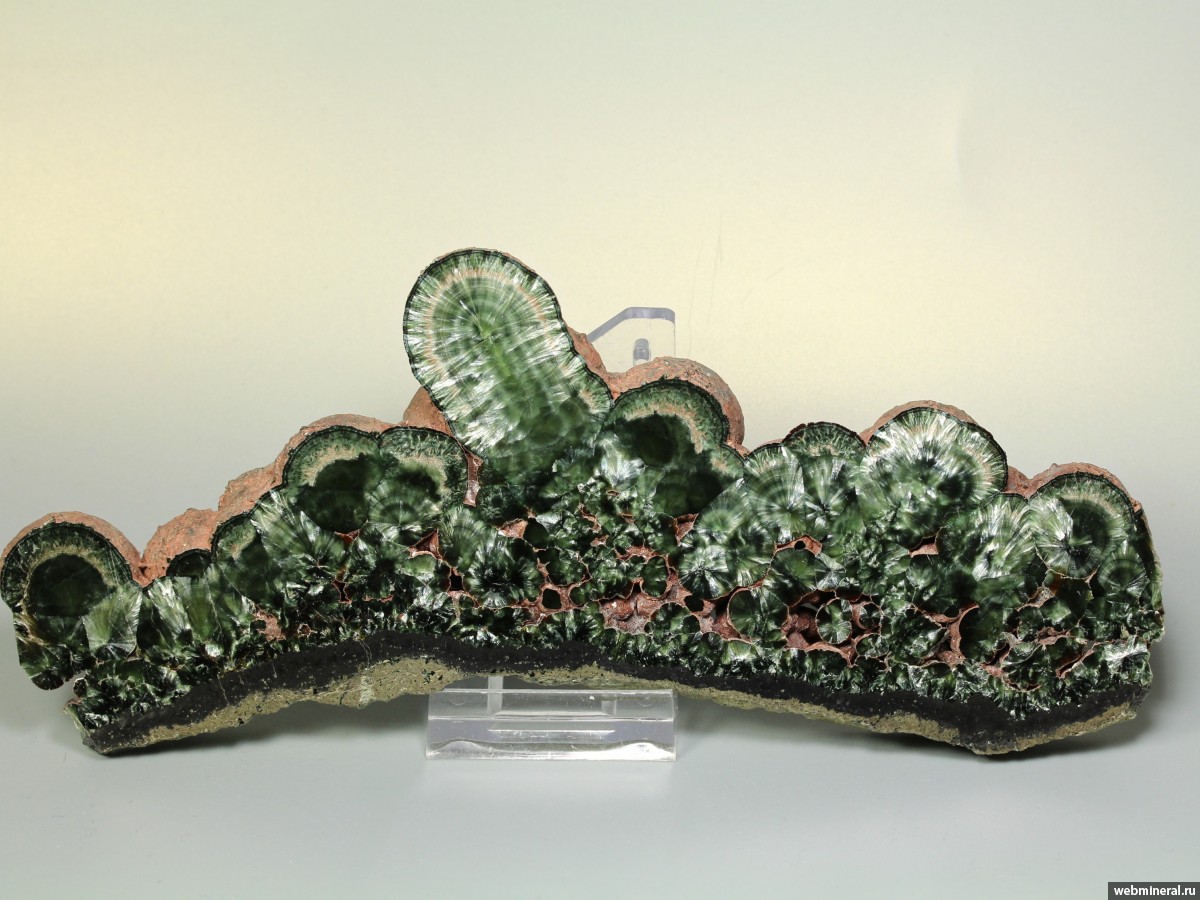
Seraphinite is a dense fine-grained variety of Clinochlore, one of the most common members of the chlorite group with a usual radiating/plumose structure. It has dark green to grey colour with silvery and feathery shimmer caused by mica inclusions. The Korshunovskoe iron deposit consists of Cambrian and Ordovician sedimentary rocks and Permian-Triassic traps. During the transformation of ores and aluminosilicate detrital material, significant amounts of magnesium and aluminum are released, resulting in the formation of clinochlore in the skarns at high temperatures (approximately 600-400 degrees Celsius). It is often found as spherulites, brushes, and kidney-like formations and has a brown oxidized outside. Polishing these reveals strikingly beautiful patterns reminiscent of the wings of the Archangel Seraphim, therefore presumably the name. Polished clinochlore clusters at the deposit are known commercially as seraphinite and can sometimes become very translucent. Usually though, it is cut into cabochons or in slabs to decorate or as inlays or other lapidary uses.
The mineral variety was first found and described in the mid-1800s by Russian mineralogist Nikolai Koksharov (1818–1892). Because the mine was primarily used for iron extraction, specimens were only of interest to mineralogists and samples were taken to museums for documentation (like the Fersman Mueum in Moscow). Only in the late 20th century it started to be marketed as a lapidary stone to collectors and cutters. Now the mine is part of a larger mining complex (often called the Korshunov Mining Plant) with several open pits and a processing plant owned by the company Mechel which still focuses iron ore but specimen are being recovered as a byproduct of the mine.
Specimens:

Contributor: Matthew Parshchikov