$165Median
511Sold (12 mo)
$200Last sale
Recent salesSee more
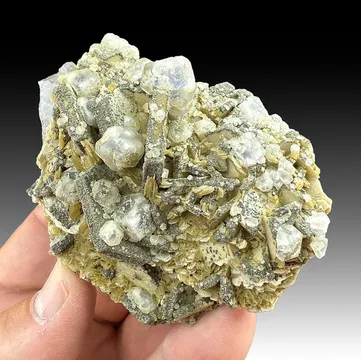
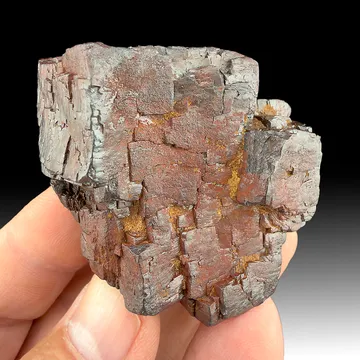
This specimen may not showcase the finest turquoise or baryte, but in the most unique style: turquoise pseudomorph baryte. In theory, it's impossible for turquoise replace baryte, doesn't chemically make sense, that's why we didn't use the term "after". We saw some turquoise replaced apatite because of the chemical similarly, they are all phosphate.
Local rock in Halloran Springs District is quartz monazite, with quartz, muscovite, beryl, microcline, and trace apatite etc., what makes this local famous is the turquoise Ps. beryl, which is confirmed by trace beryl remnants. Turquoise pseudomorph usually happened in miarolitic cavities that indicate these copper minerals are formed very late, probably derived from copper porphyry nearby.
Nearly NO EVIDENCE of occurrence of baryte in this area, which makes "turquoise Ps. baryte" incorrect, however, it is possible to see some quartz veins with baryte that derived from local meta-sediments (evidence of Chinese turquoise mine, also the morphology). So the baryte may also late, but earlier than turquoise. When the post hydrothermal fluids came in and dissolved baryte, beryl, and other minerals, then turquoise precipitated in the cavities, generate "pseudo"-"morph"(s).
I got this about 3 years ago, from Bob Reynolds Collection, a well-known fossil and mineral expert and former curator of the San Bernardino County Museum. He passed away in 2020. Just got some time to shoot this weirdo.
4cm, Apache Mine, Turquoise Mountain, Halloran Springs District, San Bernardino County, California, USA
Jingnan Zhang Coll and Photo
Comments