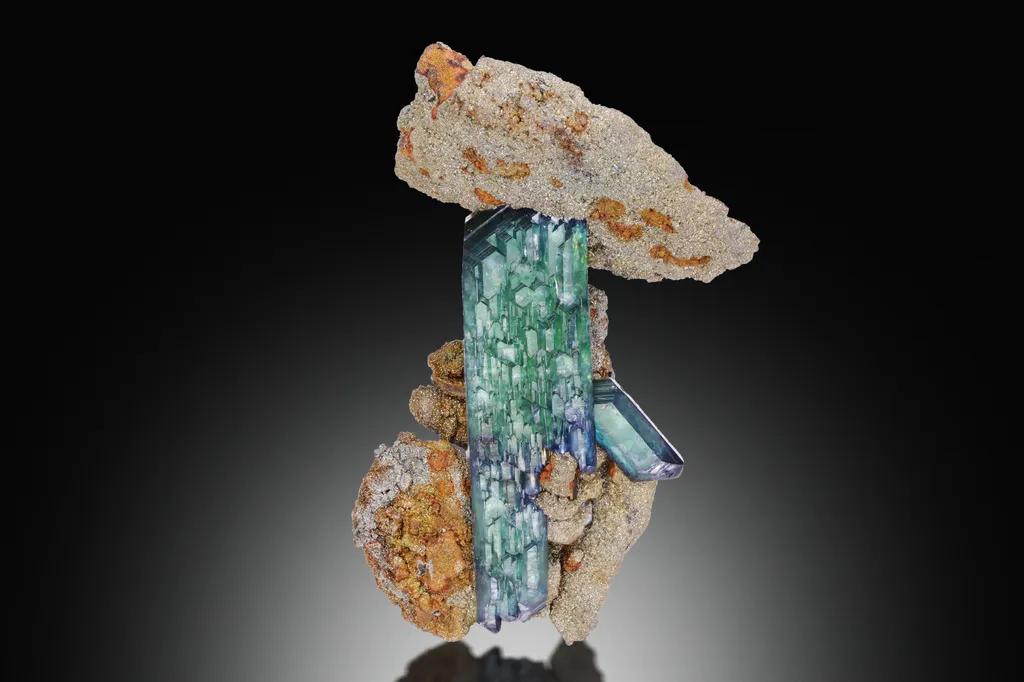
Vivianite
Vivianite is an important phosphate mineral in many natural and environmental aquatic systems. Because vivianite is stable under anoxic, and reducing, sedimentary conditions, photooxidation always plays a role in coloration that turns Fe2+ to Fe3+. Which gives it from nearly colorless/pale-green to dark bluish-green to nearly opaque.
The Bolivian tin belt is one of the classic"tin provinces"where tin deposits occur in intimate association with differentiated felsic magmatites. Huanuni mine, is one of them, not only one of the richest tin deposits, also produces spectacular vivianite crystals and sometimes associate with pyrite which represent the last stage of minerallization. During this stage, is known as supergene process, marcasite formed by weathering of earlier pyrrhotite and pyrite, siderite is altered to goethite, and well-crystallised phosphates including vivianite, wavellite and others were formed.
I am not the big fun of specimens that the terminations are not exposed, unless it's special and having a good condition lol.
Huanuni mine, Huanuni, Pantaleón Dalence Province, Oruro, Bolivia
Jingnan (Tom) Zhang Coll and Photo
Comments