






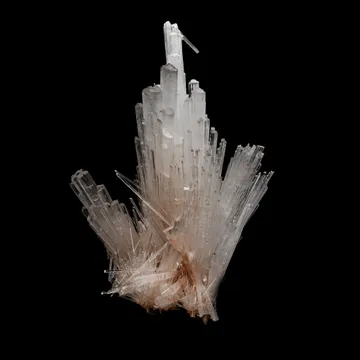
Scolecite Collectors Guide
Overview
Scolecite is a calcium zeolite (natrolite group) beloved for its elegant sprays of acicular crystals and radiant “starburst” clusters. Most crystals are colorless to snow-white, occasionally faintly pink, peach, or honey-toned from inclusions. It forms in open cavities of volcanic basalts and andesites, often alongside India’s classic apophyllite and stilbite. Aesthetic scolecite specimens range from delicate bow-tie sheaves to dramatic, palm-sized radiating suns, often perched on contrasting basalt, drusy quartz, or pastel stilbite blades. While abundant in the Deccan Traps, truly fine, undamaged sprays with balanced composition and top luster are surprisingly hard to find and remain very collectible.
Popularity
Among zeolite collectors, scolecite holds a special place for its serene, sculptural beauty. Indian discoveries since the 1980s—especially from the Pune–Mumbai corridor—flooded the market with zeolites, but the finest scolecites quickly separated themselves: long, glassy needles with mirror-bright terminations, dramatic symmetry, and striking contrasts against green apophyllite or salmon-pink stilbite. Because sprays are fragile, pristine pieces are prized, and larger starbursts or undamaged bow-ties command strong prices. Entry-level specimens are widely available, but superb display pieces—especially older classics from now-inactive quarries—are much scarcer than the species’ notoriety might suggest.
Top Collecting Localities
While scolecite occurs in many basalt-hosted zeolite regions worldwide, India’s Deccan Traps have produced the definitive standard. Below are important and well-documented localities with distinctive styles valued by collectors.
Jalgaon District, India
Jalgaon District is a broad zeolite belt with many productive quarries and road cuts. Scolecite from here spans from fine single sprays to large, dramatic starbursts associated with superb apophyllite and heulandite-stilbite combinations. Expect diversity: some clusters are snow-white and silky, others show clearer, glassier needles. Balanced compositions on basalt plates or in open vugs with contrasting species make Jalgaon pieces highly displayable.
Collector’s Guide
Evaluating Specimen Quality
- Color and Luster:
- Color ranges from colorless to snow-white; occasional faint peach, honey, or pink tones can add charm.
- Top pieces show bright, glassy tips and crisp reflections along the needles. A chalky or frosted look may indicate etching or wear.
- Crystal Form and Aesthetics:
- Classic habits include radiating starbursts, bow-tie sheaves, and open fans. Look for symmetry, unobstructed terminations, and pleasing geometry.
- In clusters, ample separation between sprays allows light to enter, enhancing sparkle and minimizing visual clutter.
- Matrix adds value when it provides contrast (dark basalt, drusy quartz) or a complementary partner (green apophyllite, pink stilbite).
- Terminations and Damage:
- The ultra-fine tips are easily bruised—inspect carefully with a loupe. Even small nicks show as bright white spots.
- Prefer specimens that display well from the front without broken tips; minor back-side contacts are more acceptable.
- Size vs. Integrity:
- Large sprays are impressive but harder to find undamaged. A smaller, pristine bow-tie often outshines a bigger but nicked cluster.
- Distinguishing from Mesolite:
- Scolecite often forms somewhat stouter, more prismatic needles with stronger longitudinal striations; mesolite tends to be more hair-like and silky.
- Visual distinctions are not foolproof. Provenance, associated species, and, ideally, analytical confirmation (Raman, optics) ensure correct labeling.
Detecting Repairs or Treatments
- Repairs and Stabilization:
- Indian zeolite pockets commonly break during extraction; reattachments with clear epoxies are not unusual.
- Look for straight glue seams at the base of sprays, tiny resin beads between needles, or misaligned striations across a break.
- Some dealers stabilize fragile clusters with dilute PVA or consolidants—acceptable if disclosed, but a natural, unaltered piece is more desirable.
- Assemblies and Fills:
- Beware of assembled displays where loose sprays are mounted onto unrelated matrix. Check for putty, plaster, or uneven, “smeared” contact zones.
- Acid Etching:
- Calcite removal with acid is common, but over-etching can dull scolecite surfaces, turning them chalky. Natural faces should appear silky to vitreous, not powdery.
- Polishing:
- Polishing scolecite is uncommon; still, an unnaturally mirror-flat “termination” may indicate alteration.
Care and Storage
Scolecite is moderately soft (about 5–5.5) and very brittle, with delicate, acicular tips—handle with great care.
- Handling and Display:
- Always hold matrix, never the sprays. Use two hands for larger pieces.
- Secure displays with a small amount of inert mineral tack under the matrix; avoid placing tack near needle clusters.
- Light and Temperature:
- Colors are generally stable under normal lighting. Avoid prolonged, direct hot sunlight to prevent thermal shock to the matrix or adhesives in repaired pieces.
- Keep conditions moderate; rapid temperature swings risk micro-fracturing.
- Cleaning:
- Dust gently with a soft blower or clean, soft artist’s brush. Avoid snagging the needles.
- If necessary, rinse lightly with lukewarm water and a drop of mild dish soap; do not soak for long periods.
- Avoid acids and harsh chemicals—zeolites can etch. Do not use ultrasonic or steam cleaners.
- Storage:
- Use padded boxes with the piece immobilized to prevent needle abrasion. Keep away from harder specimens that could scratch or crush the tips.
- Label provenance carefully—locality and era matter for Indian zeolites, especially older, now-inactive quarries.
By focusing on pristine terminations, elegant symmetry, strong luster, and an attractive matrix association, you can assemble a scolecite suite that exemplifies the serene beauty and poetry of the zeolite world.