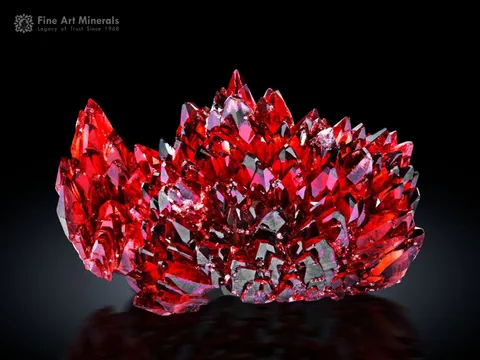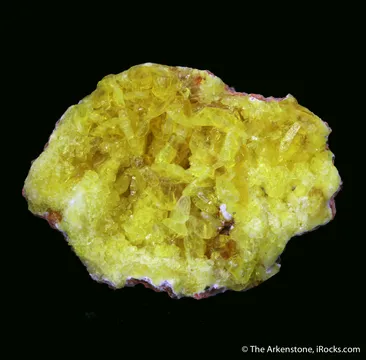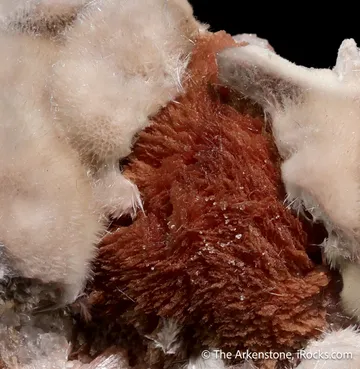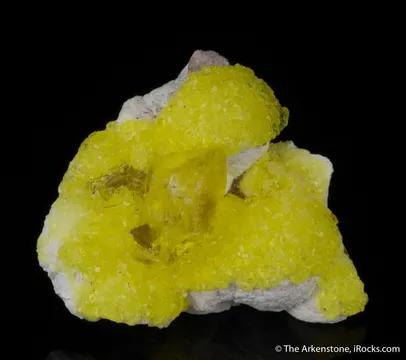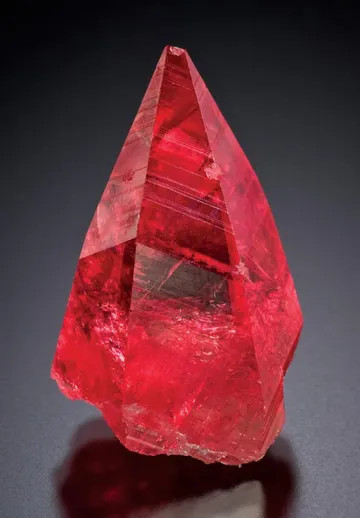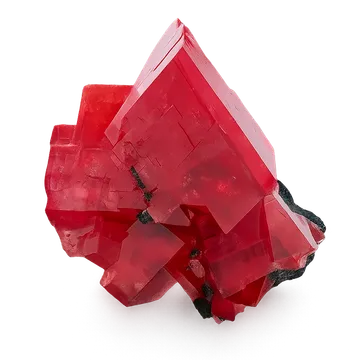
Rhodochrosite from N'Chwaning Mines, South Africa: intensely colored, gemmy crystals on manganite, renowned among collectors for form and rarity.
Key facts
Rhodochrosite from the N'Chwaning Mines is one of the great red carbonate treasures of the mineral world: intensely colored, glassy, often gemmy, and astonishingly varied in habit. The finest examples have a saturated cherry- to wine-red glow that seems improbable for a manganese carbonate, especially when perched on black manganite or manganese-oxide matrix. For serious collectors, the name N'Chwaning immediately evokes dark-red scalenohedra, “dog-tooth” crystals, bright cherry clusters, wheat-sheaf bundles, botryoidal and spherical forms, and rare matrix pieces whose contrast makes them look almost theatrical in the case.

Photo: Wikimedia Commons
The locality belongs to the Kalahari Manganese Field of the Northern Cape, South Africa, the largest land-based manganese deposit on Earth and one of the most mineralogically productive manganese districts known. The ore is hosted in Paleoproterozoic rocks of the Hotazel Formation within the Transvaal Supergroup. That setting matters to collectors because N'Chwaning rhodochrosite is not merely “pink carbonate from a manganese mine”; it is part of a world-class manganese mineral system that also produced superb manganite, ettringite, inesite, sturmanite, hausmannite, shigaite, gaudefroyite, sugilite, and a long list of rare species.
The classic red rhodochrosite was discovered in its most celebrated form during the opening and early mining of N'Chwaning I in the late 1970s. Although the broader Kalahari field had already yielded rhodochrosite at Hotazel in the 1960s, the N'Chwaning material elevated the district to legendary status among collectors. The best pieces combined rich color, transparency, sharp form, and a range of habits unmatched by most localities. N'Chwaning I is especially important for the classic red crystals; many specimens historically labeled simply “N'Chwaning” or even “N'Chwaning II” deserve closer scrutiny, because a great proportion of the famous red material came from N'Chwaning I.

Photo: Wikimedia Commons
Collectors prize this locality for a combination of beauty and scarcity. The classic pieces are not a continuously renewed product of modern specimen mining; they largely represent a narrow historical window, especially the late 1970s and early 1980s. The best N'Chwaning rhodochrosites are judged on color saturation, translucency, luster, habit, undamaged terminations, and the visual drama of the matrix. Bright, gemmy red crystals on black manganite are among the most coveted. So are undamaged scalenohedral clusters, unusually complete wheat-sheaf forms, and rare spherical or “horse-apple” botryoidal aggregates with strong color.
Search for specimens: View all rhodochrosite specimens from Nchwaning Mines, South Africa
The N'Chwaning Mines form a group of manganese mines in the Black Rock area of the Kalahari Manganese Field, within the Joe Morolong Local Municipality, John Taolo Gaetsewe District Municipality, Northern Cape Province, South Africa. The group includes N'Chwaning I, N'Chwaning II, and N'Chwaning III. The mines take their name from the farm N'Chwaning 267.
Geologically, the mines exploit stratabound manganese ore hosted by the Hotazel Formation of the Griqualand West Sequence, part of the Paleoproterozoic Transvaal Supergroup. The ore occurs in sedimentary cycles with manganese-rich layers interbedded with banded iron formation and carbonate-bearing rocks. In the northwestern Kalahari field, including Wessels, Black Rock, and N'Chwaning, much of the ore was later modified by a major hydrothermal event. This produced the high-grade, coarser, braunite-rich “Wessels-type” ore and helped create the extraordinary suite of collector minerals for which the district is famous.
The N'Chwaning deposit is a gently dipping, regular, stratabound orebody, mined underground by mechanized bord-and-pillar methods. N'Chwaning I was established in the early 1970s and is now closed. N'Chwaning II came into production in 1981 and was developed with a deep vertical shaft and underground crushing infrastructure. N'Chwaning III became fully operational in the mid-2000s, with a personnel shaft and a decline conveyor system. The broader Assmang Black Rock Mine Operations remain an active industrial manganese-mining complex, not a public collecting locality.
From a specimen standpoint, N'Chwaning I and II have different reputations. N'Chwaning I is the key source for the majority of classic red rhodochrosite, especially the famous scalenohedral and varied-habit material. Its northwestern workings, where mining began, were noted for exceptional rhodochrosite associated mainly with manganite and drusy secondary quartz. Later mining in southern areas of N'Chwaning I produced other fine minerals, including hausmannite, baryte, hydroxyapophyllite-(K), inesite, brucite, and celestine, while rhodochrosite became comparatively rare.
N'Chwaning II has produced many of the best-known collector minerals from the mine group, including superb specimens of other manganese species, but classic red rhodochrosite from the Kalahari is often over-attributed to N'Chwaning II. That distinction matters: a red, late-1970s-style N'Chwaning rhodochrosite with old labels and no precise shaft attribution should not automatically be assumed to be N'Chwaning II. The more accurate broad label “N'Chwaning Mines” is often preferable unless documentation supports a specific shaft.
Important rhodochrosite events span several periods. The first Kalahari rhodochrosites appeared at Hotazel in 1963, mostly as drusy material with gypsum, with some scalenohedral crystals appearing by 1967. The major N'Chwaning I discoveries followed about a decade later during the opening of the mine, in the late 1970s. These yielded the famous range of colors and habits, from pale pink to wine red, and from dog-tooth scalenohedra to spheres and wheat-sheaf aggregates. In 2006, N'Chwaning I also yielded notable shigaite specimens on drusy pink rhodochrosite. A small 2006 N'Chwaning II rhodochrosite pocket produced only a few dozen specimens of pink curved rhombohedra to about 1 cm, with the largest matrix specimen reported at about 12 cm.
Collecting access today is essentially through the specimen market: old collections, dealer inventories, auctions, and occasional pieces tied to later recovery. The active mine environment is controlled industrial ground. For collectors, provenance is part of the specimen. Old labels from major collections, mine-specific documentation, and clear attribution to N'Chwaning I, II, or the broader N'Chwaning Mines can materially affect confidence and value.
The most celebrated N'Chwaning rhodochrosites are red to cherry-red, wine-red, rose-red, or bright pink crystals of MnCO3 with strong vitreous luster and, in better pieces, genuine transparency or gemmy translucency. When backlit, fine crystals can shift from dark raspberry or garnet-red to a vivid internal cherry glow. Less dramatic but still locality-specific material includes pale-pink druses, small curved rhombohedra, and botryoidal crusts.
The classic habit is scalenohedral, commonly called “dog-tooth” by collectors. These crystals may occur as individual spear-like forms, tight clusters, or dense carpets on matrix. Some show natural truncated or flattened terminations that can be mistaken for damage by the inexperienced; older descriptions of the Kalahari material noted these unusual terminations as genuine crystal morphology in some specimens. Other habits include wheat-sheaf bundles, pinwheel-like aggregates, smooth spheres, botryoidal crusts built of tiny rhombs, stalactitic or layered aggregates, and curved rhombohedral crystals.

Photo: Wikimedia Commons
Size varies widely by style. Fine thumbnails and miniatures dominate the market for sharp, gemmy red crystals. Individual crystals of a few millimeters to 2 cm are common in better specimen-quality pieces; larger crystals are much rarer. Published and photo-documented classic material includes dark-red scalenohedra to several centimeters, densely coated matrix specimens, 7 cm spherical rhodochrosite on manganite, wheat-sheaf clusters around 4.8 cm, and large matrix pieces where average crystal size is reported around 2.5 cm. Drusy pink material from the 2006 N'Chwaning I shigaite association commonly consists of interlocking 1–3 mm crystals, with isolated translucent pink crystals to about 1 cm and needle-like intergrowths to about 2 cm.
Associations are a major part of the locality’s identity. Classic N'Chwaning I rhodochrosite is associated with manganite, black manganese oxides, gypsum, todorokite, chalcedony, and drusy quartz. Some of the most dramatic collector pieces show red rhodochrosite against black manganite or manganese-oxide matrix. Later and less common assemblages include rhodochrosite with shigaite, barite, pyrochroite, kutnohorite, manganocalcite, fibrous sussexite, gageite, orlymanite, caryopilite, leucophoenicite, and rare manganese silicates. N'Chwaning II material can include unusual rhodochrosite styles with botryoidal or curved rhombohedral forms, sometimes associated with other rare manganese minerals.
The highest-quality N'Chwaning rhodochrosites combine five traits: saturated red color, gemmy translucency, strong luster, distinctive habit, and intact terminations. A red scalenohedral cluster with sharp tips and no bruising is far more desirable than a larger but cleaved example. Matrix pieces command special attention when the matrix is visually contrasting and not merely massive pink carbonate. Complete three-dimensional clusters, aesthetic composition, and provenance from a known collection can all move a specimen from “classic” to exceptional.
The principal condition issue is cleavage. Rhodochrosite has perfect rhombohedral cleavage and is relatively soft for a display mineral, so N'Chwaning crystals often show broken tips, cleaved faces, small edge bruises, or contact marks. This is especially important for scalenohedral crystals, whose pointed terminations are easily lost. On old N'Chwaning pieces, a flat surface may be a natural truncated termination or a cleavage break; the distinction should be made under magnification by looking for matching luster, growth features, and whether the surface fits the geometry of the surrounding crystal.
Repairs should be expected in the broader rhodochrosite market and checked carefully on expensive N'Chwaning specimens. Look for glue lines, misaligned crystal faces, unnatural gaps filled with adhesive, and a suspiciously “perfect” cluster whose base geometry does not make sense. Ultraviolet light can help reveal some adhesives, though it is not a substitute for careful inspection. A repaired N'Chwaning rhodochrosite can still be collectible, but the repair should be disclosed and priced accordingly.
For authenticity, the most important concerns are misidentification, overly broad locality labeling, and condition concealment rather than a well-documented, locality-specific treatment. Dyed carbonate, pink calcite, rhodonite, glass, or resin imitations can appear in the general rhodochrosite market, but they rarely reproduce the precise habit, luster, and paragenesis of fine N'Chwaning crystals. A convincing N'Chwaning specimen should show plausible manganese-mine associations, carbonate cleavage behavior, appropriate crystal morphology, and credible provenance. Strong cherry-red color alone is not proof.
Locality attribution deserves special care. Many classic red specimens are safest as “N'Chwaning Mines” unless an old label, collection history, or mine documentation supports N'Chwaning I or II specifically. The majority of famous red rhodochrosite specimens are associated with N'Chwaning I, while N'Chwaning II is better known for a broad range of other spectacular minerals and for more limited rhodochrosite occurrences. Mislabeling N'Chwaning I material as N'Chwaning II is common enough that serious collectors should ask for the basis of shaft-level attribution.
The market remains strong because the classic find is historic and essentially finite. Attractive thumbnails routinely sell for hundreds to low thousands of dollars depending on color and condition, while superior miniatures and matrix pieces can bring several thousand dollars or more. Recent auction records show classic thumbnails and miniatures selling across a wide range, from under $1,000 for smaller or less dramatic pieces to several thousand dollars for fine late-1970s/early-1980s style specimens; a bright red rhodochrosite on manganite specimen from circa 1980 sold in 2024 for $9,050. Modest drusy or pink matrix pieces can still be comparatively accessible, but the truly gemmy, undamaged, red, aesthetic specimens are now firmly in the classic-mineral category.
The N'Chwaning rhodochrosite story begins before N'Chwaning became the name collectors whispered. In 1963, Hotazel produced the Kalahari field’s first rhodochrosite specimens. Those early pieces were mostly drusy material associated with gypsum, but by 1964–1967, scalenohedral crystals with sizes reported up to 4 cm were emerging from the same mine. They were good enough to bring the Kalahari Manganese Field to the attention of collectors worldwide, but the defining act was still ahead.
A decade later, as N'Chwaning I was being opened, the miners intersected the pockets that would make the locality famous. The shaft reportedly penetrated directly into vugs containing crystals. The detail that every collector remembers is almost painful: hundreds of loose rhodochrosite crystals were swept from the floor. In hindsight, those were not just pretty red carbonates underfoot; they were the first scattered evidence of one of the most important rhodochrosite discoveries ever made.
The range was astonishing. The mine did not merely produce one recognizable “type.” It produced dark-red dog-tooth scalenohedra, pale-pink material, smooth spheres, wheat-sheaf bundles, botryoidal crusts, stalactitic masses with internal concentric layering, and unusual crystals with flattened terminations. Published examples from the Desmond Sacco collection include a 10 cm specimen showing rare pinacoidal terminations, a 7 cm sphere-on-manganite piece, a 22 x 14 cm matrix specimen of dog-tooth rhodochrosite lightly coated with drusy quartz, and a 4.8 cm wheat-sheaf cluster. The great appeal of N'Chwaning is that all of these forms are recognizably from the same manganese world, yet they look like separate inventions.
The 2006 N'Chwaning I shigaite find added a different chapter. Paul Balayer, working under contract to recover specimens, returned to an old part of the mine where traces of shigaite remained in old mine-face workings. The cavities were small: the largest was described as slightly smaller than a basketball, while most were only about 10–15 cm across. Shigaite was the star, with bright, lustrous dark amber to orange-red micaceous crystals ranging from 1 mm to rare 2 cm examples. But the stage was usually rhodochrosite—drusy pink linings, saucer-shaped matrix pieces coated on both sides, and associations with barite, kutnohorite, manganocalcite, pyrochroite, and fibrous sussexite. One recorded specimen carried the largest crystal from that find: a 3.2 cm shigaite perched on drusy rhodochrosite with barite, minor pyrochroite, and smaller shigaite crystals.
Even small N'Chwaning pieces can carry long afterlives. A 1996 group of shigaite specimens on rhodochrosite from N'Chwaning I passed through the former Desmond Sacco collection and later appeared as documented collector pieces, with details as precise as 33 x 27 x 14 mm, 37 x 29 x 18 mm, and 29 x 22 x 8 mm. Their rhodochrosite matrix was noted as fluorescent in both longwave and shortwave ultraviolet light. In 2024 and 2025, one such specimen became part of a new micro-mineral story when suspected waterhouseite was investigated and then confirmed on rhodochrosite with shigaite and barite—proof that even classic specimens can still yield new observations when examined closely.
Wilson, Wendell E.; Dunn, Pete J. (1978). “Famous Mineral Localities: The Kalahari Manganese Field [South Africa].” The Mineralogical Record, 9(3), 137–153. — The early classic account that helped establish the Kalahari field, including its rhodochrosite, in the modern collecting literature.
Pohl, Demetrius; von Bezing, K. L.; Dixon, Roger D.; Cavallo, Greg (1991). “The Kalahari Manganese Field [South Africa]: an Update.” The Mineralogical Record, 22(4), 279–297. — A major update on Kalahari mineral discoveries and associations following the first wave of famous finds.
Cairncross, Bruce; Dixon, Roger (1995). Minerals of South Africa. Geological Society of South Africa. — Frequently cited for N'Chwaning I mineralogy, including the shift from rhodochrosite-rich early workings to later areas richer in other species.
Cairncross, Bruce; Beukes, Nicolas J.; Gutzmer, Jens (1997). The Manganese Adventure: The South African Manganese Fields. Associated Ore & Metal Corporation Limited. — A foundational book-length treatment of the Kalahari manganese deposits and their collector minerals.
Gutzmer, Jens; Cairncross, Bruce (2002). “Spectacular Minerals from the Kalahari Manganese Field, South Africa.” Rocks & Minerals, 77(2), 94–107. — A richly illustrated collector-focused article documenting classic Kalahari specimens, including N'Chwaning rhodochrosite habits and large published examples.
Gutzmer, Jens; Beukes, Nicolas J. (1995). “Fault-controlled metasomatic alteration of early Proterozoic sedimentary manganese ores in the Kalahari manganese field, South Africa.” Economic Geology, 90(4), 823–844. — Key geological paper on the hydrothermal alteration that produced the high-grade Wessels-type ore.
Gutzmer, Jens; Beukes, Nicolas J. (1996). “Mineral paragenesis of the Kalahari manganese field, South Africa.” Ore Geology Reviews, 11(6), 405–428. — Important scientific treatment of Kalahari mineral assemblages and paragenesis.
Cairncross, Bruce; Beukes, Nicolas J. (2013). The Kalahari Manganese Field: The Adventure Continues. Struik Nature. — Later comprehensive account cited for details on N'Chwaning rhodochrosite occurrences, including the small 2006 N'Chwaning II find.
Wilson, Wendell E.; Moore, Thomas P.; Cairncross, Bruce; Beukes, Nicolas J. (2017). “The N'Chwaning mines, Kalahari Manganese Field, Northern Cape Province, South Africa.” The Mineralogical Record, 48(1), 13–114. — The major modern Mineralogical Record monograph on the N'Chwaning Mines.
Cairncross, Bruce (2016). “Connoisseur’s Choice: Shigaite, Kalahari Manganese Field, Northern Cape Province, South Africa.” Rocks & Minerals, 91(2), 150–153. — Includes the 2006 N'Chwaning I shigaite find on drusy rhodochrosite matrix.
Cairncross, Bruce (2017). “The Where of Mineral Names: Nchwaningite, N'Chwaning II Mine, Kalahari Manganese Field, South Africa.” Rocks & Minerals, 92(3), 290–292. — Useful for N'Chwaning nomenclature and locality context.
Mindat: N'Chwaning Mines locality page — Core locality reference for the mine group, geology, mining history, mineral list, and coordinates.
Mindat: N'Chwaning I Mine — Essential for the shaft most closely associated with the majority of classic red rhodochrosite specimens.
Mindat: N'Chwaning II Mine — Important for distinguishing N'Chwaning II material and the broader specimen history of the mine group.
Mindat: Kalahari Manganese Field — Best single online overview of the district’s geology, rhodochrosite history, and collector mineralogy.
IUGS Geological Heritage Site: The Kalahari Manganese Field — Authoritative geological-heritage summary of the Kalahari field and its global significance.
Assmang: Manganese Ore operations — Operator information for the Black Rock / Nchwaning and Gloria manganese operations.
Assore history — Corporate timeline with commissioning milestones for Nchwaning I and II.
Wikimedia Commons: Rhodochrosite-237488.jpg — Publicly licensed image and description of an N'Chwaning II rhodochrosite specimen with “horse-apple” form.
Wikimedia Commons: Rhodochrosite-83179.jpg — Publicly licensed image of a gemmy cherry-red N'Chwaning rhodochrosite miniature.
Wikimedia Commons: Rhodochrosite-d06-121a.jpg — Publicly licensed image of a bright “cherry pocket” style N'Chwaning II rhodochrosite.
Mineral Auctions: Rhodochrosite on Manganite, circa 1980 finds — Useful recent auction record for market context on a classic red-on-black N'Chwaning specimen.
Mineral Auctions: N'Chwaning rhodochrosite, 2025 auction record — Recent thumbnail sale illustrating the continuing demand for classic red scalenohedral material.
Mindat specimen: Shigaite, Rhodochrosite, Waterhouseite — Modern documented specimen showing how old N'Chwaning rhodochrosite-associated pieces can still yield new mineralogical observations.