






Erythrite Collectors Guide

Overview

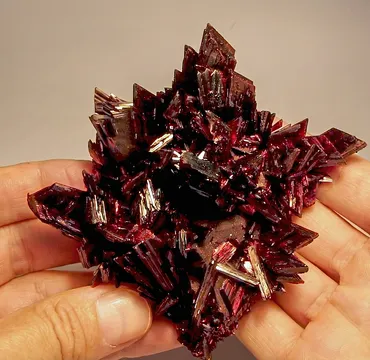
Erythrite is a vivid cobalt arsenate, Co3(AsO4)2·8H2O, best known for its striking crimson-to-magenta color that can verge into royal purple. Formed in the oxidation zones of cobalt–nickel arsenide deposits (skutterudite, safflorite, cobaltite, nickeline), it typically occurs as silky to glassy acicular crystals, radiating sprays, sheaves, and crusts, and more rarely as thin tabular prisms with sharp faces and bright luster. On contrasting white calcite or pale dolomite, erythrite “explodes” visually—one of the most instantly recognizable and photogenic secondary minerals.

While small velvety coatings (“cobalt bloom”) are common, fine specimens with long, lustrous, well-separated crystals are far scarcer and highly sought after. The modern benchmark comes from Morocco’s Bou Azzer district, which has produced world-class magenta sprays and gemmy, elongated blades on pale carbonate matrix. Historic European classics from Schneeberg (Germany) and Jáchymov (Czech Republic) provide unmatched pedigree. Erythrite is soft and fragile (Mohs ~1.5–2.5), yet its color and forms make it a perennial collector favorite, with exceptional pieces commanding strong prices relative to size.

Popularity

Erythrite’s popularity rests on color, contrast, and history. Early European cobalt districts gave the species its old nickname, “cobalt bloom,” treasured on antique matrix specimens alongside skutterudite and cobaltite. The late-20th and 21st-century revival of Bou Azzer, Morocco, dramatically raised the bar: intense magenta sprays and lustrous blades on chalk-white calcite revived global interest and set modern aesthetic standards.

Collectors at all levels engage with erythrite:

  • Beginners appreciate affordable micros and small crusts with vivid color.
  • Intermediate collectors pursue sharp, radiating sprays and complete, upright sheaves on matrix.
  • Advanced collectors target large, undamaged Moroccan “showpieces,” or rare historic European classics with impeccable provenance.

Supply can be sporadic, and the species’ fragility means pristine pieces are uncommon. The best examples—large, undamaged, three-dimensional sprays with top color and balance—are limited and compete well against other top aesthetic secondaries.

Top Collecting Localities

Bou Azzer Mining District, Morocco

Loading locality...

The world’s modern reference for erythrite. Bou Azzer’s cobalt–nickel arsenide deposits yield spectacular magenta to royal-purple sprays and sheaves, often perched on snow-white calcite or pale dolomite for dramatic contrast. Classic pockets from mines like Aït Ahmane, Aghbar, and Bouismas produced lustrous elongated blades to several millimeters or more, as well as dense radiant clusters forming exquisite bouquets. Associated species can include skutterudite, safflorite, cobaltite, quartz, calcite, roselite, and wendwilsonite—combinations that enhance both color harmony and scientific interest.

Collectors value Bou Azzer erythrite for saturated color, brightness of luster, and three-dimensional crystal groupings. Fine, intact matrix pieces with elegant composition and little or no damage are considered benchmark specimens for the species.

Collector’s Guide

Evaluating Specimen Quality

  • Color and saturation: The most important factor. Seek saturated magenta to royal-purple hues that hold their intensity in normal cabinet lighting. Slightly translucent, glassy crystals that “glow” internally are especially attractive. Pale or brownish tones are less desirable, though strong color can still present beautifully as velvety crusts.
  • Crystal habit and luster: Top specimens show long, slender, lustrous acicular blades arranged in 3D radiating sprays or sheaves, with crisp, reflective terminations. Dense velvety coatings can also be attractive, but well-separated, upright sprays generally command premiums. Avoid dull, matted surfaces unless the overall composition is exceptional.
  • Matrix and contrast: Erythrite pops on white calcite/dolomite or against light rock; darker arsenide-bearing matrices can also be dramatic. Balanced composition is key—one or more central sprays with breathing room, not overly crowded. Associations with skutterudite/cobaltite or with roselite–wendwilsonite can add value and scientific interest.
  • Size and separation: Larger sprays with individually discernible crystals are uncommon and prized. Specimens where the main spray(s) stand proud of the matrix and display well from multiple angles make the strongest impact.
  • Condition: Erythrite is fragile. Look closely for bruised tips, broken needles, or crushed edges—damage can be surprisingly easy to miss. Favor pieces with minimal or no trauma to the principal sprays. Because of the softness, even micro-chipping is common; choose examples where any minor issues are not distracting.
  • Aesthetics: Step back and evaluate symmetry, balance, and “presence.” Superb pieces have an unmistakable wow-factor: vivid color, bright luster, well-positioned sprays, and pleasing negative space around the main crystal groups.

Detecting Repairs or Treatments

Repairs and stabilization occur due to erythrite’s fragility:

  • Reattachments and stabilization: Sprays or crusts may be consolidated with thin, clear adhesives. Under a loupe, look for glossy glue halos at the base of sprays or at seams where crystals meet matrix. UV light may reveal fluorescing adhesives.
  • “Regrown” or reprecipitated coatings: Rarely, artificial recrystallization can deposit new erythrite-like crusts. Clues include unnaturally uniform coatings, lack of any peripheral zoning, and absence of typical paragenetic context. When in doubt, rely on reputable provenance.
  • Dyeing: Uncommon but possible. If color appears overly uniform and unnatural or bleeds when lightly swabbed with a barely damp cotton swab on a discreet edge (do not rub the main crystals), be cautious. Avoid aggressive testing that could damage the piece.
  • Polishing is not applicable; crystals are too soft to be sensibly “re-terminated.” Most enhancements involve consolidation rather than surface alteration. Always ask dealers to disclose any stabilization.

Care and Storage

Erythrite is soft (Mohs ~1.5–2.5), brittle, and hydrated—handle and store with exceptional care.

  • Handling:

    • Support matrix, not the sprays. Never pinch or press on the crystals.
    • Use two hands for larger pieces; transport in cushioned containers with the display face immobilized.
    • Consider a dedicated stand or small case to minimize movement and accidental contact.
  • Light and temperature:

    • Normal cabinet LED lighting is fine; avoid prolonged direct sunlight and heat. Excess heat can drive dehydration and risk micro-fracturing.
    • Keep away from hot display lights or window sills.
  • Humidity and environment:

    • Maintain stable, moderate indoor humidity; avoid extremes of aridity or dampness. Erythrite is generally stable at room conditions but is sensitive to rapid environmental changes.
    • Do not display near sources of vibration.
  • Cleaning:

    • Avoid water jets, soaking, acids, and ultrasonic cleaners. Water can mobilize fine debris into the sprays or loosen old consolidants; strong chemicals may harm matrix species.
    • Best practice is dry cleaning only: soft air bulb and the lightest dusting with a very soft brush around (not through) sprays. If absolutely necessary, a minimal, controlled use of distilled water on matrix only—never on fragile sprays—then air-dry thoroughly.
  • Storage:

    • Store upright in foam-lined trays or individual specimen boxes with ample clearance above the sprays. Keep away from harder minerals that could scratch or crush it.
    • Label with locality and any disclosures about stabilization.
  • Safety:

    • Erythrite contains arsenic. While stable to display, avoid creating dust (no trimming or grinding). Wash hands after handling and keep out of reach of children and pets. Enclosed display cases are ideal.

By prioritizing vivid color, lustrous and well-separated sprays, excellent contrast, and top condition—with careful handling—you can curate erythrite specimens that rival the finest modern and historic examples from around the world.