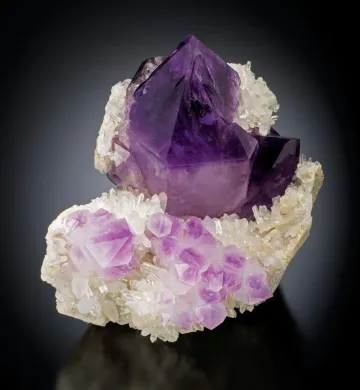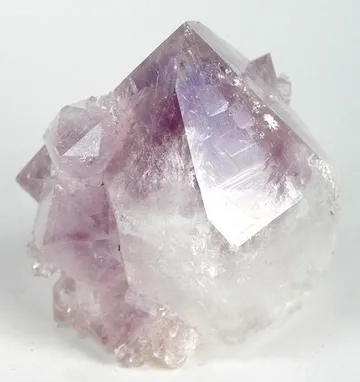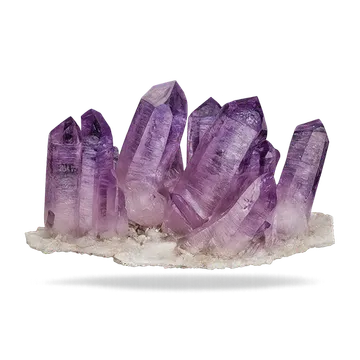
Amethyst from Guerrero, Mexico - stout, glassy crystals with wine-purple cores and pale outer zones; notable for inner color phantom and sculptural habit.
Key facts
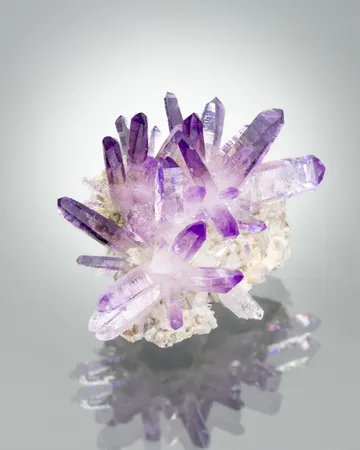
Guerrero amethyst is one of the most instantly recognizable Mexican quartz classics: not the airy, lavender, needle-like amethyst of Veracruz, but stout, glassy, tapering crystals with a concentrated wine-purple to reddish-purple interior and pale, milky, smoky, or colorless outer zones. In the best examples the purple seems suspended inside the crystal as a vivid phantom, with the termination left frosty-white or water-clear. A fine Guerrero group has real cabinet presence—broad-shouldered crystals, divergent architecture, deep internal color, and the unmistakable sense that the purple is glowing from within rather than merely coating the surface.
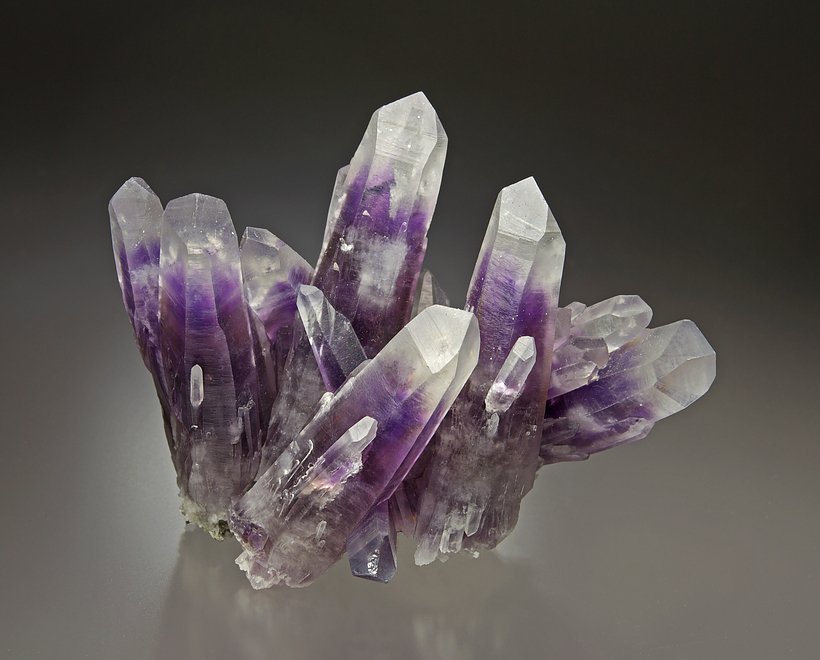
Photo: Mindat.org
The classic source is the Amatitlán area in Eduardo Neri Municipality, north-central Guerrero, in the mountains south of the Balsas River. Although labels often simplify the locality to “Guerrero,” “Amatitlán,” “Iguala,” or “Rio Balsas district,” the collectible material came from many small veins and pocket zones scattered through rugged country around Amatitlán. The named workings include the Margarita, Palo Verde, Rayas, Valenciana, Santa Rita, Amatitlán, Altamirano, and La Sorpresa mines or diggings, though many small pits and trenches were never preserved under stable locality names.
Geologically, these amethyst veins belong to the mineralized environment of the Guerrero Gold Belt, where Lower Cretaceous carbonate and calcareous sedimentary rocks of the Morelos and Mezcala formations were intruded by early Tertiary granodioritic bodies. The associated gold-iron skarn systems contain garnet-pyroxene assemblages, magnetite, specular hematite, and related metasomatic alteration. The amethyst itself occurs in veins and pods around this skarn terrain rather than as the huge basalt-hosted geodes familiar from Brazil and Uruguay. That difference helps explain its collector character: Guerrero produced sculptural crystal specimens and gem rough, not industrial-scale amethyst geode material.
Historically, Guerrero amethyst became famous in the twentieth century because it combined gem color with specimen form. Early miners and lapidaries prized the material as cutting rough, and some superb crystals were broken for faceting before the collector value of intact groups was fully appreciated. Later generations of collectors came to value the very features that make the locality diagnostic: thick tapered prisms, colorless caps, purple cores, strong phantoms, and occasional manganese-oxide coatings. Fine old examples now have a dual appeal—part Mexican classic, part world-class amethyst.
Collectors look first for color distribution and architecture. A desirable Guerrero specimen is not merely “dark purple.” The best pieces show saturated grape to reddish-purple cores, sharp internal phantoms, excellent luster, undamaged terminations, and an attractive spread of crystals rather than a crowded mass. Single crystals can be important when they show the classic tapered form and a strong phantom; clusters rise sharply in value when the crystals are well separated, balanced, lustrous, and complete.
Search for specimens: View all amethyst specimens from Guerrero, Mexico
The essential Guerrero amethyst locality is Amatitlán, a small settlement in Eduardo Neri Municipality. Mindat places the Amatitlán diggings at approximately 17.86514, -99.76164, with the village itself only a short distance from the mineralized ground. The productive amethyst area is best understood not as a single mine but as a swarm of veins over roughly a 20 × 20 km region north of Amatitlán and south of the Balsas River. Serious labels should use “Amatitlán, Eduardo Neri Municipality, Guerrero, Mexico” unless a specimen has credible older documentation tying it to a named claim such as Margarita, Palo Verde, Rayas, Valenciana, Santa Rita, Amatitlán Mine, Altamirano, or La Sorpresa.
The deposit style is small-scale vein and pocket mining associated with gold-iron skarn systems of the Guerrero Gold Belt. The regional skarns formed where Cretaceous dolomitic limestones and calcareous shales were intruded by granodiorite stocks. The skarns are described as andradite-grossular garnet and diopsidic to johannsenitic pyroxene systems, with specular hematite, magnetite, and massive magnetite pods along contacts. The amethyst veins and pods are related to this broader contact-metasomatic district, but the collectible crystals occur in localized open spaces rather than in a continuous orebody.
Mining was never the orderly bench-and-stope specimen production one associates with some modern commercial localities. The classic workings were shallow trenches, adits, and cuts dug along vein exposures. Miners followed a vein until the productive pocket zone was exhausted, sometimes only to depths of 8 or 10 meters, then abandoned that working and searched for another. This is why so many Guerrero pieces are safely labeled to Amatitlán rather than to a precise mine: the collectors’ market preserved the regional name better than the names of every temporary cut.
Extensive working began around 1930–1933. The earliest discovery story centers on Donato Retana, a farmer near Tenantla and Amatitlán, who found purple and white quartz crystals while preparing cornfields. The lapidary trade in Querétaro soon became involved because the crystals yielded attractive gem rough. At first, much of the finest material was valued as cutting stock; large crystals were broken apart for clean pieces to facet. Only later did the market fully recognize the value of intact specimen groups.
The named Margarita claim became especially important for specimen groups. Manuel Ontiveros recalled naming it for his older sister Margarita after an engineer, surveying a prospective claim in the high mountains, pointed out a chalky zone containing crystals. Digging at about 3 meters depth exposed a sand-filled pocket with numerous amethyst crystals. The Margarita Mine lay near one end of a long fault that produced much of the Amatitlán amethyst.
The Palo Verde occurrence was another major early bonanza. Ontiveros distinguished Palo Verde from most other claims because a very large pocket was reportedly found as a pod in decomposing granite at about 20 meters depth, rather than as the more typical vein occurrence. He also recalled that La Cuna and Palo Verde were the two great early bonanzas beyond Donato Retana’s original find, while the best specimen groups generally came from Margarita.
La Sorpresa entered the modern collector record in 1997–1998, when employees associated with Mike New, Wayne Thompson, and Ruben Avila mined the property. The site was described as a half-mile-long exposure of veins across a hillside overlooking a tributary of the Rio Balsas. Much of the vein material had apparently been dug previously and then backfilled, suggesting that important pockets had already been removed under an earlier name. Even so, the operation recovered fine specimens, including a celebrated Guerrero amethyst that appeared on the cover of The Mineralogical Record.
Collecting access today should be approached as a professional matter, not as casual field collecting. The localities are on claims, private or concessioned mineral ground, and in a region where security, land status, and mining rights are serious considerations. Permission from landowners and mineral-rights holders is essential. For most collectors, the responsible route is acquisition through reputable dealers, old collections, or documented auction material rather than attempting a field visit.
Guerrero amethyst is most famous for its crystal habit. The crystals are elongated but not slender in the Veracruz manner; they tend to be thicker through the lower and middle sections and then taper toward normal quartz terminations. Many show a Tessin-like taper or barrel-like swelling, with strong horizontal striations, stepped faces, and a glassy to frosted luster. Good groups are often divergent, with crystals spreading from a common base in a natural fan or flower-like arrangement.
The color is usually concentrated inside the crystal rather than evenly distributed through the whole body. Classic crystals have a deep reddish-purple to grape-purple core in the lower or central portion, fading outward to pale smoky, milky, grayish, or colorless quartz. The tips are commonly white or colorless. This is one of the most important visual distinctions from Veracruz amethyst, where the color commonly strengthens toward the termination and the crystals are usually more slender and less tapered.
Phantoms are central to the locality’s appeal. Many crystals show sharply bounded purple internal growth zones, often chevron-shaped or smoky-purple in the lower core. Some rarer crystals are concentrically zoned, with a rather plain milky outer shell hiding a much richer purple interior. Backlighting can be especially revealing: a specimen that seems subdued in reflected light may show saturated violet cores and complex phantom geometry when illuminated from behind.
Typical collectible crystals are in the 5–10 cm range, and this size is not unusual for the locality. Cabinet specimens with crystals over 10 cm are highly desirable when complete and aesthetic. Exceptional individuals much larger have been reported, including crystals exceeding 60 cm and 45 kg, though such giants are rarely encountered on the collector market as intact, displayable specimens. A Spanish-language summary of the locality has noted Amatitlán crystals reaching about 30 cm, but the very largest reported individuals are exceptional rather than typical.
Matrix varies. Many specimens are essentially crystal clusters with little matrix, especially because the veins and pockets could release groups or singles from soft, decomposed material. When present, the matrix may be silicified carbonate, crystalline quartz, or weathered host rock. Calcite is recorded from the Amatitlán diggings, and quartz is of course the principal associated mineral. Manganese oxides are common as coatings on crystals and may appear as black films or stains. Within Guerrero more broadly, amethyst has also been recorded with rhodochrosite from Taxco-area occurrences, but those should not be confused with the classic Amatitlán habit unless the label and specimen support it.
Quality is judged by a combination of factors:
The classic Guerrero “look” is a pale quartz crystal with a vivid purple heart. Once seen, it is difficult to confuse with ordinary Brazilian geode amethyst, Veracruz sprays, or commercial dyed material.
Guerrero amethyst has become a true collector’s locality rather than a steady modern production source. Small examples and lesser clusters still appear, but fine, undamaged, well-composed pieces with rich phantoms are not common. Market availability in 2026 ranges from modest, imperfect or less saturated pieces in the low hundreds of dollars to exceptional cabinet specimens priced in the tens of thousands. A 2024 auction miniature from Amatitlán, 4.3 × 4.2 × 2.3 cm, closed at $265; a 15.5 × 10.2 × 5.5 cm dealer specimen was offered at $245; and a large world-class 17 × 9 × 4 cm Arkenstone-listed piece was indexed at $55,000. Those figures illustrate the spread: locality name alone does not make a specimen elite, but top architecture, color, scale, and condition can move Guerrero amethyst into the highest tier of quartz collecting.
The most common condition issues are broken or bruised terminations, edge wear on the pale caps, missing companion crystals, and contacts where crystals detached from the pocket wall or from each other. Because many Guerrero crystals have clear or white tips, small chips may be more visible than they would be on a uniformly dark crystal. Check terminations under magnification, especially where a white cap meets a purple core. Also inspect the base of clusters for glue lines, modern fills, or reattached crystals. Repairs are not automatically disqualifying in classic mineral specimens, but they should be disclosed and priced accordingly.
Locality attribution deserves scrutiny. “Guerrero” on an old label may be accurate but imprecise; “Amatitlán” is often the safest refined locality for classic material when no mine name is documented. Be cautious with labels that over-specify a named mine without provenance. The names Margarita, Palo Verde, Rayas, Valenciana, Santa Rita, Amatitlán Mine, Altamirano, and La Sorpresa are all real in the Amatitlán district, but not every specimen sold with a named-mine label has enough evidence to support that precision.
There is one especially instructive documented treatment issue: a Mindat-listed amethyst specimen attributed uncertainly to Guerrero was subjected to hydrothermal “re-healing” in an autoclave. The broken terminations were regrown as clear quartz over approximately five months in alkaline solution at about 345 °C and 10,000 psi. That example was presented as an experiment rather than as a deceptive commercial fake, but it is an important warning. Artificial quartz overgrowth can create new clear terminations on a natural amethyst base. On suspect specimens, look for changes in surface texture, continuity of striations, unnatural clear caps, odd secondary faces, or terminations that seem too perfect compared with the rest of the crystal.
Routine dyeing or heat treatment is not the chief issue for classic Guerrero specimen material. Heating amethyst can alter color toward yellow, orange, brown, green, or colorless tones in quartz generally, and synthetic amethyst exists in the gem trade, but the collector value of Guerrero pieces lies in intact natural crystal groups with diagnostic internal purple phantoms. The greater practical risks are mislocality, undisclosed repair, assembled clusters, synthetic overgrowth on damaged crystals, and ordinary condition problems.
When buying, ask for the following:
A fine Guerrero amethyst should not look like a purple geode fragment, nor like a Veracruz spray. It should have substance: thick tapered crystals, pale outer growth, deep inner color, and the particular Mexican elegance that made Amatitlán one of the great amethyst localities of the twentieth century.
The discovery story begins in the cornfields. Around 1930, Donato Retana, a farmer living in the village of Amatitlán, was working land in the mountain highlands near Tenantla when he began turning up white and purple quartz crystals. He did what many rural discoverers of gem material did: he carried the crystals to a town where someone might know their value. In this case the destination was Iguala, and the person he asked for help was his nephew Margarito Retana.
Because Donato could not write, he needed help filing a mining claim. According to Manuel Ontiveros, the nephew filed the claim in his own name. What followed was not a polite dispute over ownership but a violent family feud in the Sierra. Ontiveros remembered the conflict as escalating through the families, involving men, women, and children, and nearly destroying both sides. The amethyst that collectors now admire in quiet display cases entered the market through a very human story of illiteracy, claim-jumping, pride, and blood.
Querétaro was then a lapidary center, and Donato traveled there looking for buyers. The Ontiveros family needed amethyst for cutting, so they began making trips to the Guerrero mountains. The routes themselves read like something from a frontier mineral chronicle. One approach went by the Balsas Train Station, then by mule and on foot to a mountain called Aguacatillo, a climb of about five hours. Another began at the Iztla Bridge over the Balsas River and required a six-hour climb to Amatitlán. Along that second trail they passed an old copper mine where azurite crystals lay as float in the soil. They admired them, but at the time they were hunting gem rough, not mineral specimens, and walked on. Later authors suggested that old copper occurrence may have been near the present-day Nukay mine.
Manuel’s father, Joaquín Ontiveros, staked a claim near Amatitlán and named it La Cuna. It was high, vegetated, and difficult to see. Manuel was asked to work it with some of the family’s best men. The claim produced excellent crystals—some, he remembered, were as large as a Coke bottle and others larger still, nearly all with deep amethyst color. At that stage the family did not yet understand the value of intact specimen crystals. They broke large crystals apart to extract clean gem rough for faceting.
Then came Margarita. Joaquín Ontiveros staked another claim high in the mountains, where a system of crystal pockets lay hidden under vegetation. Manuel hired an engineer to survey the ground for an official claim and named it Margarita after his older sister. During the survey, the engineer noticed a chalky zone with crystals embedded in it. Manuel dug there. At about 3 meters down, the pick entered a sand-filled pocket packed with amethyst. That claim would prove to sit near one end of the long fault system responsible for much of the Amatitlán production.
La Cuna did not last. Within two months, the Ontiveros party learned that dangerous rivals planned to attack them on a Sunday. A friend warned them the threat was serious. The miners worked day and night to erase signs of the operation, scattering rubble and vegetation to disguise the site. Heavy rain helped wash away traces. They left by a pathless route over the mountains rather than risk either of the known trails. The locality was never found again. Ontiveros later said, “I am the last man who still knows where it is.”
Their escape became a month-long prospecting march through the wild mountains toward the Pacific side. They found floater amethyst at one place near Chilpancingo but did not like the crystals enough to stay. At Campo Morado they obtained food, and the villagers helped them with knowledge of edible roots and forest plants. Later, at Corral de Piedra, they found a chalky formation with good-colored amethyst crystals. The soft soil allowed them to dig about 15 kg, which they divided into three loads because more would have been impossible to carry through the mountains.
The most vivid moment in Ontiveros’s account came when the party was starving. They reached a stream where a small dam had formed a pool full of fish. Manuel joked that it was a shame they had no hooks. The guide disappeared into the woods and returned with branches from an unfamiliar plant. He crushed them with a rock and let the sap run into the water. Soon fish floated to the surface, stunned for about 15 minutes. The men gathered and cooked them quickly. Afterward they pushed through forest so dense that machetes were needed to cut through interwoven fern leaves and branches. The guides navigated by sun and stars. Eventually the party emerged at Atoyac on the coast. Manuel was only 17.
Other Guerrero occurrences entered the Ontiveros story in the same practical, opportunistic way. The family used to buy lapidary-grade amethyst at Taxco. One day, while they were eating in the Taxco market and examining their purchases, a man told them he knew where there were many such crystals. They met him in Huitzuco, and he led them to the Barranca del Ocote area, about 5 km east of town. There they recovered about 5 tons of massive amethyst suitable for cabochons and shipped it to Querétaro. Farther up the barranca they found two sites with purple and white crystals that looked like Amatitlán material. They worked the pocket zone for about six months, sold the crystals as Amatitláns, never filed a formal claim, and stopped only when the digging reached hard, unaltered bedrock beyond their hand tools.
The last Guerrero amethyst expedition came after someone reported crystals visible on Pico de Oro near Caballos. Manuel and his brother Alfonso searched the mountains for a month before finding a deposit on a peak in the Filo Mayor range. They used burros rather than horses to carry food and tools, bringing in supplies each weekend. One Sunday, as they were planning further exploration, two armed men appeared and accused them of being spies. The brothers were taken deep into the countryside to a foreign leader. Along the way they saw people working among fields of poppy flowers, though Manuel said they did not understand what they were seeing at the time. The foreigners considered killing them, but someone who recognized them as miners intervened. They were allowed to collect their crystals, load the burros, and leave under guard. At the road, the guards warned them not to return. Ontiveros never again went prospecting for amethyst in Guerrero.
Those stories explain why Guerrero amethyst feels different from many classic localities. The specimens are not just mineralogical objects; they are relics of mountain footpaths, hidden claims, mule routes, lapidary families, dangerous disputes, and pockets opened by hand in the high country above the Balsas.