Quartz
Cabiche, Mun. de Quipama, Boyaca Department, Colombia
9 x 13.5 x 6 cm (3½ x 5½ x 2⅜ inches). 303 grams (.67 lb).
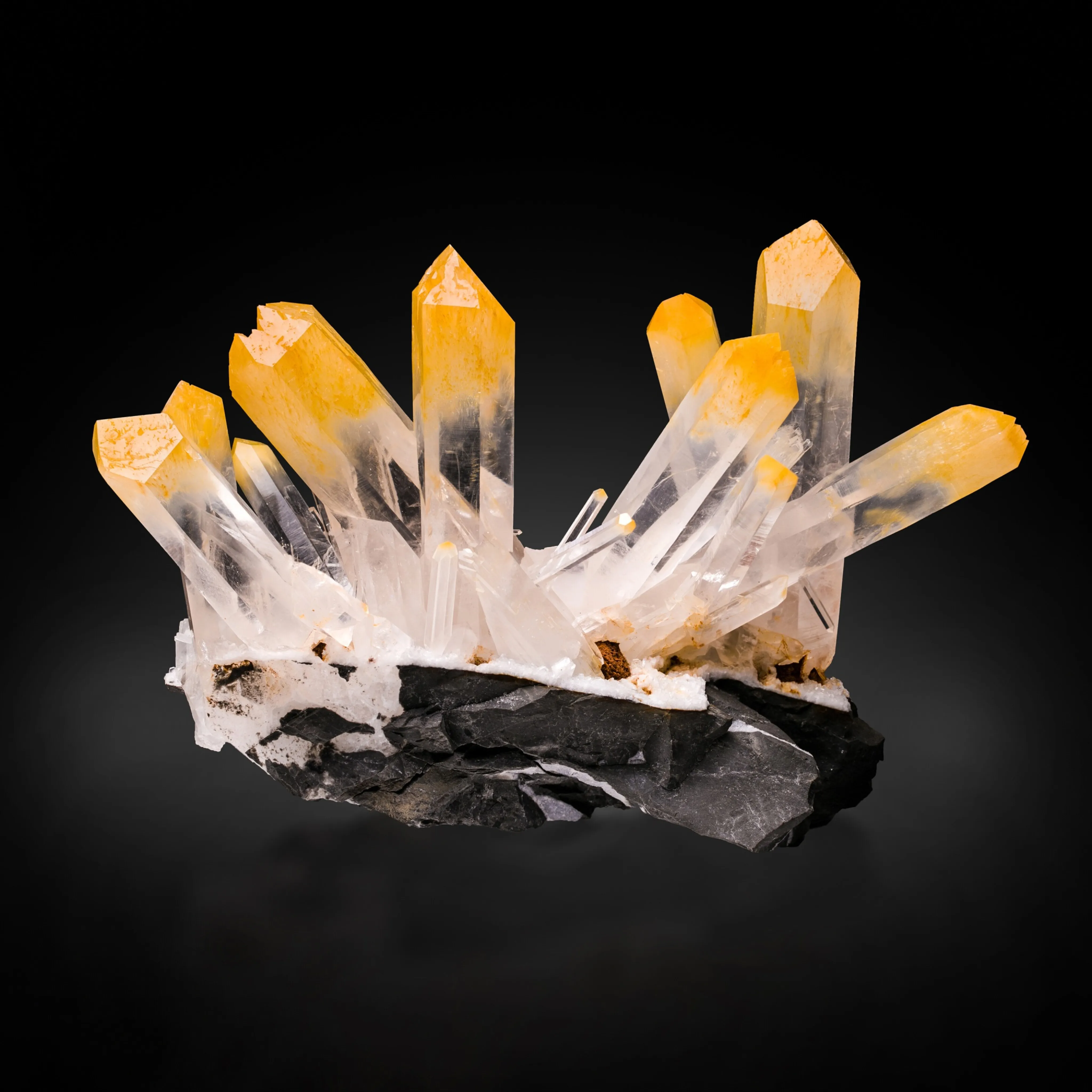
This superbly composed crystal specimen represents one of the most distinctive and recognizable varieties of quartz discovered in the past decade—known widely as “Mango Quartz,” a reference to the vivid yellow-to-orange terminations that cap the otherwise colorless crystals. This material originates from the emerald-rich mountains of Boyacá, Colombia, and was first introduced to the collecting world around 2017. Since then, it has established itself as a wholly unique variety in the quartz family, defined by the presence of halloysite inclusions within the crystal tips.
The matrix is composed of dark black shale—identical to the host rock found in Colombia’s most famous emerald deposits—providing a strong, contrasting foundation. Over this shale lies a thin coating of microcrystalline white quartz, likely a first-generation growth that either preceded or occurred concurrently with the primary crystal formation. From this white bed rise elongated quartz crystals, each with sharp trigonal terminations and exceptional luster. Their lower halves are transparent and optically clean, displaying minimal veiling or cloudiness—a desirable trait not always present in material from this region.
Toward the tips, the crystals transition from clarity to color, as fine inclusions of halloysite—a tubular clay mineral—become increasingly concentrated. These inclusions vary dramatically in hue and intensity, from barely perceptible yellow phantoms to deep, burnt orange saturation. The most prized examples exhibit the strong, warm yellow tone as found in this specimen. The halloysite does not form a surface coating, but is instead fully enclosed within the quartz, giving rise to subtle phantoms, hazes, or spray-like patterns that appear to glow internally when light enters the crystal.
What sets this particular example apart is its sculptural arrangement. Rather than the disordered aggregation common in many clusters, here the crystals rise in parallel orientation, slightly offset from one another, creating a fluid, rhythmic composition across the horizon. The balance of scale, spacing, and orientation evokes a visual cadence—a rising and falling skyline of light-filled spires capped with color.
Geologically, the quartz crystals likely formed in open cavities within the black shale, during the post-orogenic cooling of the region’s Cretaceous sedimentary sequences, roughly 90 to 100 million years ago, which were later intruded by hydrothermal fluids rich in silica. The halloysite inclusions represent a unique chemical signature of this locality, and are not known to occur with such visual regularity or saturation in quartz from any other deposit worldwide.
In the broader context of quartz collecting, Mango Quartz is an emergent classic. Though only recently discovered, it stands as an unmistakable archetype for locality-specific inclusion phenomena. Its color zoning, mineralogical uniqueness, and aesthetic appeal all converge in this piece—an elegant and finely balanced specimen that encapsulates the geological and artistic potential of this newly defined variety.
https://www.sothebys.com/en/buy/auction/2025/natural-history-2/quartz