
Cinnabar
Unknown Owner
Help improve this recordNo owner is registered for this specimen yet. If it's yours or you know more about it, you can add the owner, provenance, publications and other details.
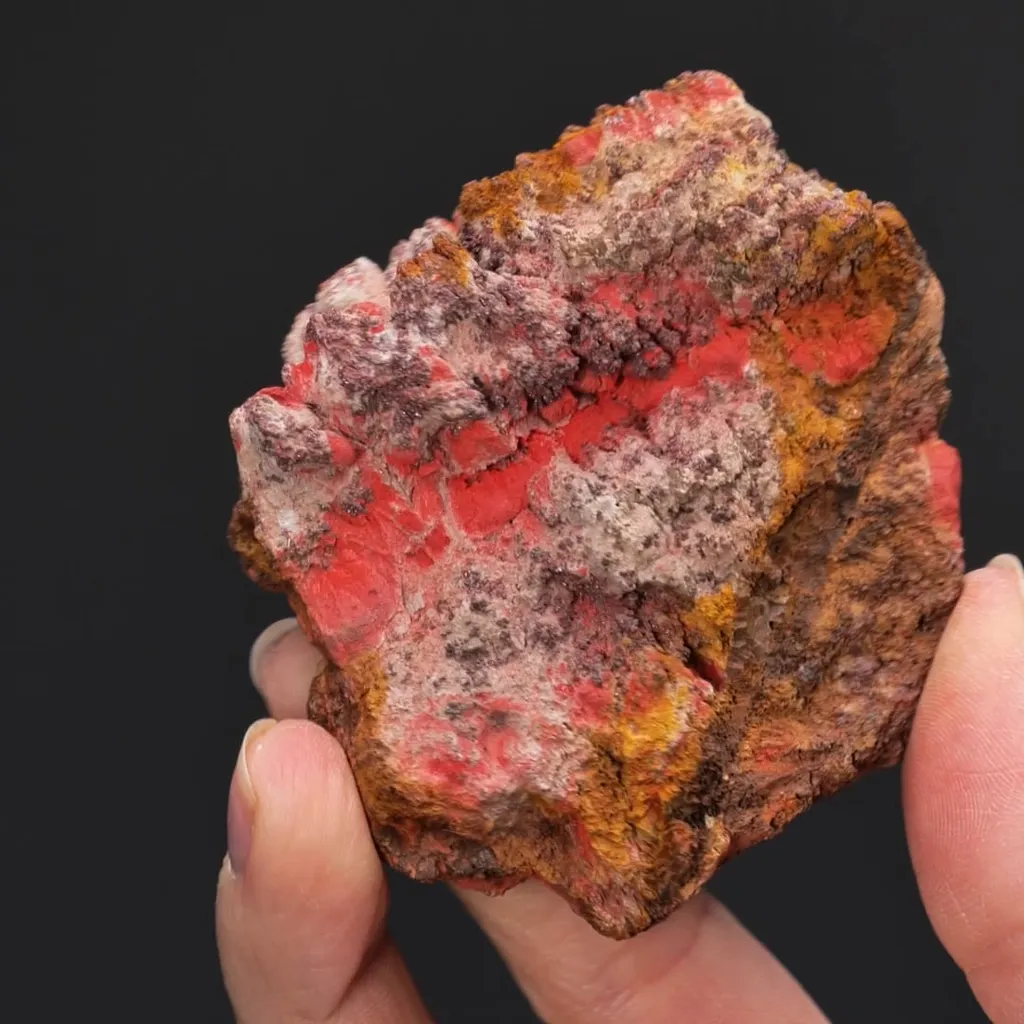
Labelled simply as Cinnabar, I reckon there are likely various other mercury minerals on this intriguing small cabinet specimen from the ancient mercury mining district of Landsberg in Rhineland-Palatinate, Germany, south-west of Frankfurt am Main. Moschellandsberg hill (now shortened to Landsberg), is within a region rich in mercury and mercury minerals, where mining began in around 1440. Because of mercury's unique property of being the only liquid metal at ambient conditions, it has been known since ancient times, and is thought to have been first discovered by the Ancient Egyptians prior to 1,500 BCE. Just what the matrix is, is difficult to ascertain because it is heavily coated in deposits of bright crimson Cinnabar, orange-yellow Ochre, chocolate brow irons minerals and a creamy white unknown. Examination with a hand lens reveals micro-dots of metallic silver in many areas if the specimen, thought to be Native Mercury. There are many other structures and colours which if examined through a stereo-microscope will no doubt turn out to be other rare mercury minerals. This specimen is accompanied with three old labels, all numbered 2022 (Ref. number, not the year!). For any specimens containing mercury and or mercury bearing minerals, it is a sensible precaution to always wash your hands after handling.
Product details
SpeciesCinnabar
SizeSmall Cabinet
Dimensions6.4 x 6.0 x 4.6 cm
Added on02/04/2026
LocalityGermany, Rhineland-Palatinate, Landsberg
Known provenance
| Date | Collector | Acquisition price |
|---|---|---|
| 07/2026 | Unknown Owner | $450.00 |
| — | Crystal Classics | Not disclosed |
Learn more
Mineral guide
Learn about Cinnabar
vivid scarlet crystals with adamantine luster; brittle yet prized, often on white carbonate, from historic mines and modern Chinese localities.Regional guide
Comments