

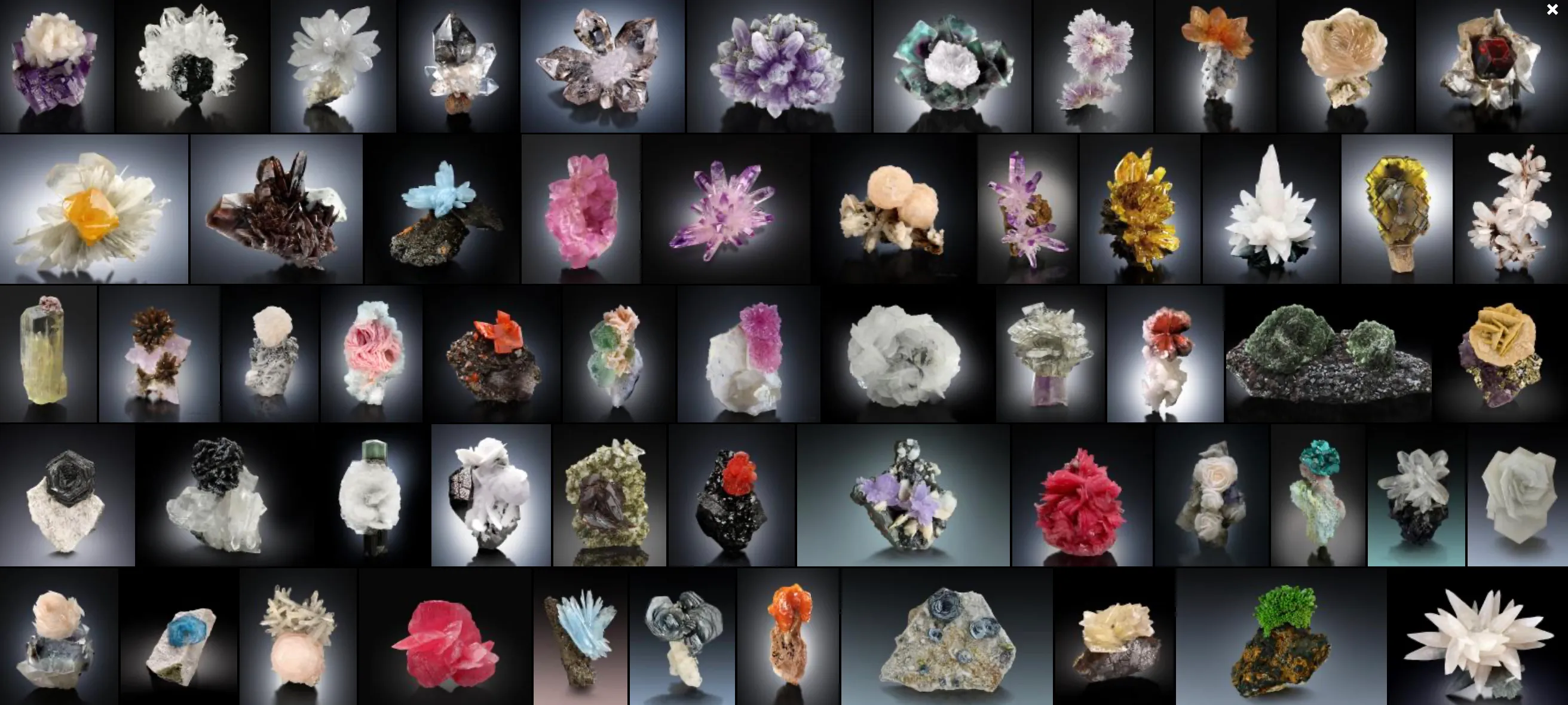

People who know me well know that I have a weakness for flowers.
Not necessarily the kind you might expect.
Over the years, mineral dealers and fellow collectors have learned that there is a fairly reliable way to get my attention: show me a specimen that looks as if it had decided to grow a flower.
There is something about floral forms in minerals that I find almost irresistible.
Perhaps it is the symmetry. Perhaps it is the way crystals radiate from a common center, creating a sense of movement and growth. A good mineral “flower” does not look static. It seems to open up, almost as if we had caught it somewhere in the process of blooming.
And, just like real flowers, the best ones often sit at the end of a stem or rise freely from their matrix. From a collector’s point of view, that is almost unfairly effective: nature has already taken care of the presentation.
Then there is contrast. A flower becomes particularly beautiful against its foliage, and much the same happens in a mineral specimen. A delicate white, pink or brightly colored crystal aggregate standing free against a dark matrix can have an extraordinary visual presence.
Of course, looking like a flower is not enough.
The same rules apply that I use for any specimen: balance, proportion, contrast and composition have to work. Sometimes the floral association is obvious; sometimes it is much more abstract. It may simply be the radial growth, the rhythm of the crystals or the way the specimen occupies space that attracts me. But quite often, after looking at it for a while, there it is again: the flower.
And then things can become dangerous.
If the “blossom” consists of an unusual mineral – or, even better, of a mineral that normally does not produce this kind of form – rarity joins aesthetics. That is usually the moment when my resistance becomes considerably weaker.
One of my favorite examples is my Calcite Rose from Yaogangxian. It combines almost everything I love about this type of specimen: a clearly defined center, beautifully radiating growth, an elegant three-dimensional form and the unmistakable appearance of a rose – created not by anything living, but simply by crystals following the laws of nature.
That, perhaps, is what fascinates me most.
Flowers and minerals could hardly be more different. One is alive, grows, blooms and disappears. The other is entirely inorganic and may survive unchanged for millions of years. And yet both can arrive at remarkably similar forms.
Nature apparently has certain ideas worth repeating.
By now, quite a few dealers know about this particular weakness of mine. So when they come across something floral, they send me a picture.
Which means that, fortunately, people keep sending me flowers.
And unlike the conventional kind, these usually last forever.